
Many English learners get confused when choosing between seal vs seel because the two words look and sound similar. However, they are not interchangeable, and each word has a different meaning and purpose. Seal is a common word used in everyday English, while seel is a rare and old-fashioned term mainly associated with historical falconry.
Understanding the difference between seal and seel can help you avoid spelling mistakes and use the right word in your writing. Whether you are writing a sentence, studying English vocabulary, or simply trying to understand an unusual word, knowing when to use each term makes communication clearer and more accurate.
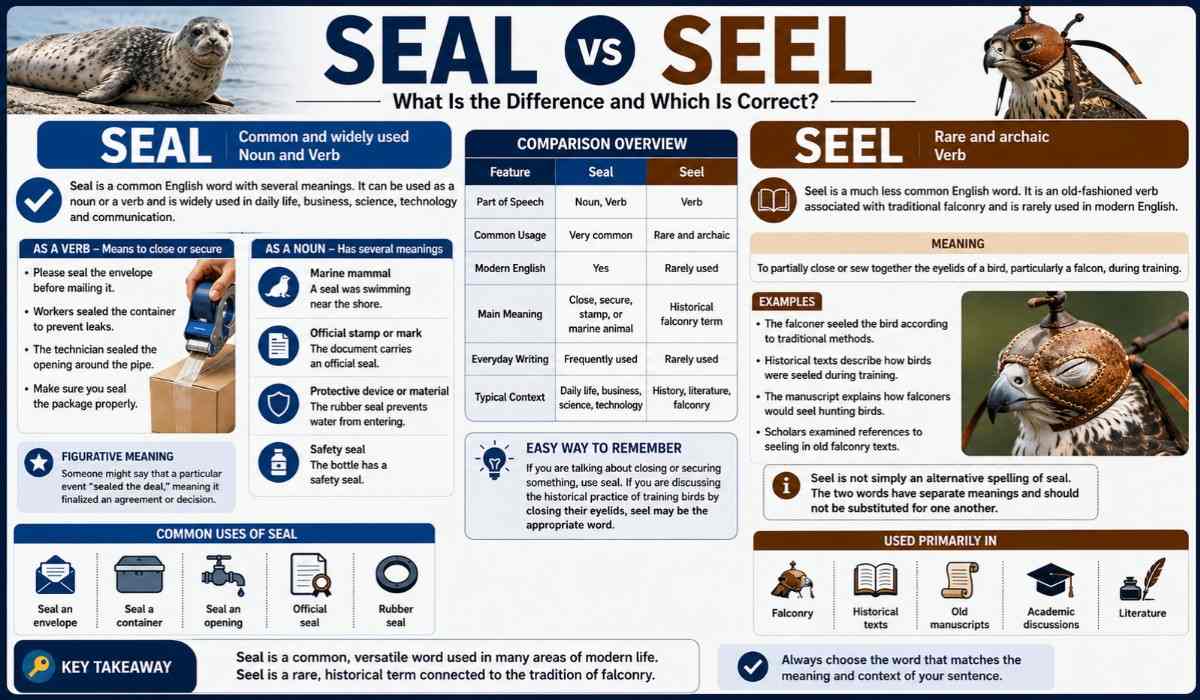
Comparison Overview
The words seal and seel may look like spelling variations, but they have completely different meanings. Seal is a familiar modern English word that can work as both a noun and a verb. It can describe closing something securely, an official mark, a protective device, or a marine animal.
Seel, by contrast, is a rare historical verb. It was traditionally connected with falconry and referred to the practice of partially closing or sewing together the eyelids of a bird during training. Because this historical practice is no longer part of ordinary life, the word seel is rarely encountered in modern conversations or everyday writing.
| Feature | Seal | Seel |
| Part of Speech | Noun, Verb | Verb |
| Common Usage | Very common | Rare and archaic |
| Modern English | Yes | Rarely used |
| Main Meaning | Close, secure, stamp, or marine animal | Historical falconry term |
| Everyday Writing | Frequently used | Rarely used |
| Typical Context | Daily life, business, science, technology | History, literature, falconry |
The easiest way to remember the distinction is simple: if you are talking about closing or securing something, use seal. If you are discussing the historical practice of training birds by closing their eyelids, seel may be the appropriate word.
Definition of Seal
Seal is a common English word with several meanings. It can be used as a noun or a verb, which makes it much more versatile than seel. In everyday communication, people commonly use seal when discussing packages, envelopes, containers, agreements, documents, and protective coverings. As a verb, seal means to close or secure something firmly. It can also mean to make something airtight, watertight, or protected from outside elements. For example, you might seal an envelope before mailing it or seal a container to prevent its contents from leaking.
Examples:
- Please seal the envelope before mailing it.
- Workers sealed the container to prevent leaks.
- The technician sealed the opening around the pipe.
- Make sure you seal the package properly.
Seal can also have figurative meanings. Someone might say that a particular event “sealed the deal,” meaning it finalized an agreement or decision. This shows how widely the word can be used in modern English.
Seal as a Noun
As a noun, seal has several meanings. One common meaning is a marine mammal that lives in oceans and coastal areas. Another meaning is an official stamp, mark, or emblem used on a document. The word can also refer to a physical device or material that prevents air, water, dust, or other substances from passing through an opening. This meaning is especially common in engineering, construction, manufacturing, and technology.
Examples include:
- A seal was swimming near the shore.
- The document carries an official seal.
- The bottle has a safety seal.
- The rubber seal prevents water from entering.
Because seal has so many meanings, context is important when interpreting the word.
Read Also: Flakey or Flaky || Finaly or Finally || Persue vs Pursue
Definition of Seel
Seel is a much less common English word. It is an old-fashioned verb associated with traditional falconry. Historically, it referred to partially closing or sewing together the eyelids of a bird, particularly a falcon, during training. The word may appear in historical books, old manuscripts, literature, or academic discussions about falconry. However, most people will rarely encounter it in modern everyday English.
Examples:
- The falconer seeled the bird according to traditional methods.
- Historical texts describe how birds were seeled during training.
- The manuscript explains how falconers would seel hunting birds.
- Scholars examined references to seeling in old falconry texts.
It is important to understand that seel is not simply an alternative spelling of seal. The two words have separate meanings and should not normally be substituted for one another.
Main Differences Between Seal and Seel
The biggest difference between seal vs seel is their meaning and modern usage. Seal is a common word that appears in many areas of communication, while seel has a very specific historical meaning.
| Aspect | Seal | Seel |
| Meaning | To close, secure, stamp, or a marine animal | Historical falconry practice |
| Frequency | Extremely common | Extremely rare |
| Modern Usage | Regularly used | Mostly historical |
| Context | Daily life, business, science, law | Falconry and historical literature |
| Part of Speech | Noun and verb | Verb |
There are several important points to remember:
- Seal is a normal modern English word.
- Seel is rare and largely historical.
- Seal has multiple meanings.
- Seel has a specific connection to falconry.
- Seel should not replace seal in ordinary sentences.
For most modern English situations, seal will be the correct choice.
Etymology and Historical Background
Understanding the history behind these words can make the difference between seal vs seel easier to remember. Although they look similar, their development and meanings are different.
Origin of Seal
The word seal has roots connected with marks, stamps, and methods of securing documents. Over time, its usage expanded beyond official marks and documents.
Today, seal can refer to:
- Official stamps
- Closing packages
- Securing containers
- Waterproofing
- Protective devices
- Marine animals
- Finalizing agreements
This broad development explains why seal appears in many different fields.
Origin of Seel
Seel developed from older English vocabulary associated with falconry. Falconry was once an important practice in which trained birds were used for hunting. The word became associated with a traditional method involving a bird’s eyelids during training. As falconry became less common in everyday life, words connected with its specialized practices also became less familiar. Today, seel survives mainly in historical, literary, and specialized discussions.
Common Contexts Where Seal Appears
Seal is used in many different areas of modern English. You can find the word in casual conversations, professional documents, technical instructions, scientific writing, and news reports.
Common contexts include:
- Business contracts
- Packaging
- Engineering
- Construction
- Medicine
- Technology
- Government documents
- Wildlife discussions
- Education
For example:
- Break the seal before opening.
- The agreement carries the company seal.
- Engineers sealed the pipe.
- Researchers observed a seal near the coast.
- The container was tightly sealed.
These examples demonstrate why seal is much more useful in everyday English than seel.
Grammar Guide
How to Use Seal in a Sentence
Seal can be used as both a verb and a noun.
As a verb, it describes an action:
- Seal the package securely.
- They sealed the crack in the wall.
- Please seal the envelope.
- The workers sealed the opening.
As a noun, it can identify an object, animal, or mark:
- A seal was swimming near the beach.
- The official seal appears on the certificate.
- The bottle’s seal was broken.
- The door needs a new seal.
How to Use Seel in a Sentence
Seel functions as a verb and is mainly associated with historical falconry.
Examples:
- Historical trainers would seel hunting birds.
- Falconers seeled hawks according to traditional practices.
- The manuscript describes how birds were seeled.
- Historians studied references to seeling.
Because the word is archaic, it may sound unusual in modern conversation. That does not necessarily make it incorrect; rather, its meaning and appropriate context are highly specialized.
Common Mistakes Learners Make
People often confuse seal vs seel because of their similar spelling and pronunciation. However, replacing one with the other can completely change the meaning or make a sentence incorrect.
Common mistakes include:
- Writing seel instead of seal when talking about closing something.
- Assuming seel is simply an alternative spelling of seal.
- Using seel in business communication.
- Confusing the marine animal seal with the verb seel.
- Treating both words as synonyms.
- Using seel in ordinary conversations without a historical context.
For example, this sentence is incorrect:
- “Please seel the envelope.”
The correct sentence is:
- “Please seal the envelope.”
The reason is that the intended meaning is “close or secure,” which is one of the standard meanings of seal.
Simple Rules to Remember
A few simple rules can make this spelling difference much easier.
- If you mean close or secure, use seal.
- If you mean the marine animal, use seal.
- If you mean an official stamp or mark, use seal.
- If you are discussing historical falconry, seel may be appropriate.
- In almost every ordinary modern situation, seal is the word you need.
A useful memory trick is to associate seal with common modern actions such as sealing a package or sealing an envelope. Think of seel as a historical word connected with birds and falconry.
Quick Tips for Writing and Speaking
When deciding between seal and seel, consider the context before choosing the spelling.
Here are some useful tips:
- Use seal in everyday communication.
- Use seal when discussing packages or documents.
- Use seal when talking about marine animals.
- Use seel only when the historical falconry meaning is intended.
- Avoid using seel as a spelling variation of seal.
- When uncertain in modern English, seal is usually the intended word.
These rules cover most situations you are likely to encounter.
When to Use Each One
Use Seal When:
You should use seal when talking about:
- Closing an envelope
- Securing a package
- Closing a container
- Preventing leaks
- Waterproofing an opening
- Official stamps
- Documents
- Agreements
- Marine animals
- Professional communication
For example, “Please seal the box before shipping it” is correct because the sentence describes securing a container. Similarly, “We saw a seal near the beach” is correct because the word refers to a marine animal.
Use Seel When:
Use seel only when the historical meaning is intended. It may be appropriate when discussing:
- Historical falconry
- Old bird-training practices
- Historical manuscripts
- Literature involving falconry
- Academic studies of traditional bird training
For example, a historian writing about traditional falconry might use the verb seel when describing the old practice.
When Not to Use Each One
Do Not Use Seal When:
You should not use seal if the specific meaning is the historical falconry practice of closing a bird’s eyelids. In that specialized context, seel is the relevant historical term. However, this situation is uncommon in modern communication.
Do Not Use Seel When:
Avoid seel when you are:
- Closing a package
- Sealing an envelope
- Securing a document
- Talking about a marine animal
- Discussing a safety seal
- Writing business documents
- Writing ordinary academic content
- Having a normal conversation
For these situations, seal is the natural modern choice.
Which One to Use: Decision Guide
If you are still unsure about seal vs seel, ask yourself what you are trying to say.
Are you talking about closing or securing something?
Use Seal.
Example: “Please seal the package before delivery.”
Are you talking about a marine animal?
Use Seal.
Example: “We saw a seal along the coast.”
Are you talking about an official mark or stamp?
Use Seal.
Example: “The document has an official seal.”
Are you discussing historical falconry?
Use Seel.
Example: “The historical text describes how falconers seeled birds.”
Are you writing ordinary modern English?
Use Seal.
Example: “In most modern writing situations, seal is the correct and natural choice.”
Real-World Practical Examples
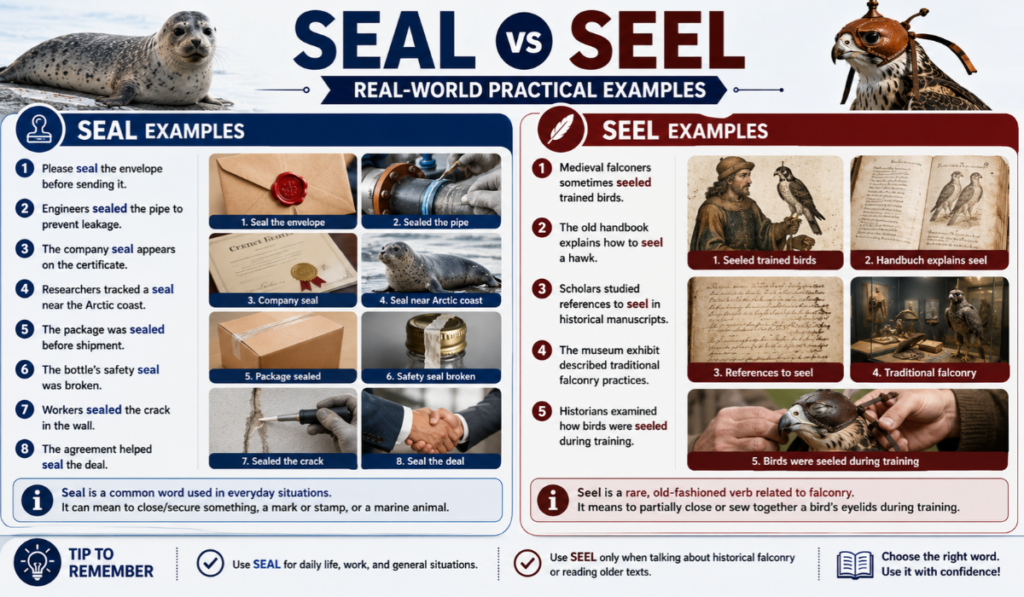
Seal Examples
- Please seal the envelope before sending it.
- Engineers sealed the pipe to prevent leakage.
- The company seal appears on the certificate.
- Researchers tracked a seal near the Arctic coast.
- The package was sealed before shipment.
- The bottle’s safety seal was broken.
- Workers sealed the crack in the wall.
- The agreement helped seal the deal.
Seel Examples
- Medieval falconers sometimes seeled trained birds.
- The old handbook explains how to seel a hawk.
- Scholars studied references to seel in historical manuscripts.
- The museum exhibit described traditional falconry practices.
- Historians examined how birds were seeled during training.
Notice how the context changes completely between the two words. Seal appears in ordinary modern situations, while seel is connected with an old and specialized practice.
A Simple Memory Trick
One easy way to remember seal vs seel is to connect seal with things you can physically close.
Think:
- Seal a letter.
- Seal a package.
- Seal a container.
- Seal a crack.
- Seal an agreement.
Then remember that seel is the unusual historical word associated with falconry. If the sentence has nothing to do with old bird-training practices, there is a very good chance that you need seal.
Quick Practice
Try choosing the correct word in each sentence:
- Please _____ the package before shipping it.
- The official document carries a royal _____.
- Historians studied how falconers would _____ hunting birds.
- The diver photographed a _____ near the beach.
- Workers must _____ the crack in the wall.
- Ancient falconers would _____ hawks during training.
- The bottle’s safety _____ was broken.
- We need to _____ the container tightly.
- Researchers tracked a young _____ along the coast.
- The manuscript describes how birds were _____.
Answers
- Seal
- Seal
- Seel
- Seal
- Seal
- Seel
- Seal
- Seal
- Seal
- Seeled
The pattern is easy to notice: modern everyday meanings generally require seal, while the historical falconry meaning requires seel.
FAQs About Seal vs Seel
Q1. What is the main difference between seal and seel?
Seal is a common modern English word used for closing, securing, stamping, or referring to a marine animal. Seel is a rare historical word associated with falconry and the practice of closing a bird’s eyelids during training.
Q2. Is seal the correct spelling in modern English?
Yes. Seal is the standard spelling for modern meanings such as closing a package, securing an object, referring to an official mark, or describing a marine mammal. Seel is generally limited to historical or specialized contexts.
Q3. Can seel replace seal in a sentence?
No. Seel cannot normally replace seal because the two words have different meanings. If you are talking about closing an envelope, securing a package, or referring to a marine animal, seal is the correct word.
Q4. What does seal mean as a verb?
As a verb, seal means to close or secure something firmly. It can also mean to make something airtight or watertight or to finalize something. Examples include “seal the package,” “seal the container,” and “seal the agreement.”
Q5. What does seal mean as a noun?
As a noun, seal can refer to a marine mammal, an official stamp or mark, or a device that prevents leakage. The exact meaning depends on the context in which the word is used.
Q6. What does seel mean?
Seel is an old-fashioned verb historically associated with falconry. It referred to the practice of partially closing or sewing together a bird’s eyelids during training.
Conclusion About Seal vs Seel
Understanding the difference between seal and seel can help you avoid an uncommon but confusing English spelling mistake. Seal is the standard modern word used for closing or securing something, referring to an official mark, describing a protective device, or talking about a marine animal. Because it has many meanings, it appears frequently in everyday conversations and professional writing.
Seel has a much narrower historical meaning and is mainly connected with traditional falconry. It is rarely used in modern English and should not be treated as another spelling of seal. Remembering this simple distinction can make your writing clearer and more accurate. When you mean closing, securing, stamping, or the marine animal, choose seal. When discussing the historical falconry practice, seel may be the appropriate term.
Read Also: Adress or Address || Recognization vs Recognition || Absence or Absense
