

Truth or dares is a classic party game enjoyed by friends, classmates, families, and groups at gatherings. Whether it is a sleepover, birthday party, road trip, classroom activity, or casual get-together, the game can quickly turn an ordinary moment into an entertaining experience. The concept behind truth or dares is simple. Players take turns choosing between answering a question honestly or completing a challenge. Truth questions can reveal funny stories, personal preferences, memories, and interesting facts, while dares encourage players to participate in playful and creative activities.
One reason truth or dares remains popular is its flexibility. The game can be adapted for children, teenagers, and adults, depending on the questions and challenges selected. It can also be played offline with a group or virtually through video calls and online platforms. In this guide, we will explore truth or dares rules, popular questions, creative dare ideas, benefits, safety tips, common mistakes, age-based variations, and frequently asked questions.
Quick Overview
Truth or dares is a social party game based on two choices:
- Truth
- Dare
A truth requires the player to answer a question honestly.
A dare requires the player to complete a specific challenge. The primary purpose of truth or dares is entertainment, interaction, creativity, and social bonding. Players can adjust the difficulty and style of the game according to their group.
What Is the Difference Between Truth and Dare?
The biggest difference in truth or dares is how the player participates. A truth involves answering a question honestly. These questions can be funny, friendly, personal, or thoughtful. A dare involves completing an action or challenge. Dares can involve singing, dancing, acting, storytelling, drawing, or other harmless activities.
Example of a Truth Question
What is your biggest fear?
The selected player answers the question honestly.
Example of a Dare
Dance for 30 seconds without music.
The selected player completes the challenge.
Therefore, truth is mainly focused on conversation and honesty, while dare is focused on action and entertainment.
Read Also: BWC Meaning || What Does CFS Mean in Text
History of Truth or Dares
Games similar to truth or dares have been played in different forms for many years. Social gatherings have often included conversation-based activities where people were encouraged to answer questions, reveal personal information, or participate in playful challenges. Over time, these activities became particularly popular among teenagers and young adults.
The simple format made the game easy to organize without requiring special equipment. Today, truth or dares has also moved into the digital world. Friends can play through video calls, messaging platforms, websites, and mobile applications. Despite these changes, the basic idea remains the same: players choose between answering a truth question and completing a dare.
Basic Rules of Truth or Dares
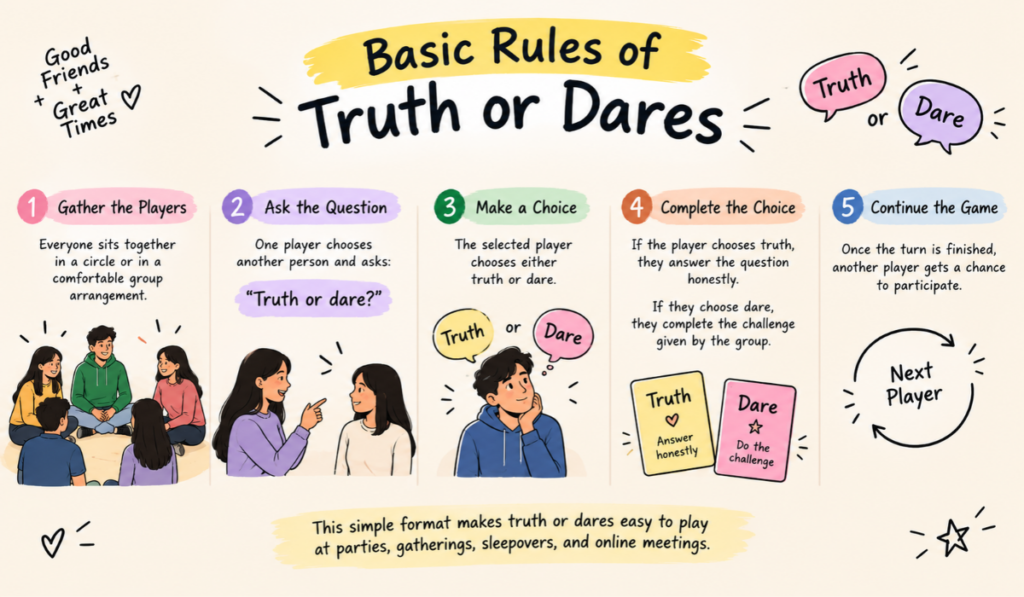
The rules of truth or dares can be changed according to the group. However, most versions follow a simple turn-based format.
Step 1: Gather the Players
Everyone sits together in a circle or in a comfortable group arrangement.
Step 2: Ask the Question
One player chooses another person and asks:
“Truth or dare?”
Step 3: Make a Choice
The selected player chooses either truth or dare.
Step 4: Complete the Choice
If the player chooses truth, they answer the question honestly.
If they choose dare, they complete the challenge given by the group.
Step 5: Continue the Game
Once the turn is finished, another player gets a chance to participate.
This simple format makes truth or dares easy to play at parties, gatherings, sleepovers, and online meetings.
Popular Truth Questions

Good truth questions can make truth or dares more interesting without making anyone uncomfortable. The best questions depend on the age and relationship of the players.
Funny Truth Questions
Try these lighthearted questions:
- What is your funniest memory?
- Have you ever laughed at a completely inappropriate moment?
- What is your strangest habit?
- What is the funniest thing you have ever done accidentally?
- What is the most embarrassing song you secretly enjoy?
Friendly Truth Questions
For a relaxed game, ask:
- Who inspires you the most?
- What is your dream job?
- What is your favorite childhood memory?
- What is one skill you would love to learn?
- What is your favorite thing about your best friend?
Deep Truth Questions
For groups that are comfortable discussing personal topics:
- What is your biggest fear?
- What is the most important goal in your life?
- What is one thing you want to improve about yourself?
- What is something you are proud of?
- What is one lesson life has taught you?
When using deeper questions in truth or dares, players should always respect personal boundaries.
Popular Dare Ideas

Dares are what bring action and excitement to truth or dares. However, challenges should remain safe, appropriate, and enjoyable for everyone.
Funny Dare Ideas
- Sing your favorite song loudly.
- Dance without any music.
- Act like a cat for one minute.
- Make the funniest face you can.
- Pretend to be a famous celebrity.
Easy Dare Ideas
- Tell a joke.
- Speak in a funny accent for one minute.
- Wear your socks on your hands for a short time.
- Say the alphabet backward as far as you can.
- Try to make another player laugh.
Creative Dare Ideas
- Draw a funny picture in one minute.
- Create a short dance move.
- Pretend to host a television show.
- Make up a short story using three random words.
- Act out a scene from a movie without speaking.
The best truth or dares challenges are entertaining without putting anyone at risk.
Truth or Dare Comparison Table
| Feature | Truth | Dare |
| Main Focus | Honesty | Action |
| Type | Question | Challenge |
| Difficulty | Emotional or conversational | Physical or creative |
| Example | Answer a personal question | Perform a funny task |
| Main Purpose | Learn more about players | Create excitement |
Both options contribute to the fun of truth or dares, but they create different types of interaction.
Why Do People Enjoy Truth or Dares?

There are several reasons why truth or dares continues to be popular.
Social Benefits
The game can:
- Encourage communication
- Break awkward silence
- Help people interact
- Encourage group participation
- Make new people feel more comfortable
Emotional Benefits
Playing truth or dares can also:
- Build confidence
- Encourage openness
- Create laughter
- Help players share experiences
- Create memorable moments
Entertainment Benefits
The game is also convenient because:
- It requires little or no equipment.
- It can be played almost anywhere.
- It works with small or large groups.
- The rules are easy to understand.
- Players can create their own questions and challenges.
Read Also: YNS Meaning Slang || BBW Meaning Slang
Real-World Examples of Truth or Dares
Example 1: Sleepover Party
Friends at a sleepover can use truth or dares to share funny memories, answer entertaining questions, and complete harmless challenges.
Example 2: School Gathering
A classroom-friendly version can help students become more comfortable with one another. Questions and dares should be age-appropriate and supervised when necessary.
Example 3: Online Video Chat
Friends living in different cities can play truth or dares through a video call. Players can take turns asking questions and giving creative challenges.
Truth or Dares for Different Age Groups
The questions and challenges should change depending on the age of the participants.
Kids
For children, truth or dares should include simple questions and safe activities.
Examples include:
- What is your favorite cartoon?
- Sing a nursery rhyme.
- Make a funny face.
- Name your favorite animal.
Teenagers
Teenagers may enjoy more creative, humorous, and personal questions.
Examples include:
- What is your funniest school memory?
- What is your dream travel destination?
- Imitate a teacher or celebrity.
- Sing your favorite song.
Adults
Adults can choose deeper conversations or humorous challenges depending on the group.
Examples include:
- What is one goal you want to achieve?
- What is your funniest travel experience?
- Pretend to give a five-minute motivational speech.
- Tell a funny story from your childhood.
Safe and Respectful Gameplay
Safety should always be a priority when playing truth or dares. A game should create laughter and connection rather than embarrassment, pressure, or harm.
Important Safety Tips
- Respect everyone’s personal boundaries.
- Avoid dangerous or harmful dares.
- Never force someone to participate.
- Allow players to skip questions or challenges.
- Keep questions appropriate for the group.
- Avoid activities that could cause injury or embarrassment.
A successful game is one where everyone feels comfortable participating.
Common Mistakes in Truth or Dares
Although the rules are simple, some mistakes can negatively affect the experience.
Mistake 1: Creating Unsafe Dares
Problem: A challenge could result in injury or damage.
Solution: Choose harmless and practical activities.
Mistake 2: Forcing Someone to Participate
Problem: A player may feel uncomfortable with a question or dare.
Solution: Give everyone the option to skip a challenge.
Mistake 3: Asking Offensive Questions
Problem: Personal or insensitive questions can make players uncomfortable.
Solution: Keep questions respectful and suitable for the group.
Mistake 4: Making the Game Too Competitive
Problem: Excessive competition can take away the fun.
Solution: Focus on entertainment, communication, and creating positive memories.
Advantages and Disadvantages of Truth or Dares
Advantages
Some major benefits of truth or dares include:
- Encourages communication
- Creates fun memories
- Helps people socialize
- Can make shy players more comfortable
- Requires minimal preparation
- Works for different types of gatherings
Disadvantages
There can also be some drawbacks:
- Certain questions may feel uncomfortable.
- Unsafe dares can cause problems.
- Players may feel embarrassed.
- Peer pressure can affect participation.
- Inappropriate questions can create conflict.
For this reason, setting simple boundaries before starting truth or dares can make the game more enjoyable.
Truth or Dares vs Other Party Games
Truth or Dares vs Would You Rather
Would You Rather is mainly based on choosing between two situations. Truth or dares, on the other hand, combines personal questions with physical or creative challenges.
Truth or Dares vs Never Have I Ever
Never Have I Ever focuses on experiences players have or have not had. Truth or dares offers both questions and actions.
Party Games vs Board Games
Traditional board games often involve specific boards, cards, pieces, and rules. Party games such as truth or dares usually emphasize conversation, participation, and quick entertainment.
Beginner to Advanced Understanding
Beginner Level
At the beginner level, players only need to understand two basic choices:
Truth: Answer honestly.
Dare: Complete a challenge.
Intermediate Level
At the intermediate level, players can create themed questions and challenges. This makes truth or dares more engaging for different groups.
Advanced Level
More experienced players can adapt the game to specific settings, such as birthday parties, sleepovers, team-building activities, or virtual gatherings.
Regional and Global Popularity
Truth or dares is enjoyed in many parts of the world. Different groups may modify the rules, questions, and challenges according to their culture and setting.
North America
The game is commonly associated with parties, sleepovers, and social gatherings.
Europe
Different conversation and party games with similar concepts can be found across various countries.
Asia
Modern party culture and social media have helped introduce the game to wider audiences.
Online Usage
Digital platforms have made it possible to play truth or dares remotely through video calls, websites, and applications.
Psychological and Social Impact
Truth or dares can influence how people communicate within a group.
Positive Effects
When played appropriately, the game can:
- Encourage openness
- Improve confidence
- Create social bonding
- Encourage communication
- Help people learn more about one another
Possible Negative Effects
However, problems can arise when players experience:
- Peer pressure
- Embarrassment
- Uncomfortable questions
- Unsafe challenges
- Pressure to reveal private information
Keeping the game respectful and voluntary helps maintain a positive experience.
Truth or Dares in Popular Media
The concept of truth or dares frequently appears in movies, television programs, social media content, and online videos. Such scenes often use the game to create comedy, suspense, friendship moments, or unexpected situations.
Digital versions have also become popular. Many websites and mobile applications can generate random truth questions and dare challenges, making it easier for players to start a game without preparing their own list.
Educational Perspective
A safe and age-appropriate version of truth or dares can sometimes be adapted for group activities, workshops, and team-building exercises.
For example:
- Truth questions can encourage communication.
- Creative dares can encourage participation.
- Group activities can help participants interact.
- Simple challenges can encourage creativity.
However, educational versions should always use questions and challenges that are suitable for the participants and environment.
Exercises With Answers
Question 1: What does truth mean in the game?
Answer: It means answering a selected question honestly.
Question 2: What does dare mean?
Answer: It means completing a challenge.
Question 3: Can a player skip an uncomfortable task?
Answer: Yes. Players should be allowed to skip anything that makes them uncomfortable.
Question 4: What is the main purpose of Truth or Dares?
Answer: The main purpose is entertainment, communication, and social interaction.
Question 5: Should dares be safe?
Answer: Yes. Dares should always be safe, respectful, and appropriate.
FAQs About Truth or Dares
Q1. What is Truth or Dares?
Truth or dares is a party game in which players choose between answering a question honestly or completing a challenge.
Q2. Is Truth or Dares safe?
Yes, when players respect boundaries and avoid dangerous, offensive, or inappropriate questions and challenges.
Q3. Can children play Truth or Dares?
Yes. Children can play an age-appropriate version with simple questions and safe challenges.
Q4. Why is Truth or Dares popular?
The game is easy to organize and can create laughter, conversation, entertainment, and memorable moments.
Q5. Can Truth or Dares improve friendships?
It can encourage communication and give friends opportunities to share stories and experiences in a relaxed environment.
Q6. What are good truth questions?
Funny, friendly, creative, and respectful questions are generally good choices.
Q7. What are safe dare ideas?
Singing, dancing, drawing, acting, telling jokes, and other simple creative activities are good options.
Q8. Can Truth or Dares be played online?
Yes. Friends can play through video calls, online platforms, or applications.
Q9. What should players avoid in Truth or Dares?
Players should avoid dangerous dares, offensive questions, unwanted pressure, and activities that could cause harm or serious embarrassment.
Q10. Is Truth or Dares only for teenagers?
No. Different versions can be created for children, teenagers, adults, families, friends, and other groups.
Conclusion
Truth or dares remains a popular social game because it combines honesty, creativity, action, and entertainment in a simple format. Players can answer interesting questions, share stories, perform funny challenges, and enjoy time together without needing complicated equipment or preparation. The experience can change depending on the group, age, and setting. A sleepover might use funny questions and silly challenges, while adults may prefer deeper conversations or creative activities. Online groups can also enjoy the same concept through video calls.
The most important part of truth or dares is making sure everyone feels comfortable. Players should respect boundaries, avoid dangerous challenges, and never pressure someone into answering a question or completing a dare. When played with the right balance of humor, creativity, honesty, and respect, truth or dares can turn an ordinary gathering into a fun and memorable experience.
Read Also: WYO Meaning Slang || IMO Full Form Slang
