
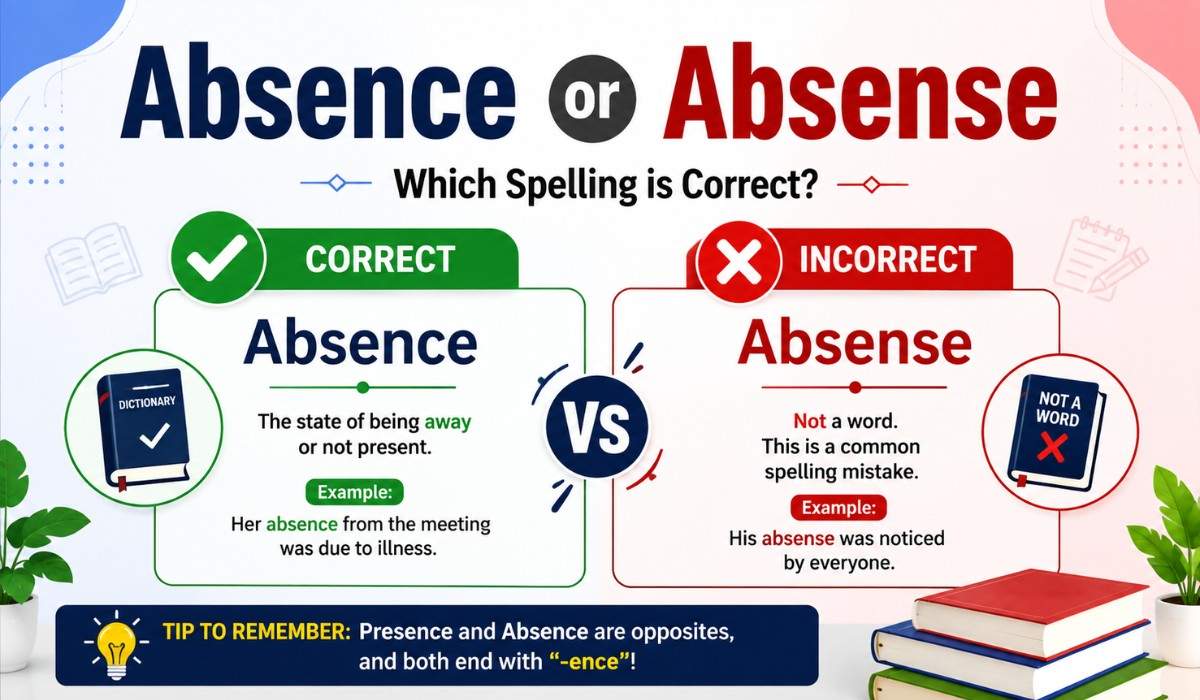
If you’ve ever wondered whether to write absence or absense, you’re not alone. Thousands of students, professionals, and English learners search for this spelling confusion every month. The simple answer is that “absence” is the correct spelling, while “absense” is a common spelling mistake. Although both words sound similar when spoken, only absence is recognized in English dictionaries and should be used in writing, exams, emails, and professional communication.
In this guide, you’ll learn the difference between absence vs absense, their meanings, correct usage, common mistakes, memory tricks, examples, and FAQs. By the end of this article, you’ll never confuse these two spellings again.
Quick Answer
If you’re looking for a quick answer, here it is:
- ✅ Absence = Correct spelling
- ❌ Absense = Incorrect spelling
The word absence refers to the state of being away from a place, person, event, or activity. On the other hand, absense is simply a misspelling and should never be used in formal or informal writing. Whenever you’re writing an email, assignment, resume, application, or exam, always choose absence.
Simple Origin or Background
The word absence comes from the Latin word absentia, which means “being away” or “not present.” Over time, the word entered Old French before becoming part of the English language. Since its introduction into English, the spelling has always been absence, ending with “-ence.”
Many people mistakenly write absense because the ending of the word sounds like “-ense” when pronounced. English pronunciation and spelling don’t always match perfectly, which is why this error is so common among students and English learners. Understanding the origin of the word makes it easier to remember that absence is the only correct spelling.
Read Also: Panic vs Panick
Clear Explanation of the Difference
Although absence and absense look similar, they are not interchangeable. One is a valid English word, while the other is a spelling mistake.
What does “absence” mean?
Absence is a noun that means the state of not being present somewhere. It can refer to a person missing from school, work, a meeting, or any other place where they are expected to be.
Examples:
- Her absence from school worried her teacher.
- The manager explained his absence during the meeting.
- We noticed John’s absence at the family gathering.
- Due to his absence, the event started late.
- The company requires a written explanation for any employee’s absence.
In all these examples, absence correctly describes someone or something that is missing or not present.
What does “absense” mean?
Absense is not an English word. It does not appear in standard dictionaries and should never be used in academic, professional, or everyday writing. Many people accidentally type absense because it sounds similar to absence, but it is simply a spelling error.
Incorrect Examples:
- ❌ His absense was noticed by everyone.
- ❌ She submitted an absense letter.
- ❌ The teacher marked his absense.
Correct Versions:
- ✅ His absence was noticed by everyone.
- ✅ She submitted an absence letter.
- ✅ The teacher marked his absence.
If you ever see absense in your writing, replace it immediately with absence.
Comparison Table
| Feature | Absence | Absense |
| Correct English Word | ✅ Yes | ❌ No |
| Found in Dictionaries | ✅ Yes | ❌ No |
| Part of Speech | Noun | Not a valid word |
| Meaning | State of being away or not present | No meaning |
| Correct for Exams | ✅ Yes | ❌ No |
| Correct in Emails | ✅ Yes | ❌ No |
| Used in Professional Writing | ✅ Yes | ❌ Never |
The comparison clearly shows that absence is the only acceptable spelling in English.
Which One to Use and When
Choosing between absence and absense is actually very simple once you know the rule. Regardless of whether you’re writing an email, school assignment, office report, or social media post, the correct spelling is always absence.
Always use “absence”
Whenever you want to describe someone who is not present, use the word absence. It is the standard spelling accepted in British English, American English, and all major dictionaries.
Examples include:
- His absence from work was approved.
- The school recorded her absence.
- We missed your absence at the celebration.
- The doctor provided an absence certificate.
- The meeting continued despite the manager’s absence.
Using the correct spelling helps your writing appear professional, accurate, and grammatically correct.
Never use “absense”
The spelling absense should never be used because it is incorrect. Even though many people accidentally type it, spell-checkers and grammar tools usually identify it as an error. Using absense in exams, job applications, official letters, or professional documents can create a negative impression and may lead to lost marks or credibility. Whenever you write absense, simply replace it with absence.
Simple Tip
A simple way to remember the correct spelling is to focus on the ending “-ence.” The word absence ends with the same letters as other correctly spelled English nouns like presence, patience, and silence.
An easy memory trick is: If someone is absent, there is an “absence”—never an “absense.”
You can also remember the phrase: “Presence and absence both end with -ence.”
Practicing this pattern a few times will help you remember the correct spelling naturally.
Common Mistakes People Make
Many English learners and even native speakers occasionally make spelling mistakes. Since absence and absense sound very similar, it’s easy to understand why people get confused. However, knowing these common mistakes will help you avoid them in your writing.
Mistake 1: Writing “absense” instead of “absence”
The most common mistake is simply replacing “-ence” with “-ense.” Because the pronunciation is similar, many people assume the spelling should follow the sound. Unfortunately, this is incorrect.
Incorrect Examples
- ❌ My absense was due to illness.
- ❌ Please explain your absense from work.
- ❌ The teacher recorded my absense.
Correct Examples
- ✅ My absence was due to illness.
- ✅ Please explain your absence from work.
- ✅ The teacher recorded my absence.
Whenever you write this word, remember that the correct ending is “-ence,” not “-ense.”
Mistake 2: Confusing Sound with Spelling
English contains many words that are pronounced differently from how they are spelled. This often causes learners to rely on pronunciation rather than correct spelling.
For example, absence may sound like “absense” when spoken quickly, but dictionaries and grammar rules recognize only absence as the correct spelling. Developing the habit of checking unfamiliar words in a dictionary or using spell-check tools can help prevent such errors.
Mistake 3: Not Checking Spelling in Exams
Many students lose marks in school or competitive exams because they don’t proofread their answers. A small spelling mistake like writing absense instead of absence can make an otherwise correct sentence look inaccurate.
Before submitting your exam paper, assignment, or project, spend a few minutes reviewing your spelling. Paying attention to commonly confused words can improve your writing quality and help you score better.
Mistake 4: Mixing It with Similar Words
Some learners confuse absence with related words such as absent, present, or presence. While these words are connected, they have different meanings and grammatical roles.
For example:
- Absent is an adjective that describes someone who is not present.
- Absence is a noun that refers to the state of being away.
- Presence is a noun meaning the state of being present.
Understanding the difference between these words makes it much easier to choose the correct one in different situations.
Everyday Real-Life Examples
Learning grammar becomes much easier when you see words used in real-life situations. Below are some common examples showing how absence is correctly used in different contexts.
In Emails
The word absence is frequently used in professional and personal emails when informing someone about missing work, school, or an event.
Examples:
- I would like to inform you about my absence from today’s meeting.
- Please accept my absence due to a medical emergency.
- Kindly approve my leave of absence for tomorrow.
- Thank you for understanding my absence from the training session.
These examples demonstrate the correct and professional use of the word.
In School or College
Students regularly use absence when discussing attendance, leave applications, or classroom records.
Examples:
- The teacher marked my absence in the attendance register.
- She submitted an application explaining her absence from class.
- His absence during the examination required official approval.
- Frequent absence may affect your overall attendance percentage.
Educational institutions always use absence, never absense, in official documents.
In News
News reports often use the word absence while covering politics, sports, entertainment, or public events.
Examples:
- The minister’s absence raised several questions during the meeting.
- Fans noticed the captain’s absence from the match.
- The actor’s absence from the award ceremony became a trending topic.
- The committee discussed the reasons for his unexpected absence.
These examples show how commonly the word appears in newspapers and news websites.
On Social Media
People also use absence while posting updates or responding to followers on social media platforms.
Examples:
- Sorry for my recent absence from social media.
- My long absence was due to exams.
- Thanks for supporting me during my absence online.
- After a short absence, I’m finally back!
Using the correct spelling helps maintain a professional and polished online presence.
In Daily Conversations
The word absence naturally appears in everyday conversations between family members, friends, teachers, and colleagues.
Examples:
- We noticed your absence yesterday.
- Her absence made everyone curious.
- His absence changed the team’s plans.
- Your absence was felt throughout the event.
These examples demonstrate how often the word is used in spoken and written English.
Read Also: Lives or Lifes
Short Learning Section for Students and Beginners
If you’re just starting to learn English, remembering a few simple rules can help you avoid confusing absence and absense.
Rule 1
The correct spelling is always absence. The spelling absense is incorrect and should never be used in writing.
Whenever you are unsure, think of the phrase:
“There is no S before the ending—only C in absence.”
Rule 2
Remember that absence is a noun, while absent is an adjective.
Examples:
- He is absent today. (Adjective)
- His absence was recorded. (Noun)
Learning the difference between these forms will improve both your grammar and vocabulary.
Rule 3
Practice reading and writing the word absence regularly. The more often you see and use the correct spelling, the easier it becomes to remember.
You can also enable spell-check while writing emails, assignments, or documents to catch spelling mistakes before submitting your work.
Practice Sentences
Try completing these sentences with the correct word.
- Her ______ from school was due to illness.
- The manager explained his ______ during the meeting.
- We noticed John’s ______ at the family function.
- Please submit an application for your ______ from work.
- The teacher recorded every student’s ______.
Answers:
- absence
- absence
- absence
- absence
- absence
By practicing these simple sentences, you’ll quickly develop the habit of using the correct spelling every time
FAQ Section
Q1. Is “absense” a real word?
No, absense is not a real English word. It is a common spelling mistake caused by the way the word is pronounced. The correct spelling is absence, which is recognized by all major English dictionaries and should always be used in writing.
Q2. What is the correct spelling: absence or absense?
The correct spelling is absence. It is the standard form used in British English, American English, and all formal writing. The spelling absense is incorrect and should never be used in exams, emails, assignments, or professional documents.
Q3. What does “absence” mean?
Absence is a noun that means the state of not being present at a particular place, event, or activity. It is commonly used to describe someone missing from school, work, meetings, or other situations where they are expected to attend. For example, “Her absence from the office was due to illness.”
Q4. Why do people write “absense” instead of “absence”?
Many people write absense because they spell the word based on its pronunciation. Since absence sounds similar to “absense” when spoken, it is easy to assume the spelling ends with -ense. However, the correct spelling has always ended with -ence.
Q5. Is “absence” a noun or an adjective?
Absence is a noun that refers to the condition of being away or not present. It should not be confused with absent, which is an adjective used to describe a person who is not present. For example, “Rahul is absent today,” while “Rahul’s absence was recorded by the teacher.”
Q6. How can I remember the correct spelling of “absence”?
An easy way to remember the correct spelling is to associate absence with presence. These two words are opposites, and both end with “-ence.” Remembering the phrase “Presence and absence both end with -ence” can help you avoid the incorrect spelling absense in the future.
Conclusion
Understanding the difference between absence or absense is much easier than it first appears. While the two spellings may sound alike, absence is the only correct English word, whereas absense is simply a spelling mistake. Whether you’re writing a school assignment, office email, leave application, resume, or social media post, using the correct spelling demonstrates good language skills and professionalism.
The easiest way to remember the correct spelling is to focus on the ending “-ence.” Since absence and presence are opposite words and both end with “-ence,” this simple trick can help you avoid mistakes. By practicing the examples, following the grammar rules, and proofreading your writing, you’ll confidently use absence correctly in every situation.
