
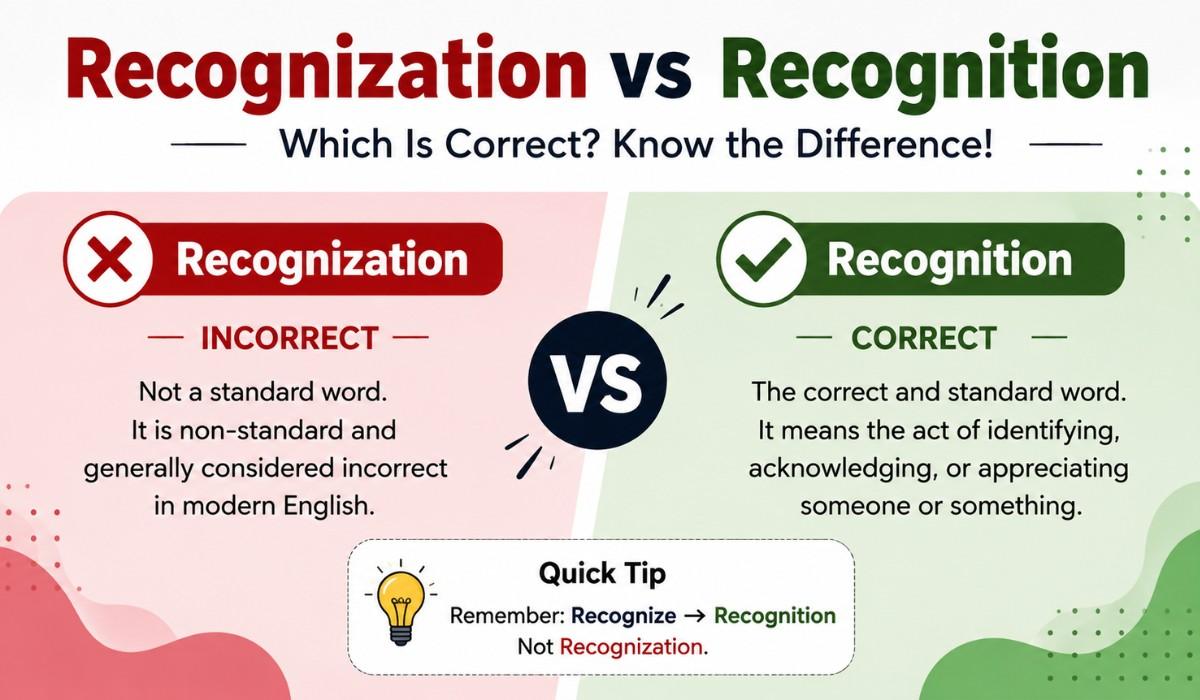
If you’ve ever wondered whether recognization vs recognition is the correct form, you’re not alone. Many English learners, students, writers, and even native speakers often confuse these two words because they look and sound similar. However, only one of them is considered standard English and is widely accepted in dictionaries, academic writing, and professional communication.
The correct word is recognition. It refers to identifying someone or something, acknowledging an achievement, or receiving appreciation for success. On the other hand, recognization is generally regarded as a non-standard or incorrect form in modern English. While you may occasionally come across it online, it is rarely accepted in formal writing or everyday usage.
In this comprehensive guide, you’ll learn the difference between recognization vs recognition, their meanings, correct usage, examples, common mistakes, grammar rules, and practical tips to help you remember which word to use. By the end of this article, you’ll confidently know why recognition is the preferred choice in almost every situation.
Recognization vs Recognition: Quick Answer
If you’re looking for the short answer, here it is:
| Word | Correct? | Meaning |
| Recognition | ✅ Yes | The act of identifying, acknowledging, or appreciating someone or something. |
| Recognization | ❌ No (Non-standard) | Rarely used and generally considered incorrect in modern English. |
For almost every context whether you’re writing an essay, email, blog post, resume, or business report you should use recognition.
What Does Recognition Mean?
Recognition is a common English noun that comes from the verb recognize. It refers to the act of identifying someone or something because you have seen or known them before. It can also mean giving appreciation, praise, or acknowledgment for someone’s efforts, achievements, or contributions. The word is widely used in education, business, law, healthcare, psychology, and everyday conversations.
Definition of Recognition
Recognition means:
- Identifying a person or object you’ve encountered before.
- Acknowledging someone’s achievements or contributions.
- Official acceptance or approval.
- Appreciation for good work or outstanding performance.
Because of its broad meaning, recognition appears frequently in newspapers, books, academic papers, business reports, and professional communication.
Common Uses of Recognition
Recognition can be used in several different situations.
1. Identifying Someone
This is the most common meaning of the word.
Examples:
- I recognized my teacher immediately.
- The child showed instant recognition of his parents.
- Facial recognition technology is becoming more advanced every year.
Here, recognition refers to identifying someone or something that is already familiar.
2. Appreciating Achievement
Recognition is often used when someone’s hard work is acknowledged.
Examples:
- She received recognition for her excellent performance.
- His dedication earned him national recognition.
- Employees appreciate public recognition for their efforts.
This meaning is especially common in workplaces, schools, and award ceremonies.
3. Official Approval
Recognition can also refer to formal acceptance by an organization or government.
Examples:
- The university received international recognition.
- The certificate gained official recognition.
- The organization is seeking government recognition.
Read Also: Absence or Absense
Is Recognization a Real Word?
This is one of the most searched questions online. The simple answer is that recognization does exist historically, but it is not accepted as standard modern English. Today, nearly all dictionaries, grammar guides, publishers, educators, and style manuals recommend using recognition instead. If you write recognization in an academic paper, professional email, or official document, many readers may assume it is a spelling mistake.
Why “Recognization” Is Considered Incorrect
English has many nouns ending in -tion, but not every verb follows the same pattern.
For example:
- Organize → Organization ✅
- Realize → Realization ✅
- Recognize → Recognition ✅ (not recognization)
The noun recognition developed differently through the history of the English language, becoming the accepted standard over centuries. Although recognization occasionally appears in older texts or informal writing, it has never become the preferred form.
What Major Dictionaries Say
Leading English dictionaries recognize recognition as the correct noun.
Examples include:
- Cambridge Dictionary
- Oxford English Dictionary
- Merriam-Webster Dictionary
- Collins Dictionary
These dictionaries define recognition but either omit recognization entirely or label it as non-standard and uncommon. This is one of the strongest reasons why writers should always choose recognition.
Recognization vs Recognition: Key Differences
Although the two words appear similar, they differ greatly in acceptance, usage, and correctness.
Comparison Table
| Feature | Recognition | Recognization |
| Standard English | ✅ Yes | ❌ No |
| Found in dictionaries | ✅ Yes | Rarely |
| Used in academic writing | ✅ Yes | ❌ No |
| Used in business communication | ✅ Yes | ❌ No |
| Accepted worldwide | ✅ Yes | ❌ No |
| Recommended by grammar experts | ✅ Yes | ❌ No |
The comparison clearly shows that recognition is the only word you should normally use.
Grammar Explanation
The confusion often arises because many English nouns ending in -ize become -ization.
For example:
| Verb | Noun |
| Organize | Organization |
| Realize | Realization |
| Modernize | Modernization |
| Prioritize | Prioritization |
Many learners naturally expect:
Recognize → Recognization ❌
However, English doesn’t always follow perfectly predictable patterns.
Instead, the correct noun is: Recognize → Recognition ✅
This is simply an exception that has become standard through historical usage.
Pronunciation Difference
Another reason people confuse these words is pronunciation.
Recognition
Pronounced approximately as: rek-uhg-NISH-un
The stress falls naturally on the “ni” sound.
Recognization
Although some people pronounce it similarly, it is not considered standard English pronunciation because the word itself is generally avoided.
Why Is “Recognition” Preferred?
Language evolves based on common usage. Over hundreds of years, recognition became the universally accepted noun because it was consistently used in literature, education, legal documents, and formal communication. As a result, dictionaries, style guides, and grammar experts recognize it as the correct form.
Using recognition ensures your writing sounds professional, natural, and grammatically correct. Whether you’re writing an email, preparing an academic assignment, publishing a blog post, or creating business content, choosing the standard word helps you communicate clearly and avoid unnecessary errors.
Why Do People Confuse Recognization and Recognition?
The confusion between recognization vs recognition mainly arises because English contains many nouns ending in -ization. Words like organization, realization, civilization, and modernization follow a predictable pattern, leading many people to assume that recognize should become recognization. However, English is full of exceptions, and recognition is one of them.
Another reason for the confusion is that “recognization” occasionally appears in old books, online forums, or user-generated content. Since readers encounter the word from time to time, they may mistakenly believe it is correct. In reality, professional writers, editors, teachers, and dictionaries overwhelmingly recommend using recognition.
Influence of Similar Words
English learners often rely on familiar word patterns. For example:
| Verb | Correct Noun |
| Organize | Organization |
| Authorize | Authorization |
| Prioritize | Prioritization |
| Recognize | Recognition |
Since most “-ize” verbs become “-ization” nouns, it’s understandable why people assume recognization is correct. However, recognition is the accepted exception.
Online Usage Creates Confusion
The internet contains millions of blogs, social media posts, and websites where spelling and grammar are not always carefully checked. As a result, incorrect words like recognization continue to circulate, making people believe they are acceptable. When in doubt, it’s always best to consult a trusted dictionary rather than relying solely on online usage.
Recognition in British English vs American English
One of the good things about the word recognition is that it is the standard form in both British and American English. Unlike words such as colour/color or centre/center, there is no spelling difference between the two varieties of English.
British English
In British English, recognition is used in everyday conversations, newspapers, business communication, and academic writing.
Examples:
- The scientist received international recognition for her research.
- The company gained recognition for its excellent customer service.
American English
American English also uses recognition in exactly the same way.
Examples:
- The athlete earned national recognition after winning the championship.
- Facial recognition technology has improved significantly.
Regardless of whether you’re writing for a British or American audience, recognition is always the correct choice.
Examples of Recognition in Everyday Sentences
Understanding a word becomes much easier when you see it used in real-life situations. Here are some examples showing how recognition fits naturally into different contexts.
Workplace Examples
Recognition plays an important role in motivating employees and improving workplace morale.
Examples:
- She received recognition for completing the project ahead of schedule.
- Employee recognition programs increase job satisfaction.
- His years of dedication earned him company-wide recognition.
- The manager thanked the team publicly in recognition of their hard work.
Academic Examples
Recognition is also common in schools, colleges, and universities.
Examples:
- She received recognition for academic excellence.
- The university earned international recognition for its research.
- His outstanding performance brought recognition from the faculty.
- Several students received recognition during the annual awards ceremony.
Business Examples
Businesses frequently use the word when discussing awards, achievements, and reputation.
Examples:
- Brand recognition is essential for long-term business success.
- The startup gained global recognition within just three years.
- Customer recognition helps strengthen brand loyalty.
- The company received recognition for innovation.
Everyday Conversation Examples
Recognition is equally common in casual conversations.
Examples:
- I smiled in recognition when I saw my childhood friend.
- The dog showed immediate recognition of its owner.
- Her voice brought instant recognition.
- His face was familiar, but I couldn’t make the recognition immediately.
Common Mistakes to Avoid
Although recognition is a simple word, many people make mistakes when using it. Here are some of the most common errors.
Mistake 1: Using Recognization
❌ She received recognization for her efforts.
✅ She received recognition for her efforts.
Always replace recognization with recognition.
Mistake 2: Assuming All “-ize” Words Become “-ization”
Many learners believe every verb ending in -ize forms its noun by adding -ization.
This is not always true.
Correct Examples:
- Organize → Organization
- Realize → Realization
- Recognize → Recognition
Remember that English contains many exceptions.
Mistake 3: Using Recognition Incorrectly
Recognition means acknowledgment or identification.
It should not replace words like:
- Recommendation
- Appreciation
- Acceptance
- Respect
Each of these words has its own specific meaning.
Mistake 4: Incorrect Spelling
Some incorrect spellings include:
- Recognisation (acceptable only in British English for the verb’s related forms? Actually recognition remains unchanged.)
- Recognizition
- Recognizion
- Recognisationn
The correct spelling is always: Recognition
Tips to Remember the Correct Word
If you often forget whether to write recognization or recognition, these simple memory tricks can help.
Remember the Verb Pair
Think about the relationship:
Recognize → Recognition
Do not try to add -ization.
Think About Awards
Whenever someone wins an award, they receive:
✅ Recognition
Never:
❌ Recognization
This simple association makes the correct word easier to remember.
Read More Professional English
Reading newspapers, books, business articles, and academic journals helps reinforce the correct spelling naturally. You’ll notice that professional writers always use recognition.
Use Grammar Tools
Modern grammar checkers immediately identify recognization as incorrect and recommend recognition.
Practice Writing
Create your own sentences.
For example:
- She received recognition for volunteering.
- The restaurant gained recognition for excellent food.
- Facial recognition improves smartphone security.
The more you write the word correctly, the easier it becomes to remember.
Read Also: Lives or Lifes
When Should You Use Recognition?
The simple rule is that you should use recognition whenever you want to talk about identifying someone or something, acknowledging an achievement, or giving official approval. It is the standard noun form of the verb recognize and is accepted in all types of writing, including academic papers, business documents, emails, news articles, and everyday conversations.
Whether you’re writing for school, work, or your own blog, choosing recognition ensures your content is grammatically correct and easy to understand.
Use Recognition for Identifying Someone or Something
Recognition often refers to identifying a familiar person, place, voice, or object.
Examples:
- The little girl smiled in recognition when she saw her grandmother.
- Voice recognition software has become much more accurate.
- Facial recognition technology is now widely used in smartphones.
- I recognized him immediately, and there was instant recognition between us.
Use Recognition for Awards and Achievements
Recognition is commonly used when someone receives praise or appreciation for their work.
Examples:
- She received recognition for her outstanding leadership.
- His research earned international recognition.
- The company won recognition for customer satisfaction.
- Every employee deserves recognition for their hard work.
Use Recognition for Official Approval
Recognition can also mean formal acceptance by an organization, institution, or government.
Examples:
- The college received national recognition.
- The charity is seeking official government recognition.
- His qualifications gained international recognition.
In all of these situations, recognition is the correct and natural choice.
Final Verdict: Recognization vs Recognition
After comparing recognization vs recognition, the answer is clear: recognition is the correct word to use in modern English. Although recognization has appeared in some historical texts and can occasionally be found online, it is considered a non-standard form and is not recommended for formal writing. Major dictionaries, grammar experts, educational institutions, and professional editors consistently prefer recognition.
To summarize:
| Question | Answer |
| Which word is correct? | Recognition |
| Is recognization accepted in modern English? | Generally No |
| Which word should students use? | Recognition |
| Which word should professionals use? | Recognition |
| Which word appears in dictionaries? | Recognition |
If you want your writing to sound natural, professional, and grammatically correct, always choose recognition.
Conclusion
Understanding the difference between recognization vs recognition is easier than it first appears. While the two words look similar, only recognition is accepted as standard English. It is the correct noun form of the verb recognize and is used to describe identification, acknowledgment, appreciation, or official approval.
The confusion often comes from the fact that many English words ending in -ize form nouns ending in -ization, such as organization and realization. However, English contains many exceptions, and recognition is one of them. This is why dictionaries, grammar guides, universities, publishers, and professional writers consistently recommend using recognition instead of recognization.
Whether you’re writing an assignment, preparing a business report, updating your resume, or publishing online content, choosing recognition will improve the accuracy and professionalism of your writing. Remember this simple rule: Recognize → Recognition, not Recognization.
FAQs
Q1. Is recognization a real word?
Recognization has appeared in some historical texts, but it is considered a non-standard and uncommon word in modern English. Most dictionaries and grammar experts recommend using recognition instead.
Q2. Which is correct: recognization or recognition?
Recognition is the correct and widely accepted word. It is appropriate for academic, professional, and everyday writing.
Q3. Why do people use recognization?
Many people assume recognize should become recognization because other verbs like organize become organization. However, recognition is the standard exception in English.
Q4. Is recognization accepted in formal English?
No. Formal writing, educational institutions, publishers, and professional editors prefer recognition. Using recognization may be viewed as a grammatical mistake.
Q5. Can I use recognization in academic writing?
No. Academic writing should always use recognition because it is the accepted standard English noun.
Q6. What does recognition mean?
Recognition refers to identifying someone or something, acknowledging achievements, appreciating contributions, or granting official approval.
Q7. Is recognition used in both British and American English?
Yes. Recognition is the standard spelling in both British English and American English.
Q8. What is the noun form of recognize?
The correct noun form of recognize is recognition.
