
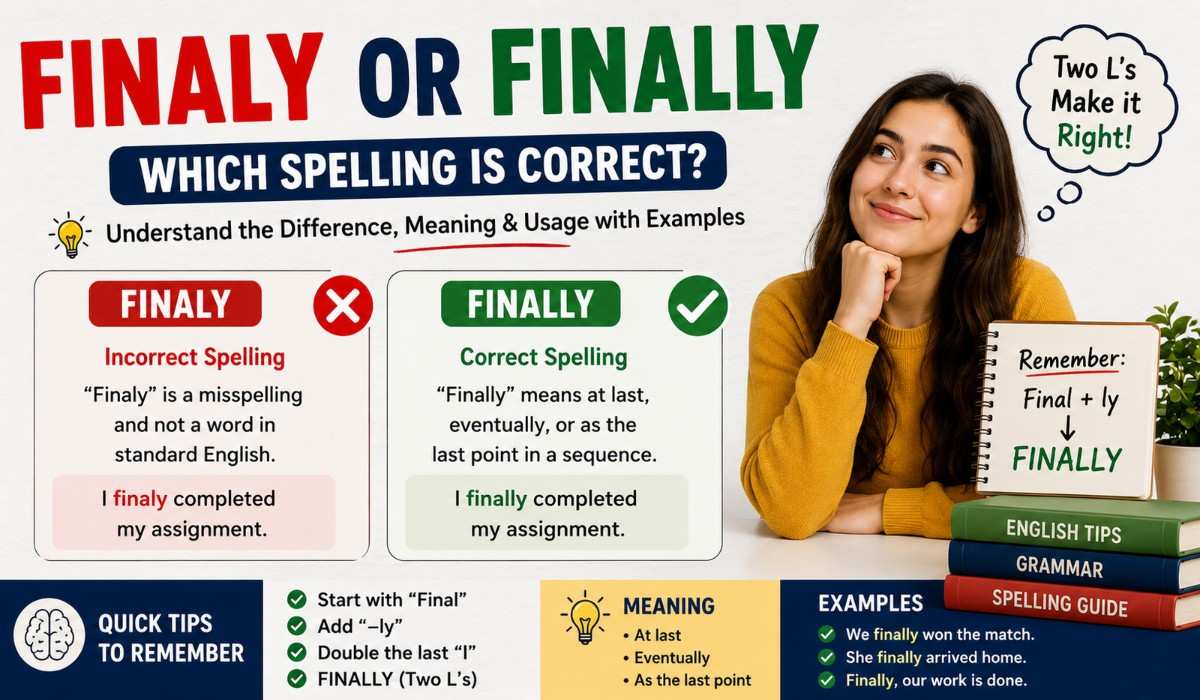
If you are confused about “finaly or finally,” you are not alone. Many English learners and even native speakers accidentally leave out one “l” when writing this word. The correct spelling is “finally,” with two l’s. “Finaly” is an incorrect spelling and should not be used in formal or professional writing.
The confusion usually happens because the word comes from “final,” which has only one “l” at the end. When the suffix “-ly” is added, however, the spelling changes to “finally,” with the final consonant doubled. Understanding this small spelling rule can help you avoid a common English writing mistake.
In this guide, we will explain the difference between finaly or finally, discuss the meaning of “finally,” show how to use it correctly in sentences, and explain why “finaly” is considered incorrect. You will also find simple examples, common mistakes, pronunciation guidance, grammar tips, and an easy way to remember the correct spelling.
Finaly or Finally: Which One Is Correct?
The correct spelling is finally.
“Finaly” is a misspelling of “finally” and is not considered standard English. If you are writing an email, article, school assignment, business document, social media post, or professional message, you should always use “finally.”
| Spelling | Correct? | Meaning |
| Finaly | No | Incorrect spelling |
| Finally | Yes | At last; after a long time; as the last point |
The word “finally” is an adverb formed from “final.” It can describe something that happens at the end of a process or after a period of waiting.
For example:
- I finally finished my homework.
- She finally arrived at the station.
- Finally, we reached a decision.
- He finally understood the problem.
In each sentence, “finally” tells the reader that something happened at the end of a process or after some delay.
Why Is “Finaly” Incorrect?
The spelling “finaly” is incorrect because it does not follow the spelling pattern used when “-ly” is added to certain words ending in a consonant. The base word is “final,” and when “-ly” is added, the final “l” is doubled.
The result is:
final + ly → finally
This gives us two consecutive “l” letters before the “y.”
The incorrect version drops one of those letters:
final + y → finaly
That is why “finaly” may look understandable but is still considered a spelling mistake.
This is a common type of error because English spelling does not always work exactly as pronunciation suggests. When people type quickly, they may write “finaly” because the second “l” is easy to overlook.
What Does Finally Mean?
“Finally” generally means “at last,” “eventually,” or “as the last point.” Its exact meaning depends on the context in which it is used. The word can indicate that something has happened after a long wait.
For example:
I finally received my package.
Here, “finally” suggests that the speaker had been waiting for the package.
It can also indicate the final point in a sequence or discussion.
For example:
Finally, we need to review the budget.
In this sentence, “finally” introduces the last item in a list of points.
The word can therefore communicate both time and sequence. This flexibility makes “finally” a very common adverb in everyday and formal English.
Read Also: Persue vs Pursue
How to Spell Finally Correctly
A simple way to remember the spelling is to start with the word “final.”
The word is:
final
Now add “ly”:
final + ly
Because the base word already ends in “l,” the resulting spelling is:
finally
So the correct spelling contains two “l” letters:
f i n a l l y
A useful spelling breakdown is:
- F
- I
- N
- A
- L
- L
- Y
The most common mistake is writing only one “l”:
f i n a l y
Remembering “final + ly” can make the correct spelling much easier to recall.
Finaly or Finally: Difference With Examples
The main difference between finaly or finally is simple: “finally” is correct, while “finaly” is incorrect. There is no separate meaning associated with “finaly.” It is simply a misspelled version of “finally.”
Consider these examples:
Incorrect: I finaly completed the project.
Correct: I finally completed the project.
Incorrect: She finaly called me.
Correct: She finally called me.
Incorrect: We finaly reached home.
Correct: We finally reached home.
Incorrect: Finaly, I would like to thank everyone.
Correct: Finally, I would like to thank everyone.
The corrected sentences all use “finally” with two l’s.
When Should You Use Finally?
“Finally” can be used in several situations. Understanding these uses is more helpful than simply memorizing the spelling.
Finally to Mean At Last
One of the most common uses of “finally” is to describe something that happens after waiting or difficulty.
For example:
- The train finally arrived.
- I finally found my keys.
- She finally passed her examination.
- They finally reached an agreement.
In these examples, “finally” emphasizes that the event happened after some delay. It often carries a feeling of relief, satisfaction, excitement, or impatience.
For example:
“We finally won the match.”
This sentence suggests that the team may have waited a long time or experienced several unsuccessful attempts before winning.
Finally to Introduce the Last Point
“Finally” can also be used when presenting a series of ideas or arguments.
For example:
First, we discussed the problem. Second, we considered the available solutions. Finally, we selected the best option.
Here, “finally” means that the point being introduced is the last one in the sequence.
This use is especially common in essays, presentations, reports, speeches, and explanations.
Finally to Describe the End of a Process
The word can also indicate that a process has reached its conclusion.
For example:
- The construction work finally ended.
- The team finally completed the project.
- The machine finally started working.
- The company finally launched the product.
In each case, something took place over a period of time and eventually reached an ending.
Finally to Express Relief
“Finally” can sometimes express a strong feeling of relief.
For example:
“I finally finished my assignment!”
The sentence does more than state that the assignment was completed. It can also suggest that the writer had been working on it for a long time and is relieved that it is over.
Similarly:
“We finally got home after a long journey.”
The word adds emotional context to the sentence.
Examples of Finally in Sentences
Learning through examples is one of the easiest ways to understand the correct use of “finally.”
Here are some everyday examples:
- I finally completed my work.
- She finally answered my message.
- We finally reached the hotel.
- He finally understood the instructions.
- The rain finally stopped.
- They finally agreed on a price.
- I finally found the book I was looking for.
- The students finally submitted their assignments.
- The doctor finally arrived.
- We finally solved the problem.
The word can appear in different positions depending on the sentence.
For example:
“I finally completed the task.”
It can also begin a sentence:
“Finally, I completed the task.”
The meaning is similar, but the placement can change the emphasis and rhythm of the sentence.
Finally at the Beginning of a Sentence
“Finally” is frequently used at the beginning of a sentence, especially when introducing the last point in a sequence.
For example:
“Finally, we need to discuss the cost.”
Another example is:
“Finally, the team reached its destination.”
When “finally” begins a sentence, it is often followed by a comma.
For example:
“Finally, the long wait was over.”
This punctuation helps separate the introductory adverb from the main statement.
However, punctuation can depend on sentence structure and style. The important point is that “finally” itself remains spelled with two l’s.
Finally in Formal Writing
“Finally” is perfectly acceptable in formal English. It can be used in academic writing, business documents, reports, essays, presentations, and professional communication.
For example:
“Finally, the results indicate that the proposed strategy is more effective.”
Another example:
“Finally, the report recommends improving customer support services.”
In formal writing, “finally” can help organize information and make the structure easier to follow.
However, writers should avoid using it excessively. If every paragraph begins with “finally,” the writing may sound repetitive. It is best used when the meaning genuinely relates to an ending, conclusion, or final point.
Finally in Everyday Conversation
“Finally” is also extremely common in casual conversations.
For example:
- “You finally made it!”
- “I finally finished the series.”
- “Finally, it is Friday.”
- “She finally called me back.”
- “We finally found a place to eat.”
In informal conversation, “finally” can communicate excitement, frustration, impatience, relief, or satisfaction.
The emotional meaning often depends on the speaker’s tone.
For example:
“You finally came!”
Depending on how it is said, this could sound welcoming and excited or slightly annoyed.
Common Mistakes With Finally
The most obvious mistake is writing “finaly” instead of “finally.” However, there are other ways writers can misuse the word.
Mistake 1: Writing Finaly
Incorrect:
“I finaly completed the project.”
Correct:
“I finally completed the project.”
The solution is to remember the two “l” letters.
Mistake 2: Confusing Final With Finally
“Final” and “finally” are related words, but they do not perform the same grammatical function.
“Final” is usually an adjective.
For example:
“This is the final decision.”
“Finally” is an adverb.
For example:
“They finally made a decision.”
The first sentence describes the decision. The second tells us when or how the decision happened.
Mistake 3: Using Finally When You Mean Final
Consider:
“This is finally version.”
This sentence is incorrect because “finally” does not describe a noun in this way.
The correct sentence is:
“This is the final version.”
On the other hand:
“We finally completed the final version.”
Here, both words are correct because they perform different roles.
Mistake 4: Overusing Finally
Although “finally” is useful, repeating it too often can make writing sound unnatural.
For example:
“First, we checked the data. Finally, we prepared the report. Finally, we sent the report. Finally, we informed the client.”
A better version would vary the transitions:
“First, we checked the data. Next, we prepared the report. We then sent it to the client and informed them of the results.”
Good writing uses transition words naturally rather than mechanically.
Final vs Finally: What Is the Difference?
The words “final” and “finally” come from the same root but have different grammatical functions.
“Final” usually works as an adjective.
Examples:
- The final match starts at 8 p.m.
- This is my final answer.
- We received the final report.
- The final decision was announced yesterday.
“Finally” is an adverb.
Examples:
- The match finally started.
- I finally received the report.
- We finally made a decision.
- She finally gave her answer.
A quick comparison:
| Word | Part of speech | Example |
| Final | Adjective | This is the final round. |
| Finally | Adverb | The final round finally began. |
Understanding this difference can prevent many grammar and spelling mistakes.
Finaly or Finally in Professional Writing
When writing professionally, spelling accuracy matters. A single spelling error may not completely change the meaning of a sentence, but repeated mistakes can make a document appear less polished.
For example, consider an email saying:
“We finaly completed the project.”
The intended meaning is clear, but “finaly” is still an error.
The professional version is:
“We finally completed the project.”
This small correction makes the sentence grammatically and orthographically correct.
The same rule applies to:
- Business emails
- Reports
- Resumes
- Cover letters
- Blog posts
- Academic assignments
- Website content
- Presentations
- Social media captions
- Marketing material
Using the correct spelling helps make your writing more credible and professional.
How to Remember the Spelling Finally
One of the easiest memory tricks is:
Final + ly = Finally
Start with:
FINAL
Then add:
LY
The result is:
FINALLY
Another way to remember it is to think:
“Final has one L, but finally has two.”
You can also break the word into smaller parts:
FIN + ALLY
Although this is not the actual linguistic structure of the word, the visual pattern can help you remember that there are two l’s:
FINALLY
Not:
FINALY
Writing the correct spelling several times can also help reinforce the pattern.
Pronunciation of Finally
“Finally” is generally pronounced approximately as “FYE-nuh-lee.” The pronunciation may vary slightly depending on the speaker’s accent, but the spelling remains the same.
It is important to remember that pronunciation does not clearly reveal the double “l” in the spelling. This is one reason why people sometimes write “finaly.” For English learners, connecting the word to its base form “final” can make the spelling easier to remember.
Synonyms of Finally
Depending on the context, several words and phrases can have a similar meaning to “finally.”
Some alternatives include:
- At last
- Eventually
- Ultimately
- In the end
- At the end
- Lastly
- In conclusion
- After all this time
However, these words are not always interchangeable.
For example:
“She finally arrived.”
could become:
“She eventually arrived.”
But “eventually” emphasizes something happening after some time, while “finally” can also express relief or mark the last item in a sequence.
Similarly:
“Finally, we discussed the budget.”
could become:
“Lastly, we discussed the budget.”
Here, “lastly” may be more appropriate because the purpose is to introduce the final point in a sequence.
Finally vs Eventually
“Finally” and “eventually” are sometimes confused because both can refer to something happening after a period of time.
Consider:
“He finally agreed.”
This can suggest that the speaker was waiting for him to agree and may feel relieved or impatient.
“He eventually agreed.”
This emphasizes that the agreement happened after some time, without necessarily expressing the same emotional reaction.
The words can sometimes be used interchangeably, but the context determines which one sounds more natural.
Finally vs Lastly
“Finally” can mean “lastly” when organizing a list or argument.
For example:
“First, we reviewed the proposal. Second, we examined the costs. Finally, we discussed the timeline.”
In this context, “finally” introduces the last point.
You could also say:
“Lastly, we discussed the timeline.”
Both are grammatically correct.
However, “finally” has additional meanings related to something happening after waiting or difficulty, while “lastly” is primarily used to introduce the final item in a sequence.
Finaly or Finally: Quick Comparison
If you want a quick answer, the following table summarizes everything:
| Question | Answer |
| Is finaly correct? | No |
| Is finally correct? | Yes |
| Correct spelling | Finally |
| Number of l’s in finally | Two |
| Part of speech | Adverb |
| Base word | Final |
| Meaning | At last, eventually, or as the last point |
| Example | I finally finished my work. |
The easiest rule is simple: whenever you mean “at last” or “as the last point,” spell the word “finally.”
Finaly or Finally: Examples for Students
Students often encounter this spelling in essays, assignments and examinations. Here are some examples that can help:
Incorrect: I finaly understood the lesson.
Correct: I finally understood the lesson.
Incorrect: Finaly, the teacher checked our answers.
Correct: Finally, the teacher checked our answers.
Incorrect: We finaly completed the experiment.
Correct: We finally completed the experiment.
Incorrect: The team finaly won the competition.
Correct: The team finally won the competition.
Incorrect: Finaly, we reached the conclusion.
Correct: Finally, we reached the conclusion.
These examples show why the double “l” is important.
Finaly or Finally: How to Avoid the Mistake
There are several simple ways to avoid writing “finaly.”
First, remember the base word “final.” When you add “ly,” write the complete form rather than trying to spell the pronunciation.
Second, visually memorize the correct spelling:
FINALLY
Third, use spell-checking tools when writing long documents. Modern word processors will usually identify “finaly” as a spelling error.
Finally, read your writing once before publishing or submitting it. Small mistakes are often easier to identify during proofreading.
Read Also: Recognization vs Recognition
Why Spelling Accuracy Matters
Spelling may seem like a small part of writing, but accurate spelling improves readability and credibility. A reader should be able to focus on your message rather than noticing repeated errors.
Words such as “finally” are especially important because they appear frequently in everyday English. Learning the correct spelling once can prevent the same mistake from appearing repeatedly in emails, assignments and online content.
Improving spelling does not require memorizing thousands of rules. Learning common patterns and frequently confused words can make a noticeable difference.
Conclusion
The answer to “finaly or finally” is straightforward: “finally” is the correct spelling, while “finaly” is an incorrect spelling. “Finally” is an adverb that commonly means “at last,” “eventually,” or “as the last point.” It can describe something that happens after a period of waiting, introduce the final point in a sequence, or express relief when something is completed.
The easiest way to remember the spelling is to connect it with the word “final” and add “ly”: final + ly = finally. Remember that “finally” contains two l’s. Whether you are writing a school assignment, professional email, blog article, report or social media post, use “finally” whenever you need this word. If you see “finaly,” treat it as a spelling mistake and correct it to “finally.”
FAQs About Finaly or Finally
Q1. Is finaly or finally correct?
“Finally” is correct. “Finaly” is a common misspelling and is not considered standard English.
Q2. Why does finally have two l’s?
“Finally” is formed from “final” and “-ly.” The correct spelling is “final” + “ly,” resulting in “finally,” with two consecutive l’s.
Q3. What does finally mean?
“Finally” can mean “at last,” “eventually,” or “as the last point.” Its meaning depends on how it is used in a sentence.
Q4. Is finaly a real English word?
No. “Finaly” is generally considered a misspelling of “finally.” It should be corrected when used in standard English writing.
Q5. What is an example of finally in a sentence?
An example is: “I finally completed my assignment.” Here, “finally” shows that the assignment was completed after some time or effort.
Q6. What is the difference between final and finally?
“Final” is generally an adjective, while “finally” is an adverb. For example, “This is the final match” uses “final” as an adjective, while “The match finally started” uses “finally” as an adverb.
Q7. Can finally be used at the beginning of a sentence?
Yes. “Finally” can begin a sentence, particularly when introducing the last point in a sequence. For example: “Finally, we discussed the results.”
Q8. What are some synonyms for finally?
Depending on the context, synonyms or similar expressions include “at last,” “eventually,” “ultimately,” “in the end,” and “lastly.” However, the best choice depends on the intended meaning of the sentence.
