
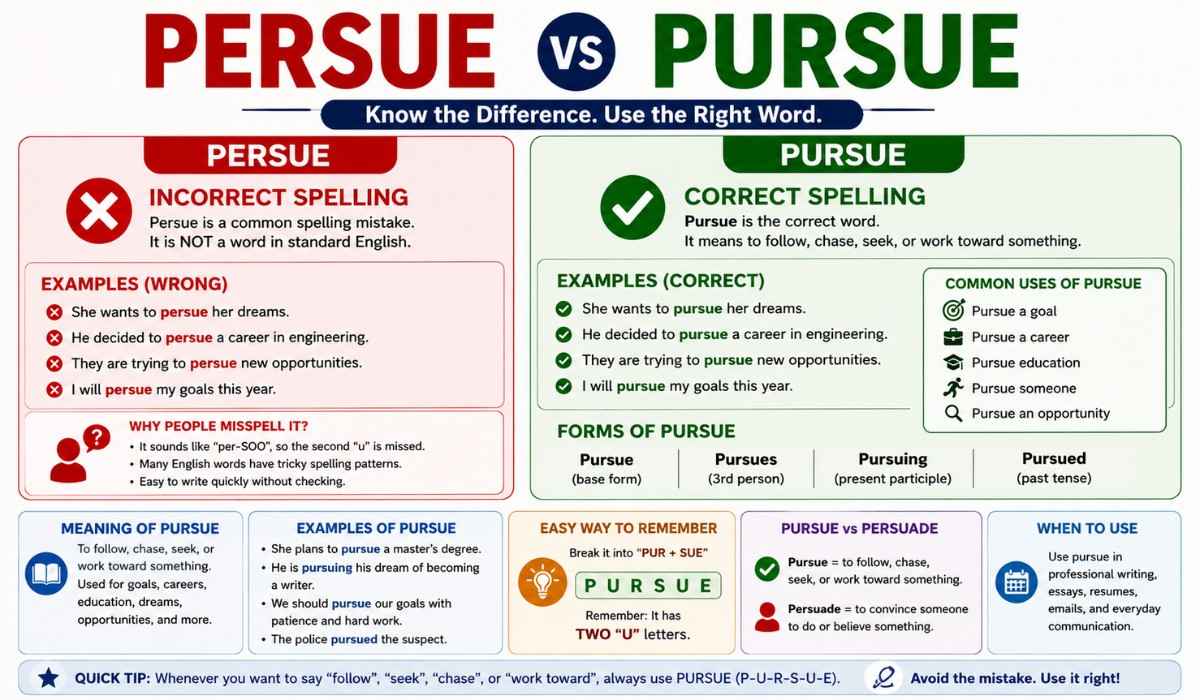
Persue vs Pursue is a common spelling confusion in English, especially when writing words related to goals, careers, interests, education, or personal ambitions. The correct spelling is pursue, while persue is a misspelling and is not accepted as a standard English word. Pursue means to follow, continue, seek, or work toward something, such as a career, dream, goal, opportunity, or person. Understanding the difference between these two forms can help you avoid spelling mistakes in emails, essays, resumes, applications, social media posts, and everyday writing.
The confusion usually happens because pursue does not sound exactly the way it looks. When spoken quickly, the first part of the word can make it easy to forget the second “u” in pursue. However, remembering the correct spelling is important because spell-checkers, grammar tools, teachers, employers, and readers may flag persue as incorrect. In this guide, we will explain persue vs pursue in detail, including their meanings, pronunciation, examples, common mistakes, synonyms, usage, and simple ways to remember the correct spelling.
Persue vs Pursue: Quick Answer
When comparing persue vs pursue, pursue is the correct spelling and persue is incorrect. The word pursue is a verb that means to follow something, try to achieve something, continue doing something, or chase someone or something. It can be used in many different situations, from pursuing a career to pursuing a goal or pursuing an interest.
Persue does not have a recognized standard meaning in modern English. Although people sometimes type or write persue when they intend to use pursue, the missing “u” makes the spelling incorrect. If you are writing a sentence and are unsure which form to use, always choose pursue.
| Word | Correct? | Meaning |
| Persue | No | Common misspelling of pursue |
| Pursue | Yes | To follow, seek, chase, or work toward something |
For example, you should write, “She wants to pursue a career in medicine.” You should not write, “She wants to persue a career in medicine.” The second sentence contains a spelling error, even though its meaning may still be understood by the reader.
What Does Pursue Mean?
Pursue is a verb that generally means to follow or chase someone or something. It can describe a physical action, such as pursuing a person who is running away, but it is more commonly used in a broader or figurative sense. People can pursue dreams, careers, goals, opportunities, education, relationships, and interests.
The word can also mean to continue or engage in an activity. For example, someone may pursue higher education after completing school, or a person may pursue a hobby because they enjoy it. In professional writing, pursue is frequently used when discussing ambitions, plans, applications, careers, and objectives.
Pursue Meaning in Simple English
In simple English, pursue means “to go after something you want.” The thing you are pursuing does not always have to be a physical object. You can pursue a goal, dream, career, opportunity, or even a person.
For example, if someone wants to become a writer and actively works toward that goal, we can say that the person is pursuing a writing career. Similarly, if a student continues studying to earn a higher qualification, the student is pursuing higher education.
Dictionary Meaning of Pursue
The word pursue has several related meanings depending on the context. It can mean to follow someone or something, especially in an attempt to catch them. It can also mean to try to achieve or obtain something.
Another meaning is to continue an activity or course of action. This broader meaning is why pursue appears frequently in professional, academic, and personal contexts. Understanding the context makes it easier to recognize how the word is being used.
Read Also: Adress or Address
Is Persue a Correct Word?
No, persue is not the correct standard spelling of the English word. It is usually a spelling mistake made when someone intends to write pursue. Although the error is common and the intended meaning is often obvious, persue should not be used in formal or professional writing.
If you see persue in a sentence, the writer most likely means pursue. This mistake can occur because English spelling does not always follow pronunciation perfectly. The letters in pursue can be easy to rearrange or simplify when writing quickly.
Why Do People Spell Pursue as Persue?
One reason people write persue is that they may pronounce pursue without clearly hearing the second “u” sound. The word is pronounced approximately as “per-SOO,” which can make the spelling less obvious.
Another reason is that many English words have different spelling patterns, so writers may unconsciously assume that pursue follows a simpler pattern. Regular exposure to the correct spelling is one of the easiest ways to prevent this mistake.
Is Persue Used in English?
Persue can sometimes appear online because people misspell pursue, but that does not make it a correct English word. Search engines and digital platforms may contain many examples of the incorrect spelling because users make spelling errors.
For school assignments, professional documents, resumes, websites, applications, and formal communication, persue should be avoided. Use pursue instead.
Persue vs Pursue: Main Difference
The main difference between persue vs pursue is spelling and correctness. Pursue is the standard English word, while persue is a misspelling. Both forms may be intended to express the same idea, but only pursue is grammatically and orthographically correct.
Pursue can mean to chase, follow, seek, or work toward something. The exact meaning depends on the sentence. Persue has no separate meaning that makes it a valid alternative to pursue.
Persue vs Pursue Spelling Difference
The most important spelling difference is the letter “u.” Pursue is spelled P-U-R-S-U-E, while the incorrect form persue is spelled P-E-R-S-U-E.
A useful way to remember the correct spelling is to notice the sequence “pur-su-e.” The word contains “pur” at the beginning and “sue” at the end. Thinking of these parts together can make the correct spelling easier to recall.
Persue vs Pursue Meaning Difference
There is no meaningful difference in definition because persue is not the accepted spelling of a separate English word. When someone writes persue, they almost always mean pursue.
Therefore, if you are choosing between the two forms in a sentence, pursue is the correct choice. There is no situation in standard English where you should replace pursue with persue.
How to Pronounce Pursue
Pursue is generally pronounced as “per-SOO.” The stress falls on the second syllable, so the final part of the word receives more emphasis.
The pronunciation can sometimes contribute to the spelling confusion. Because the word sounds relatively simple when spoken, writers may incorrectly spell it as persue. Learning both pronunciation and spelling together can make the word easier to remember.
Pursue Pronunciation Example
Consider the sentence, “I want to pursue my dream.” The word pursue sounds approximately like “per-SOO.”
You can practice the word by saying it slowly and then spelling it aloud: P-U-R-S-U-E. Repeating this combination several times can help establish the correct spelling in your memory.
Examples of Pursue in Sentences
The word pursue can be used in many types of sentences. It is particularly common when discussing education, careers, goals, ambitions, opportunities, and personal interests.
Because pursue has several related meanings, looking at examples is one of the best ways to understand how the word works. The following examples show common situations where pursue is the appropriate word.
Examples Related to Career
She decided to pursue a career in journalism.
After graduation, he plans to pursue a career in software development.
Many students pursue professional careers after completing their degrees.
If you are passionate about your work, you can pursue a career that matches your interests.
These examples use pursue to describe working toward or choosing a particular career path.
Examples Related to Education
She wants to pursue a master’s degree after completing her bachelor’s degree.
He decided to pursue higher education abroad.
Students who want to specialize in the subject can pursue advanced studies.
I plan to pursue a degree in business administration.
In these sentences, pursue means to continue working toward an educational qualification or academic objective.
Examples Related to Goals
You should pursue your goals with patience and determination.
She worked hard to pursue her dream of becoming a professional athlete.
They are pursuing new opportunities to expand their business.
He continues to pursue his goal despite several challenges.
Here, pursue refers to actively trying to achieve something.
Pursue in Different Contexts
Pursue is a flexible word that works in both everyday and formal English. Its meaning changes slightly depending on what follows it. When used with a person, it can mean to chase or seek a relationship. When used with a goal, it usually means to work toward achieving it.
In professional English, pursue often sounds more polished than simpler expressions such as “go after.” This is why the word frequently appears in business writing, academic articles, career advice, and formal communication.
Pursue a Career
The phrase “pursue a career” is extremely common in English. It means to choose and actively work toward a particular professional path.
For example, “She decided to pursue a career in medicine” means that she chose medicine as her career direction and intends to work toward becoming a medical professional.
Pursue a Goal
“Pursue a goal” means to work continuously toward achieving a desired result. It suggests effort, commitment, and action.
For example, “He is pursuing his goal of starting a successful business” indicates that he is actively taking steps to make that goal a reality.
Pursue an Opportunity
“Pursue an opportunity” means to take action to obtain or make use of an opportunity. The phrase is common in business and professional settings.
For example, “The company decided to pursue the opportunity to enter a new market.” In this sentence, pursue suggests actively trying to take advantage of the opportunity.
Pursue a Person
Pursue can also be used when talking about following or chasing a person. It may describe a physical chase or, depending on the context, an attempt to develop a romantic relationship.
For example, “The police pursued the suspect” describes a physical pursuit. “He decided to pursue her” could refer to romantic interest, depending on the surrounding context.
Common Mistakes With Pursue
Pursue is not an especially difficult word, but its spelling can cause repeated mistakes. The most common error is removing the “u” after “p,” resulting in persue.
Another mistake involves changing the ending of the word. Some writers may produce forms such as pursu or pursure because they are trying to spell the word based on pronunciation. These forms are also incorrect.
Writing Persue Instead of Pursue
The most common error is writing “persue.” For example, “She wants to persue her dreams” is incorrect.
The correct sentence is “She wants to pursue her dreams.” Whenever the meaning involves following, seeking, or working toward something, pursue is the spelling you should use.
Confusing Pursue With Other Words
Pursue is sometimes confused with words such as persuade, persecute, and proceed because they may appear in similar formal contexts. However, these words have completely different meanings.
Persuade means to convince someone to do or believe something. Persecute means to treat someone cruelly or unfairly, especially because of their identity or beliefs. Proceed means to continue or move forward. Pursue means to follow, seek, chase, or work toward something.
Pursue vs Persue in Professional Writing
Using the correct spelling is particularly important in professional writing. A spelling mistake in a resume, cover letter, business proposal, email, or application can make the writing appear less polished.
For example, a sentence such as “I wish to persue a career with your organization” contains an obvious spelling error. The professional version should be “I wish to pursue a career with your organization.” Checking commonly confused words before submitting important documents can prevent such mistakes.
Pursue in Resumes and Cover Letters
Pursue is useful when describing career ambitions in resumes and cover letters. You might write, “I am seeking an opportunity to pursue a career in digital marketing.”
The word can also be used when describing education or professional development. For example, “I pursued a certification in project management to strengthen my professional skills.” These uses are natural and appropriate in formal career writing.
Pursue in Academic Writing
Students frequently use pursue when discussing educational plans, research interests, or academic goals. For example, “The researcher pursued a new approach to understanding the problem.”
Because academic writing requires careful spelling and grammar, using pursue instead of persue is important. A spell-check tool can catch many mistakes, but learning the correct spelling is even better.
Synonyms of Pursue
Understanding synonyms can make it easier to recognize the meaning of pursue. Depending on the context, synonyms include follow, chase, seek, aim for, work toward, strive for, continue, and undertake.
However, these words are not always interchangeable. For example, “chase” works well when discussing physical movement, while “strive for” is more appropriate when discussing a goal. Pursue is useful because it can work in both physical and figurative contexts.
Pursue Synonyms for Goals
When pursue refers to a goal, suitable alternatives include strive for, work toward, aim for, seek, and endeavor to achieve.
For example, “She pursued her ambition” could become “She worked toward her ambition” without changing the basic meaning. However, pursue often sounds more concise and natural in formal writing.
Pursue Synonyms for Following
When pursue means to follow someone or something, alternatives can include chase, follow, track, or go after.
For example, “The police pursued the vehicle” could also be expressed as “The police followed the vehicle.” The exact synonym should depend on the situation and the level of formality required.
Antonyms of Pursue
The opposite of pursue can depend on the context. When pursue means to chase or follow, an opposite might be avoid, escape, or retreat.
When pursue means to work toward a goal, possible opposites include abandon, give up, neglect, or ignore. For example, someone who stops working toward a goal could be described as abandoning or giving up on that goal.
Understanding both synonyms and antonyms can help you develop a stronger vocabulary and use pursue more naturally in different situations.
How to Remember the Correct Spelling of Pursue
A simple way to remember “pursue is to break it into smaller parts: “pur” + “sue.” The spelling is P-U-R-S-U-E. Saying each part slowly can help you remember that the word contains two “u” letters.
Another useful technique is to connect the spelling with a familiar sentence. For example, remember the phrase “pursue your dreams.” Because this phrase is commonly used, repeating it can help reinforce the spelling.
Easy Spelling Trick
Think of pursue as “PUR + SUE.” The word starts with PUR and ends with SUE.
Write it several times: pursue, pursue, pursue. Then use it in a sentence: “I want to pursue my goals.” This small exercise can make the spelling much easier to remember.
Remember the Two U Letters
The most important spelling detail is the two “u” letters in pursue. The word is not “persue” because it begins with “pur,” not “per.”
You can remember it as P-U-R-S-U-E. If you are unsure while writing, pause and check whether your spelling contains both “u” letters.
Pursue vs Persue: Grammar and Word Form
Pursue is a verb. It describes an action, such as pursuing a goal, pursuing an education, pursuing a career, or pursuing a person.
The word can be used in different grammatical forms. The base form is pursue, the third-person singular form is pursues, the present participle is pursuing, and the past tense and past participle are pursued.
Pursue, Pursues, Pursuing, and Pursued
Here are the main forms of the verb:
Pursue: I want to pursue my dream.
Pursues: She pursues every opportunity to learn.
Pursuing: He is pursuing a degree in engineering.
Pursued: They pursued their objective for several years.
Understanding these forms is useful because the spelling changes slightly when grammatical endings are added, but the main spelling pattern remains recognizable.
Pursue vs Persue: Examples of Correct and Incorrect Usage
Seeing the incorrect and correct forms side by side can make the difference easier to understand. In every example below, pursue is the correct form.
Incorrect: She wants to persue a career in medicine.
Correct: She wants to pursue a career in medicine.
Incorrect: He decided to persue his dream.
Correct: He decided to pursue his dream.
Incorrect: They are trying to persue new opportunities.
Correct: They are trying to pursue new opportunities.
The pattern is straightforward: whenever you mean to say “follow,” “seek,” “chase,” or “work toward,” use pursue.
Read Also: Panic vs Panick
Why Correct Spelling Matters
Correct spelling makes your writing easier to understand and gives your content a more professional appearance. Even when readers understand a misspelled word from context, repeated errors can reduce their confidence in the quality of the writing.
This is particularly important for students, job seekers, bloggers, website owners, and professionals. A simple spelling correction from persue to pursue can make a sentence look much more polished.
Importance for Students
Students may use pursue when writing about their educational plans, ambitions, and career goals. A spelling error in an assignment can affect the overall impression of otherwise good writing.
Learning commonly confused words such as persue vs pursue can help students improve their vocabulary and avoid repeated mistakes in exams and written assignments.
Importance for Professionals
Professionals often use pursue in resumes, cover letters, proposals, reports, and emails. Writing the word correctly demonstrates attention to detail.
For example, “I am eager to pursue new professional opportunities” is correct and professional. Replacing pursue with persue would create an unnecessary spelling mistake.
Persue vs Pursue: Final Verdict
When it comes to persue vs pursue, there is only one correct choice in standard English: pursue. Persue is a common spelling mistake and should not be used in formal or professional writing.
Pursue means to follow, chase, seek, continue, or work toward something. It can describe pursuing a career, pursuing education, pursuing a goal, pursuing an opportunity, or pursuing a person. Remembering the spelling P-U-R-S-U-E will help you use the word correctly in everyday and formal communication.
Frequently Asked Questions About Persue vs Pursue
Q1. Is persue or pursue correct?
Pursue is correct, while persue is a common spelling mistake. Pursue means to follow, seek, chase, or work toward something. For example, “She wants to pursue her dreams” is the correct usage.
Q2. What is the meaning of pursue?
Pursue means to follow, chase, seek, or make an effort to achieve something. It can be used for goals, careers, education, opportunities, ambitions, or even physically following someone. For example, “He decided to pursue a career in engineering” means he chose to work toward a career in engineering.
Q3. Is persue a word?
Persue is not a standard English word and is generally used as a misspelling of pursue. If you want to describe someone seeking, following, chasing, or working toward something, pursue is the correct word to use.
Q4. How do you spell pursue?
Pursue is spelled P-U-R-S-U-E. An easy way to remember the spelling is to divide it into “pur” and “sue.” Remember that pursue contains two letter “u” sounds in its spelling pattern, which can help you avoid writing persue.
Q5. What is the past tense of pursue?
The past tense of pursue is pursued. For example, “She pursued her dream of becoming a writer.” The word pursued is formed by adding “-d” to the base form pursue.
Q6. What is the difference between pursue and persuade?
Pursue means to follow, seek, chase, or work toward something, while persuade means to convince someone to do or believe something. For example, “He pursued his career” means he worked toward his career, whereas “She persuaded him to apply” means she convinced him to apply.
Conclusion
The confusion between persue vs pursue is mainly a spelling issue, but it is worth understanding because pursue is a very common word in everyday, academic, and professional English. Pursue is the correct spelling, while persue is an incorrect form that commonly appears because of pronunciation and spelling confusion. Whenever you want to describe following, seeking, chasing, or working toward something, pursue is the word you should choose.
Whether you are talking about pursuing a career, pursuing higher education, pursuing a dream, pursuing an opportunity, or pursuing a goal, the spelling remains P-U-R-S-U-E. A simple way to remember it is to divide the word into “pur” and “sue” and remember the two “u” letters. Once you recognize this spelling pattern, the persue vs pursue confusion becomes much easier to avoid.
