
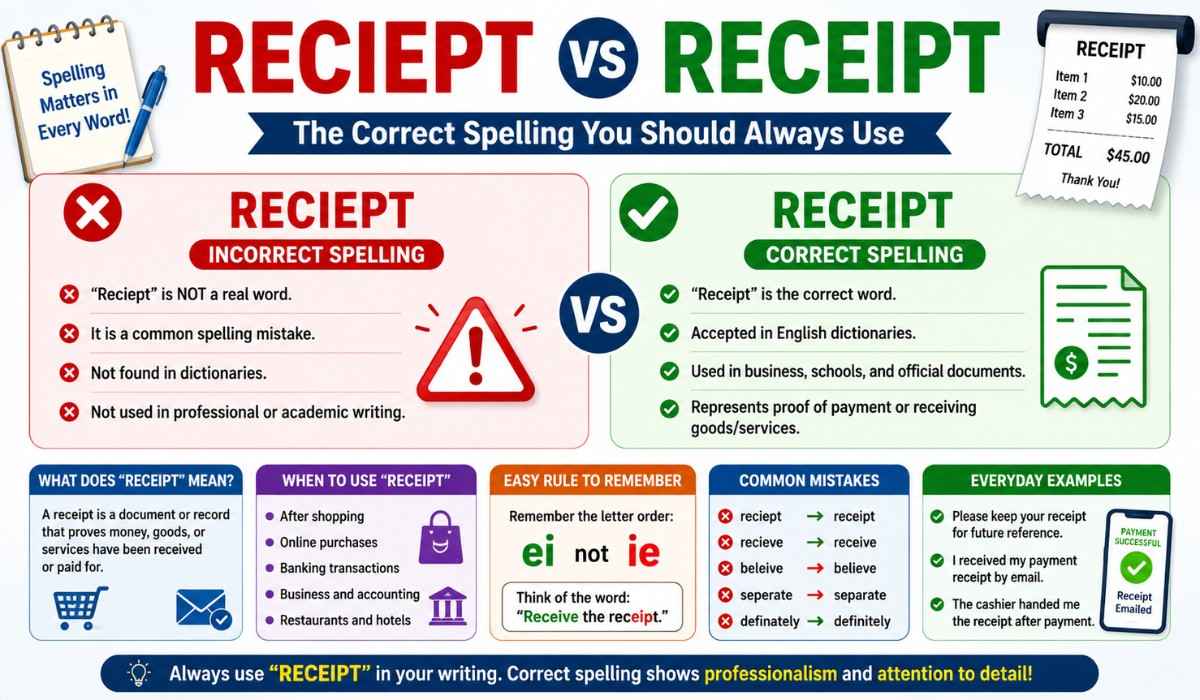
Have you ever typed “reciept” instead of “receipt” and wondered which spelling is correct? If you’re searching for the difference between Reciept vs Receipt, you’re not alone. This is one of the most common English spelling mistakes because the letters “i” and “e” often confuse writers. Whether you’re writing an email, preparing business documents, completing school assignments, or simply sending a message, using the correct spelling is important.
In this guide, you’ll learn the difference between Reciept vs Receipt, understand why people often make this mistake, discover the correct spelling, and explore easy tricks to remember it forever.
Quick Answer Reciept vs Receipt
The correct spelling is “receipt.”
“Reciept” is an incorrect spelling and is not recognised as a standard English word.
| Word | Correct or Incorrect | Meaning |
| Receipt | Correct | A written or digital record showing that money or goods have been received. |
| Reciept | Incorrect | A common spelling mistake. |
If you’re writing for work, school, business, or professional communication, always use “receipt.”
Read Also: Villain vs Villian
Simple Background Explanation
English contains many words that don’t follow simple spelling patterns. The word “receipt” is one of them. It comes from the Latin word recepta and later entered English through Old French. Over time, the spelling changed into the modern English word “receipt,” while its pronunciation became much simpler.
Interestingly, the “p” in the receipt is silent. We pronounce it as:
“ri-SEET”
Because we don’t hear the “p” or clearly notice the order of “ei,” many people accidentally write “reciept.”
Spell checkers often catch this mistake, but it’s still one of the most frequently misspelled business-related words.
Clear Explanation of the Difference
The difference is very simple.
“Receipt” is the correct English spelling used in dictionaries, schools, businesses, banks, shopping websites, and official documents.
“Reciept” is simply a spelling error.
For example:
Correct:
- Please keep your receipt for future reference.
- I received the payment receipt by email.
- The cashier handed me the receipt after payment.
Incorrect:
- Please keep your reciept.
- I lost my reciept yesterday.
- Send me the reciept by email.
Whenever you need to refer to proof of payment, proof of purchase, or confirmation of a transaction, always write “receipt.”
Comparison Table
The following table makes the difference even easier to understand.
| Feature | Receipt | Reciept |
| Correct English spelling | Yes | No |
| Found in dictionaries | Yes | No |
| Used in business | Yes | No |
| Used in schools | Yes | No |
| Accepted in exams | Yes | No |
| Professional writing | Yes | No |
| Common spelling mistake | No | Yes |
As you can see, there is only one correct choice: “receipt.”
What “Receipt” Means
A receipt is a document that confirms someone has received payment, goods, or services. It acts as proof that a transaction has taken place.
Receipts can be:
- Printed receipts
- Digital receipts
- Email receipts
- Online shopping receipts
- Bank receipts
- Restaurant receipts
- Grocery receipts
- Hotel receipts
- Fuel receipts
Businesses issue receipts to customers after purchases, while customers keep them for returns, exchanges, warranties, tax records, or expense claims.
Here are a few simple examples:
- I kept the receipt in my wallet.
- The online store emailed my receipt immediately after payment.
- Please bring your receipt if you want to exchange the item.
- The accountant requested all expense receipts.
- Without the receipt, the shop could not process the refund.
The word “receipt” is used daily in banking, shopping, travel, education, healthcare, and many other industries.
When to Use “Receipt”
You should use the word “receipt” whenever you’re referring to proof that money, goods, or services have been received. It is commonly used in everyday conversations, business transactions, banking, shopping, education, and accounting.
Here are some common situations where “receipt” is the correct word:
After Shopping
Whenever you buy something from a store, the cashier usually gives you a receipt.
Example:
- Please keep your receipt in case you need to return the item.
- I received my receipt after paying at the supermarket.
Online Purchases
Most online stores send a digital receipt by email after your payment is successful.
Example:
- Amazon emailed my receipt within a few minutes.
- I downloaded the receipt from my account.
Business and Accounting
Businesses use receipts to record payments and maintain financial records.
Example:
- Please attach the receipt to your expense report.
- Every payment must have a receipt.
Banking
Banks also issue receipts after deposits, withdrawals, or other transactions.
Example:
- The ATM printed a receipt after my withdrawal.
- Keep the bank receipt for future reference.
Restaurants and Hotels
Hotels and restaurants provide receipts after customers pay their bills.
Example:
- The waiter handed me the receipt after dinner.
- The hotel emailed my payment receipt.
In every one of these examples, “receipt” is the correct spelling.
Easy Rule to Remember
One of the easiest ways to remember the correct spelling is to focus on the letters “ei.” Many people accidentally reverse these letters and write “ie.”
Remember this simple trick:
Think of the ending:
“ceipt”
The correct spelling is always:
Receipt
Not:
Reciept
Another easy memory trick is this sentence:
“Receive the receipt.”
Notice that both words contain the letters “ei.”
Although “receive” and “receipt” aren’t spelled exactly the same throughout, remembering that both use “ei” instead of “ie” can help reduce mistakes. The more often you type the correct spelling, the easier it becomes to remember.
Why People Make This Mistake
The mistake happens for several reasons.
The Pronunciation Doesn’t Match the Spelling
We pronounce the word as:
“ri-SEET”
The silent “p” makes the spelling less obvious.
“I Before E” Confusion
Many people learn the spelling rule:
“I before E except after C.”
However, English has many exceptions, and people often apply the rule incorrectly.
Fast Typing
When typing quickly, it’s easy to switch the order of “i” and “e.”
For example:
Typing:
reciept
instead of:
receipt
is one of the most common keyboard mistakes.
Habit
If someone has typed “reciept” incorrectly for years, the incorrect spelling may feel natural until they consciously correct it. Fortunately, once you become aware of the correct spelling, the mistake usually disappears quickly.
Common Mistakes to Avoid
Here are some spelling mistakes people frequently make.
| Incorrect | Correct |
| reciept | receipt |
| recieve | receive |
| beleive | believe |
| acheive | achieve |
| freind | friend |
| seperate | separate |
| definately | definitely |
| occured | occurred |
Notice a pattern? Many English spelling mistakes happen because the letters “i” and “e” are placed in the wrong order. Using a spell checker helps, but understanding the correct spelling makes your writing much stronger.
Everyday Real Life Examples
Let’s see how “receipt” is used in everyday situations.
Shopping
Customer:
“Can I have my receipt, please?”
Cashier:
“Certainly. Here is your receipt.”
Restaurant
Waiter:
“Would you like the receipt?”
Customer:
“Yes, please.”
Office
Manager:
“Submit all travel receipts before Friday.”
Employee:
“I’ve attached every receipt to my expense report.”
Online Shopping
Buyer:
“I haven’t received my receipt yet.”
Support:
“We’ve emailed your receipt. Please check your inbox and spam folder.”
School
Teacher:
“Keep the library receipt until you return the book.”
Student:
“I’ve placed the receipt inside my notebook.”
Banking
Customer:
“I lost my ATM receipt.”
Bank Staff:
“We can help you access your transaction history.”
These examples show how often the word “receipt” appears in daily life. Whether you’re shopping, travelling, studying, or working, using the correct spelling helps your writing appear more accurate and professional.
Easy Learning Section for Beginners
If you’re just starting to improve your English spelling, don’t worry—mixing up “reciept” and “receipt” is a very common mistake. The good news is that once you understand the correct spelling, it’s easy to remember.
Here are a few simple tips:
- The correct spelling is always “receipt.”
- “Reciept” is never correct in standard English.
- Remember the letter order: “ei,” not “ie.”
- The “p” in “receipt” is silent, so don’t let the pronunciation confuse you.
- Read and write the word several times to make it stick in your memory.
Here’s a quick practice exercise:
Choose the correct spelling:
- I kept the ______ after buying groceries.
- A. Reciept
- B. Receipt
Answer: B. Receipt
- Please email me the payment ______.
- A. Receipt
- B. Reciept
Answer: A. Receipt
- The cashier printed my ______.
- A. Receipt
- B. Reciept
Answer: A. Receipt
Practice using the correct spelling in your daily writing, and it will soon become second nature.
Read Also: Lives or Lifes
Frequently Asked Questions
Q1. Is “reciept” a real word?
No, “reciept” is not a recognised English word. It is a common spelling mistake that many people make by reversing the letters “i” and “e.” The only correct spelling is “receipt,” which is accepted in dictionaries and used in professional, academic, and everyday writing.
Q2. What is the correct spelling: “reciept” or “receipt”?
The correct spelling is “receipt.” It is the standard English word used to describe a document or record that confirms payment or the receipt of goods or services. “Reciept” is always considered incorrect.
Q3. Why do people spell “receipt” as “reciept”?
People often write “reciept” because the letter combination “ei” can be confusing, especially when typing quickly. The silent “p” in “receipt” also makes the spelling less obvious, causing many writers to accidentally reverse the letters.
Q4. What does the word “receipt” mean?
A receipt is a written or digital document that serves as proof of a payment or transaction. It is commonly issued after purchasing products or services and may also be used for returns, exchanges, expense claims, accounting, and tax purposes.
Q5. How can I remember the correct spelling of “receipt”?
A simple way to remember the correct spelling is to focus on the letter order: “receipt” contains “ei,” not “ie.” You can also reinforce the spelling by reading and writing the word regularly in everyday situations such as shopping, banking, or online purchases.
Q6. Will using “reciept” instead of “receipt” affect my writing?
Yes, it can. Although most readers will understand what you mean, using the incorrect spelling can make your writing appear less professional and reduce your credibility. Using the correct spelling, “receipt,” is especially important in business documents, academic assignments, emails, and formal communication.
Conclusion
Understanding the difference between “reciept” and “receipt” is simple once you know the correct spelling. “Receipt” is the only accepted English word and should always be used when referring to proof of payment, purchases, or transactions. On the other hand, “reciept” is a common spelling mistake that should be avoided in both personal and professional writing.
Whether you’re writing an email, preparing a business document, completing schoolwork, or simply texting a friend, using the correct spelling improves your communication and shows attention to detail. A helpful way to remember it is to focus on the letter order—”receipt” uses “ei,” not “ie.”
The next time you’re unsure, remember this simple rule: always write “receipt.” With regular practice and the memory tips shared in this guide, you’ll avoid this common mistake and write with greater confidence.
