
Have you ever typed “villian” and wondered if it was correct? You’re not alone. Thousands of people search for “villain vs villian” every month because the two spellings look almost identical. However, only one of them is correct in standard English.
Whether you’re writing a story, a school assignment, a social media post, or simply trying to improve your English, using the correct spelling is important. In this guide, we’ll explain the difference between villain and villian, why the confusion happens, how to remember the correct spelling, and provide plenty of examples to help you avoid this common mistake.
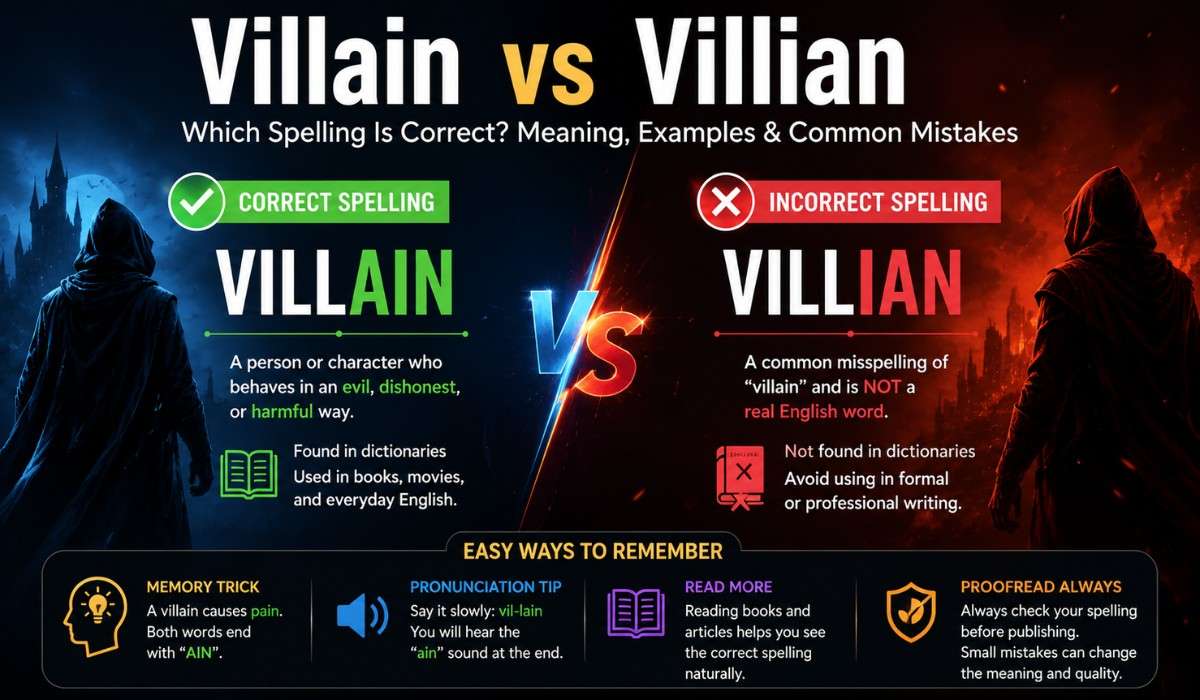
Villain vs Villian: Quick Answer
If you’re looking for the short answer, here it is:
- Villain Correct spelling
- Villian Incorrect spelling
The correct English word is villain.
The spelling “villian” is simply a common misspelling and does not appear as a standard English word in reputable dictionaries such as Oxford, Cambridge, or Merriam-Webster.
Which Spelling Is Correct?
The only accepted spelling is: Villain
A villain is a person or character who performs evil actions, causes trouble, or opposes the hero in a story.
Examples:
- The villain kidnapped the prince.
- Every superhero needs a powerful villain.
- The audience loved the movie’s mysterious villain.
Read Also: Diner or Dinner
Is “Villian” a Real Word?
No, Villian is not recognized as a proper English word. If you type “villian” into most word processors or grammar-checking software, it will usually be marked as a spelling mistake and suggested to be corrected to villain.
What Does “Villain” Mean?
The word villain has been used in English for centuries and appears in countless novels, movies, television shows, comic books, and video games.
Definition of Villain
A person who deliberately behaves in a cruel, dishonest, or evil way, especially in a story or film.
In literature, the villain is usually the main opponent of the hero.
Examples include:
- The Joker in Batman
- Lord Voldemort in Harry Potter
- Darth Vader in Star Wars
- Scar in The Lion King
These characters create conflict and challenge the protagonist throughout the story.
Origin of the Word
Interestingly, the word villain originally had a completely different meaning. It comes from the Old French word vilain, which referred to a farm worker or peasant. During the Middle Ages, the meaning gradually changed because peasants were unfairly stereotyped as rude or uncivilized. Eventually, the word evolved to describe someone with bad morals or evil intentions. Today, the original meaning has disappeared almost entirely.
How “Villain” Is Used Today
Today, villain has a much broader meaning.
It can describe:
- A criminal
- A fictional bad character
- Someone behaving badly
- The main antagonist in stories
Examples:
- The police arrested the villain.
- He became the villain of the movie.
- Social media made him look like the villain.
The word isn’t limited to fiction anymore it can also describe real people in certain contexts.
What Does “Villian” Mean?
Many English learners wonder whether villian has a different meaning.
The answer is simple: It doesn’t.
Is It in the Dictionary?
No major English dictionary lists villian as an accepted spelling.
Search for it in:
- Oxford Dictionary
- Cambridge Dictionary
- Merriam-Webster
- Collins Dictionary
You’ll either find no result or be redirected to villain.
Why Do People Spell It “Villian”?
The mistake happens because of the position of the letters.
People often accidentally write:
Villian
instead of
Villain
The letters “ai” become “ia.”
This small switch changes the spelling into an incorrect word.
Villain vs Villian: Side-by-Side Comparison
| Feature | Villain | Villian |
| Correct English Word | Yes | No |
| Found in Dictionaries | Yes | No |
| Accepted in Formal Writing | Yes | No |
| Used in Books | Yes | No |
| Used in Movies | Yes | No |
| Standard English | Yes | No |
The comparison clearly shows that villain is the only correct spelling.
Why Is “Villian” Such a Common Misspelling?
Despite being incorrect, villian appears frequently online. Here are the main reasons.
Pronunciation Confusion
When spoken quickly, the pronunciation of villain can make the order of the letters sound unclear. Many people naturally type what they hear.
Typing Errors
The letters A and I are commonly switched while typing.
Since the keyboard allows fast typing, it’s easy to write:
Villian
instead of
Villain
without noticing.
Influence of Social Media
Social media platforms often contain spelling mistakes. When users repeatedly see villian, they may assume it’s acceptable. This leads to the incorrect spelling spreading across posts, comments, and memes.
Lack of Proofreading
Many people publish blogs, assignments, or messages without checking spelling. Modern spell-check tools usually catch the mistake, but they’re not always enabled.
English Isn’t Phonetic
English contains many words that aren’t spelled exactly as they sound.
Examples include:
- Friend
- Weird
- Receive
- Believe
- Villain
Learning the correct spelling requires memorization rather than pronunciation alone.
Examples of “Villain” in Sentences
Seeing the word used in context makes it much easier to remember.
Everyday Examples
- The villain escaped before the police arrived.
- Every superhero needs a strong villain.
- The villain’s secret plan failed.
- She plays the villain in the new television series.
- The audience enjoyed the villain more than the hero.
Literature Examples
Many famous novels feature unforgettable villains.
For example:
- Count Dracula in Dracula
- Long John Silver in Treasure Island
- Professor Moriarty in the Sherlock Holmes stories
Each villain plays an important role in driving the story forward.
Movie Examples
Hollywood has created some of cinema’s greatest villains.
Examples include:
- The Joker
- Thanos
- Hannibal Lecter
- Norman Bates
- The Wicked Witch of the West
These characters are memorable because they challenge the protagonist and create dramatic tension.
Villain in Movies, Books, and Popular Culture
The word villain is deeply connected to storytelling. Whether it’s a novel, movie, television series, comic book, or video game, the villain is usually the character who creates conflict and challenges the hero. Without a compelling villain, many stories would lose their excitement and emotional impact.
Famous Movie Villains
Some of the most iconic villains in film history include:
- Darth Vader (Star Wars)
- The Joker (The Dark Knight)
- Lord Voldemort (Harry Potter)
- Thanos (Avengers: Infinity War and Endgame)
- Scar (The Lion King)
- Hannibal Lecter (The Silence of the Lambs)
- Maleficent (Sleeping Beauty)
These characters are remembered not just for being evil but for having strong personalities, memorable dialogue, and complex motivations.
Villains in Literature
Books have introduced readers to unforgettable villains for centuries.
Popular examples include:
- Count Dracula (Dracula)
- Captain Hook (Peter Pan)
- Professor Moriarty (Sherlock Holmes)
- Sauron (The Lord of the Rings)
- The White Witch (The Chronicles of Narnia)
A well-written villain often makes the hero’s journey more meaningful.
Villains in Video Games
Gaming has also produced many famous villains, such as:
- Bowser (Super Mario)
- Ganondorf (The Legend of Zelda)
- Sephiroth (Final Fantasy VII)
- Albert Wesker (Resident Evil)
- GLaDOS (Portal)
In many games, defeating the villain is the player’s primary objective.
Tips to Remember the Correct Spelling of “Villain”
Learning memory tricks can help you avoid making the same spelling mistake.
Remember the Letter Order
The correct spelling is:
Vill + ain
Notice that “ain” comes at the end.
Many people accidentally write:
Vill + ian
Simply remember: The ending is “AIN,” not “IAN.”
Think of the Word “Pain”
A villain usually causes pain.
Both words end with:
AIN
- Pain
- Villain
This simple connection makes the correct spelling easier to remember.
Read More Books
The more often you see the correct spelling in books, articles, and newspapers, the more natural it becomes. Regular reading improves spelling without requiring memorization.
Use Spell Check
Modern writing tools like Microsoft Word, Google Docs, Grammarly, and most smartphone keyboards automatically detect villian and suggest villain. Always review spelling suggestions before publishing your work.
When Should You Use the Word “Villain”?
The word villain can be used in several different contexts.
In Fiction
The most common use is for the main antagonist in a story.
Example:
- The villain tried to destroy the kingdom.
In Movies
Example:
- Marvel movies often feature powerful villains.
In Everyday Conversation
Sometimes people use the word figuratively.
Example:
- The media portrayed him as the villain of the controversy.
In this case, the person may not actually be evil they are simply viewed negatively by others.
In Journalism
Writers often describe criminals, fraudsters, or corrupt individuals as villains when expressing a strong opinion.
Example:
- The financial scam’s mastermind became the story’s biggest villain.
Common Grammar Mistakes Related to “Villain”
Besides spelling, some writers misuse the word grammatically.
Incorrect Capitalization
Use lowercase unless it’s part of a proper title.
The villain escaped.
The Villain Chronicles (book title)
Incorrect Plural Form
Singular:
- Villain
Plural:
- Villains
Example:
- The movie features several villains.
Incorrect Possessive Form
Singular possessive:
- Villain’s
Plural possessive:
- Villains’
Examples:
- The villain’s plan failed.
- The villains’ hideout was discovered.
Why Correct Spelling Matters
Using the correct spelling improves your writing in several ways:
- Makes your content look professional.
- Improves readability.
- Prevents confusion.
- Helps with school and workplace communication.
- Builds credibility with readers.
- Supports better SEO, as search engines recognize standard spellings.
Even a small spelling error like villian can affect the quality of your writing.
Read Also: Crier or Cryer
Frequently Asked Questions
Q1. Is “villain” or “villian” the correct spelling?
The correct spelling is villain. The spelling villian is incorrect and is considered a common misspelling. Dictionaries such as Oxford, Cambridge, and Merriam-Webster recognize only villain as the standard English word.
Q2. Is “villian” a real English word?
No, villian is not a real English word. It does not appear in reputable dictionaries and should not be used in formal or informal writing. If you type “villian” in most writing tools, it will usually be flagged as a spelling mistake and corrected to villain.
Q3. What does the word “villain” mean?
A villain is a person or fictional character who performs evil, dishonest, or harmful actions. In stories, novels, movies, and television shows, the villain is usually the main antagonist who creates conflict for the hero or protagonist.
Q4.Why do people often spell “villain” as “villian”?
Many people accidentally write villian because they reverse the letters “a” and “i.” Since the pronunciation is similar, this typing error is quite common, especially among English learners and fast typists.
Q5. How can I remember the correct spelling of “villain”?
A simple way to remember the spelling is to associate it with the word pain. A villain often causes pain, and both words end with “ain.” This memory trick makes it easier to remember that villain is spelled with “ain” rather than “ian.”
Conclusion
Understanding the difference between villain vs villian is simple once you know the correct spelling. While the two words may look similar, villain is the only accepted English word, whereas villian is a spelling mistake that frequently occurs due to typing errors or pronunciation confusion. Whether you’re writing a school essay, a novel, a blog post, or simply sending a message, using the correct spelling helps make your writing more professional and easier to understand.
A good way to remember it is by associating villain with the word pain both end in “ain.” This small trick can help you avoid the mistake in the future. By mastering common spelling differences like villain vs villian, you’ll strengthen your English writing skills and communicate with greater confidence. Whenever in doubt, remember: the correct spelling is always “villain.”
