
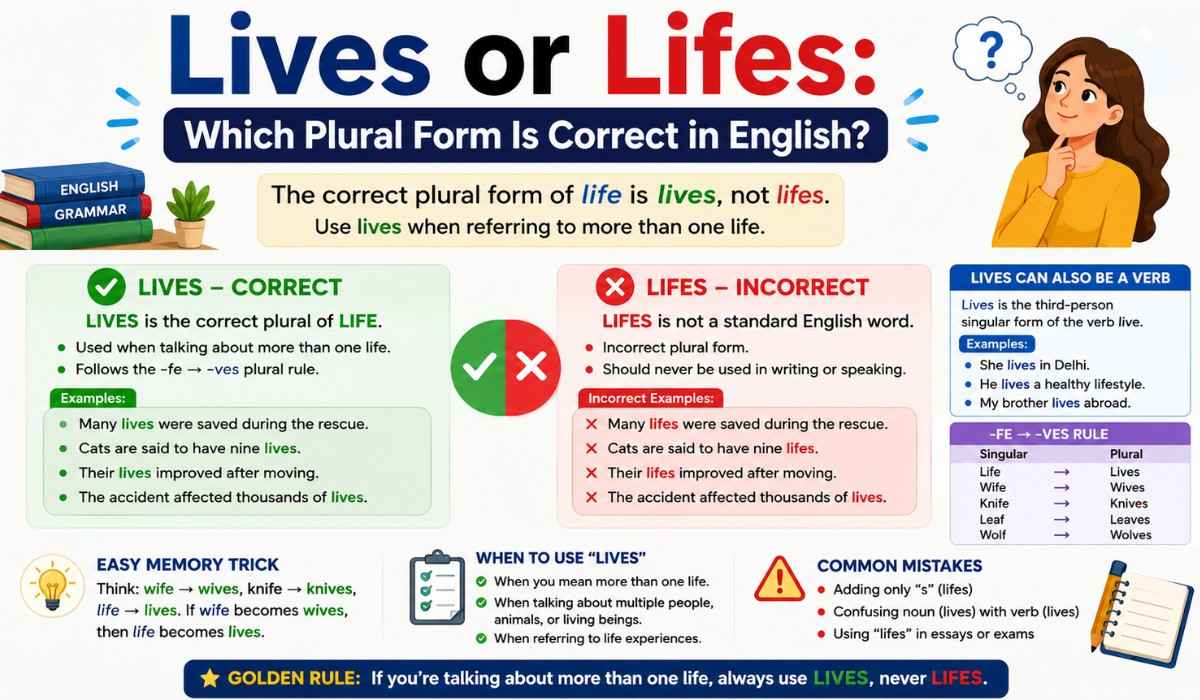
Many English learners get confused between lives or lifes when trying to write the plural form of the word life. Since English has several irregular plural nouns, it’s easy to wonder whether adding -s or changing the ending is the correct choice. This confusion is common among students, writers, and even native speakers who don’t often think about grammar rules.
The good news is that the answer is simple. Lives is the correct plural form of life, while lifes is not considered a correct word in standard English. Whether you’re writing an essay, preparing for an exam, or improving your spoken English, understanding this rule will help you avoid one of the most common spelling mistakes.
In this guide, we’ll explain the difference between lives or lifes, why the spelling changes, how to use the word correctly with examples, and some easy tricks to remember the rule forever.
Quick Answer
If you’re in a hurry, here’s the simple answer.
- Lives is the correct plural of life.
- Lifes is grammatically incorrect in standard English.
- Use lives whenever you’re referring to more than one life.
- The word lives can also be used as a verb, depending on the sentence.
Quick Comparison
| Word | Correct? | Meaning |
| Lifes | No | Incorrect spelling |
| Lives | Yes | Plural form of life |
Examples
- Many lives were saved during the rescue operation.
- Cats are believed to have nine lives.
- Our lives have changed over the years.
- The new law affected thousands of lives.
Read Also: Diner or Dinner
The Basic Difference Between Lives and Lifes
Understanding the difference between lives or lifes is much easier once you know how English forms certain plural nouns. The singular noun life ends with -fe. Instead of simply adding -s, English changes -fe to -ves when making the plural. That’s why life becomes lives. On the other hand, lifes does not follow English grammar rules and should never be used in formal or informal writing.
Difference at a Glance
| Feature | Lifes | Lives |
| Correct English Word | No | Yes |
| Plural of Life | No | Yes |
| Used in Dictionaries | No | Yes |
| Standard Grammar | Incorrect | Correct |
Whenever you want to talk about multiple people, animals, or living beings, always choose lives.
What Does “Life” Mean?
Life as a Singular Noun
The word life is a singular noun that refers to the existence of a living person, animal, or organism. It can also describe someone’s experiences, lifestyle, or the period during which someone is alive. Depending on the context, life can have several meanings.
Common Meanings of Life
- The existence of a living person or animal
- A person’s experiences and journey
- A way of living
- The period between birth and death
Examples
- She enjoys a peaceful life in the countryside.
- Life is full of surprises.
- His life changed after getting a new job.
- Everyone deserves a happy life.
- Good health is essential for a better life.
In all of these examples, life refers to one person’s existence or experience, so the singular form is used.
What Does “Lives” Mean?
Lives as the Plural of Life
The word lives is simply the plural form of life. It is used whenever you are talking about more than one person’s life, multiple animals, or several living beings.
Examples of Lives
- The firefighters saved many lives.
- Our lives have improved since moving here.
- The flood affected thousands of lives.
- Animals live very different lives in the wild.
- Technology has changed our lives dramatically.
Notice that lives always refers to more than one life in these examples.
Why Does Life Become Lives?
The -FE to -VES Rule
One reason people search for lives or lifes is that English plural rules are not always straightforward.
Most nouns simply add -s.
For example:
- Book → Books
- Chair → Chairs
- Car → Cars
However, some nouns ending in -f or -fe follow a different rule. Instead of adding -s, they replace the ending with -ves.
Examples
| Singular | Plural |
| Life | Lives |
| Wife | Wives |
| Knife | Knives |
| Leaf | Leaves |
| Wolf | Wolves |
| Shelf | Shelves |
| Calf | Calves |
Because life ends with -fe, its plural naturally becomes lives, not lifes. This is one of the most important spelling rules in English grammar and is worth remembering because it applies to several commonly used nouns.
Can “Lives” Also Be a Verb?
One reason many people search for lives or lifes is because the word lives has two different meanings in English. Besides being the plural form of life, it is also the third-person singular form of the verb live. The correct meaning depends entirely on how the word is used in a sentence. Understanding this difference will help you avoid grammar mistakes in both writing and speaking.
Lives as a Noun
When lives is used as a noun, it refers to more than one life.
Examples:
- The doctors saved many lives during the emergency.
- Our lives have changed significantly over the past few years.
- The earthquake affected thousands of lives.
- Soldiers risk their lives to protect the country.
- Many animals live very different lives in the wild.
In these examples, lives is the plural form of life.
Lives as a Verb
The word lives can also be a verb. It is the third-person singular form of the verb live, meaning “to reside” or “to continue existing.”
Examples:
- She lives in Mumbai.
- My brother lives in Australia.
- He lives close to his workplace.
- The author lives a simple lifestyle.
- Their grandmother lives with them.
Although the spelling is the same, the meaning changes according to the sentence.
Lives or Lifes Comparison Table
If you’re still wondering whether to write lives or lifes, this comparison table makes the difference easy to understand.
| Feature | Lifes | Lives |
| Correct English spelling | No | Yes |
| Standard dictionary word | No | Yes |
| Plural of Life | No | Yes |
| Can be used as a verb | No | Yes |
| Used in formal writing | Never | Always |
| Example | Many lifes | Many lives |
The table clearly shows that lives is the only correct spelling when referring to the plural of life.
Which One Should You Use?
Choosing between lives or lifes is actually very simple once you know the grammar rule.
Use “Lives” When
Always use lives when referring to more than one life or discussing the experiences of multiple people or animals.
Correct Examples
- Many lives were saved by the rescue team.
- Our lives became much easier after moving.
- Cats are believed to have nine lives.
- Technology has transformed our lives.
- Several lives depend on this important decision.
Whenever the meaning is more than one life, the correct word is lives.
Never Use “Lifes”
The word lifes is not accepted in standard English and should never be used.
Incorrect
- Many lifes were affected.
- Their lifes changed forever.
- The accident saved several lifes.
Correct
- Many lives were affected.
- Their lives changed forever.
- The accident saved several lives.
If you’re writing an essay, assignment, email, or exam, using lifes may be marked as a spelling or grammar mistake.
Common Mistakes People Make
Even advanced English learners occasionally confuse lives or lifes. Here are the most common mistakes and how to avoid them.
Adding Only “S”
Many people assume that every English noun forms its plural by simply adding -s.
Examples include:
- Book → Books
- Pen → Pens
- Student → Students
Because of this pattern, learners sometimes write:
Life → Lifes
However, life is an irregular noun.
The correct form is:
Life → Lives
Confusing the Noun and Verb Forms
Another common mistake is misunderstanding whether lives is functioning as a noun or a verb.
Consider these sentences:
- Their lives changed after graduation. (Noun)
- She lives near the university. (Verb)
Although both words are spelled lives, their meanings are completely different. The noun refers to multiple lives. The verb tells us where someone lives or how someone lives.
Writing “Lifes” in Essays or Exams
Many spelling mistakes occur because people type quickly without checking their grammar.
Writing lifes in:
- School assignments
- Competitive exams
- College essays
- Professional emails
- Blog posts
can leave a poor impression and reduce the quality of your writing. A quick proofread will help you catch this common error.
Everyday Examples of “Lives”
Seeing real-life examples makes the grammar rule much easier to remember.
In News Reports
News articles often use lives when reporting important events.
Examples:
- Emergency workers saved dozens of lives.
- The cyclone affected thousands of lives.
- Doctors worked overnight to save many lives.
- The new policy aims to improve people’s lives.
In Everyday Conversations
The word lives frequently appears in casual conversations.
Examples:
- Our lives have become much busier.
- Pets bring happiness into our lives.
- Travel has changed our lives forever.
- Exercise improves our lives in many ways.
In Books and Literature
Authors often use lives while describing characters or storytelling.
Examples:
- The novel follows the lives of three friends.
- Their lives became connected through unexpected events.
- History remembers the lives of great leaders.
- The documentary explores the lives of endangered animals.
On Social Media
You’ll frequently notice the word lives in motivational quotes and captions.
Examples:
- Kindness changes lives.
- Small habits improve our lives.
- Books can transform lives.
- Every decision shapes our lives.
These everyday examples reinforce that lives is the correct plural form and is widely used in spoken and written English.
Easy Memory Trick
Remembering the correct form of lives or lifes doesn’t have to be difficult. A simple memory trick can help you avoid this common grammar mistake every time. Many English nouns ending in -f or -fe change to -ves when they become plural. Since life follows the same rule, its plural is lives. Instead of memorizing only one word, remember a group of similar words.
Similar -FE to -VES Words
| Singular | Plural |
| Life | Lives |
| Wife | Wives |
| Knife | Knives |
| Leaf | Leaves |
| Wolf | Wolves |
| Shelf | Shelves |
| Calf | Calves |
| Half | Halves |
If you can remember wife → wives, it’s much easier to remember life → lives.
A simple phrase to keep in mind is: “If a wife becomes wives, then life becomes lives.”
This quick trick works well for students, competitive exam aspirants, and anyone learning English grammar.
Practice Sentences
Let’s test your understanding of lives or lifes. Choose the correct word to complete each sentence.
Fill in the Blanks
- Many ______ were saved during the rescue operation.
- Cats are believed to have nine ______.
- Their ______ changed after they moved abroad.
- The accident affected thousands of ______.
- The doctor dedicated his career to saving ______.
- Our daily habits influence our ______.
- She ______ in Bengaluru with her family.
- My uncle ______ near the beach.
- These volunteers changed many ______.
- He ______ a healthy and active lifestyle.
Take a moment to answer before checking the solutions below.
Answers
- lives
- lives
- lives
- lives
- lives
- lives
- lives (verb)
- lives (verb)
- lives
- lives (verb)
Notice that the spelling remains lives, but in some sentences it functions as a noun, while in others it is a verb.
Read Also: Villain vs Villian
Frequently Asked Questions (FAQs)
Q1. Is lifes a real English word?
No, lifes is not a correct word in standard English. The correct plural form of life is lives. Whenever you are referring to more than one life, you should always use lives.
Q2. What is the correct plural of life?
The correct plural of life is lives. It follows the English grammar rule where many nouns ending in -fe change to -ves in the plural form.
Q3. Why does life become lives instead of lifes?
The word life ends with -fe, and many English nouns with this ending form their plural by replacing -fe with -ves. That is why life becomes lives, not lifes.
Q4. Can lives be used as both a noun and a verb?
Yes, lives can function as both a noun and a verb. As a noun, it is the plural of life, as in “Many lives were saved.” As a verb, it is the third-person singular form of live, as in “She lives in Delhi.”
Q5. Why do people confuse lives and lifes?
People often confuse lives and lifes because most English nouns become plural by simply adding -s. However, life is an irregular noun that follows the -fe → -ves rule, making lives the only correct plural form.
Conclusion
Understanding the difference between lives or lifes is one of the easiest ways to improve your English grammar. While both spellings may look similar, only one is accepted in standard English. Whenever you’re referring to more than one life, always use lives. The spelling lifes is incorrect and should be avoided in essays, exams, professional writing, and everyday communication. It’s also important to remember that lives has two grammatical roles. It can be the plural noun of life, as in “Many lives were saved,” or the third-person singular form of the verb live, as in “She lives in Mumbai.” The meaning becomes clear from the context of the sentence.
A simple way to remember the rule is to think of other words that follow the same pattern, such as wife → wives, knife → knives, and life → lives. By practicing these examples and using the memory trick shared above, you’ll never confuse lives and lifes again. Whether you’re a student, writer, English learner, or preparing for competitive exams, using the correct form will make your writing more accurate and professional.
