
Have you ever wondered whether the correct spelling is “panic” vs “panick”? You’re not alone. Many people accidentally type “panick” while writing emails, social media posts, school assignments, or professional documents. Since words like “traffic,” “picnic,” and “magic” often follow different spelling patterns when their forms change, it’s easy to assume that “panick” might also be correct.
The simple truth is that “panic” is the only correct spelling in modern English. The word “panick” is considered a spelling mistake and does not appear as a standard English word in dictionaries. However, the confusion often arises because some forms of the word, such as “panicking” and “panicked,” include an extra “k.” Understanding why this happens can help you avoid one of the most common spelling errors.
In this guide, you’ll learn the difference between panic and panick, discover why people make this mistake, see real-life examples, and understand the correct spelling rules with simple explanations.
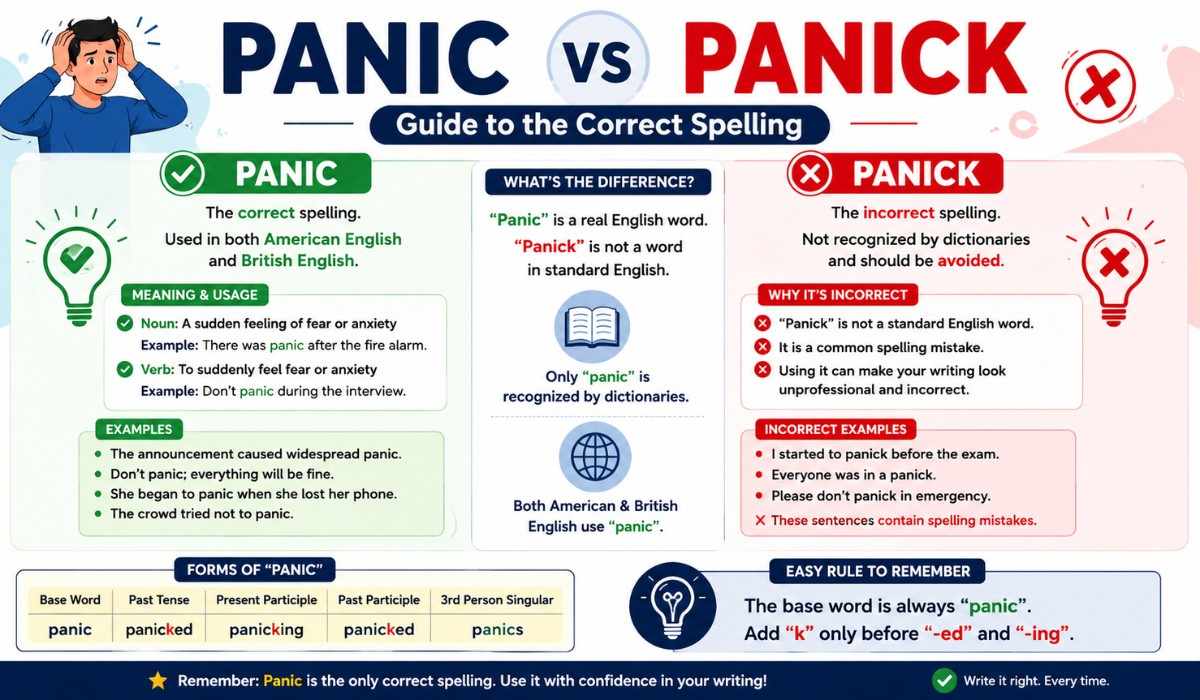
Quick Answer “Panic vs Panick”
If you’re looking for a quick answer, here it is:
- Panic = Correct
- Panick = Incorrect
Always use “panic” when writing in English.
Examples:
- I began to panic before the exam.
- The sudden noise caused panic among the crowd.
- Don’t panic; everything will be fine.
Avoid writing:
- I started to panick.
- Everyone was in a panick.
These sentences contain spelling mistakes.
Read Also: Lives or Lifes
Simple Origin or Background
The word “panic” has existed in the English language for hundreds of years. It originates from the Greek word “panikos,” which means sudden fear. The term was inspired by Pan, the Greek god believed to create unexpected fear or terror among people traveling through forests and lonely places.
Over time, the word entered Latin, then French, and eventually English. Throughout its history, the accepted spelling has remained “panic.”
Although the word has evolved in pronunciation and usage, the spelling has never officially become “panick.” Modern English dictionaries, grammar books, and style guides all recognize only “panic” as the correct base word.
Clear Explanation of the Difference
The confusion between “panic” and “panick” mainly comes from English spelling rules. While the base word is “panic,” some of its grammatical forms require adding the letter “k.” This causes many people to mistakenly believe the original word should also end with a “k.”
Let’s understand both words individually.
What is “panic”?
“Panic” is a real English word that can function as both a noun and a verb. As a noun, it describes a sudden feeling of fear or anxiety.
Examples:
- There was panic after the fire alarm sounded.
- The announcement caused widespread panic.
- Investors sold their shares in panic.
As a verb, it means to become frightened or anxious.
Examples:
- Don’t panic during the interview.
- She began to panic when she lost her phone.
- We shouldn’t panic over small problems.
In every situation, “panic” is the correct spelling.
What is “panick”?
“Panick” is not a standard English word.
It does not appear as the accepted spelling in major dictionaries such as Oxford, Cambridge, Merriam-Webster, or Collins. If you type “panick” into most word processors, spell-check software will automatically suggest changing it to “panic.”
Most people write “panick” because they are thinking about words like:
- panicked
- panicking
Since these words contain a “k,” writers sometimes incorrectly assume the base word should also include one. This is one of the most common English spelling mistakes.
Comparison Table
| Feature | Panic | Panick |
| Correct English spelling | Yes | No |
| Recognized by dictionaries | Yes | No |
| Used in formal writing | Yes | No |
| Used in academic writing | Yes | No |
| Accepted in British English | Yes | No |
| Accepted in American English | Yes | No |
| Part of speech | Noun and Verb | Not a standard word |
| Recommended for writing | Yes | Never |
The comparison clearly shows that “panic” is always the correct choice, regardless of whether you’re writing in American English, British English, or any other variety of English.
Which One to Use and When
Whenever you’re writing or speaking in English, always choose “panic.”
Whether you’re writing an essay, an email, a social media post, a business report, or a text message, the spelling remains exactly the same.
Correct examples:
- Don’t panic before your presentation.
- The passengers remained calm instead of panic.
- The teacher told everyone not to panic.
- The market experienced widespread panic.
- She tried not to panic during the emergency.
Incorrect examples:
- Don’t panick.
- Everyone started to panick.
- There was panick everywhere.
Replacing “panick” with “panic” immediately makes these sentences grammatically correct.
Special Note About Forms of “Panic”
This is where most learners become confused.
Although the base word is “panic,” the spelling changes slightly when certain endings are added.
| Base Word | Correct Form |
| Panic | Panic |
| Past Tense | Panicked |
| Present Participle | Panicking |
| Third Person Singular | Panics |
| Past Participle | Panicked |
Notice something important:
The extra “k” appears only before endings like “-ed” and “-ing.”
Examples:
- She panicked during the earthquake.
- They are panicking unnecessarily.
- Nobody panics without a reason.
The base word itself never changes to “panick.”
Common Mistakes People Make
Even though “panic” is the correct spelling, many English learners and even native speakers occasionally write “panick.” Most of these mistakes happen because of spelling rules or simple typing habits. Understanding these common errors will help you avoid them in your own writing.
Mistake 1: Writing “panick” Instead of “panic”
This is by far the most common mistake. People often believe that adding a “k” makes the word look correct because they have seen forms like “panicked” and “panicking.”
Incorrect examples:
- Don’t panick before your interview.
- I always panick during exams.
- The crowd started to panick.
Correct examples:
- Don’t panic before your interview.
- I always panic during exams.
- The crowd started to panic.
Remember that the base word is always “panic.” The letter “k” is added only when certain suffixes, such as “-ed” or “-ing,” are attached.
Mistake 2: Thinking “panick” Is British Spelling
Some people assume that “panick” is simply the British version of “panic,” just as “colour” and “color” differ between British and American English.
However, this assumption is incorrect.
Both British English and American English use exactly the same spelling:
- Panic ✔
- Panick ✘
No major English dictionary or style guide accepts “panick” as an alternative spelling.
Mistake 3: Confusing Spelling Rules
English spelling rules can sometimes be confusing. Words ending in “c” often add a “k” before certain endings.
For example:
- Picnic → Picnicking
- Mimic → Mimicked
- Panic → Panicked
After seeing these forms, many learners mistakenly think the original word should also end with a “k.”
The correct rule is simple:
- Base word = Panic
- With “-ing” = Panicking
- With “-ed” = Panicked
The base spelling never changes.
Mistake 4: Typing Errors
Sometimes “panick” appears simply because of fast typing. While writing emails, messages, or social media posts, people may accidentally press the “k” key before finishing the word.
Fortunately, most spell-check tools immediately identify this mistake and suggest replacing “panick” with “panic.”
Even if you rely on spell check, it’s a good habit to proofread your writing before sending or publishing it.
Everyday Real Life Examples
Learning through real-life examples is one of the easiest ways to remember the correct spelling. Below are some common situations where the word “panic” is used correctly.
In Emails
Professional emails should always use the correct spelling.
Example 1:
“Our team experienced some panic after the server stopped working, but the issue has now been resolved.”
Example 2:
“Please don’t panic if you receive an unexpected notification. We are currently updating the system.”
Using “panick” in professional communication may leave a poor impression and make your writing appear less polished.
In News
News reports frequently use the word “panic” to describe public reactions during emergencies.
Examples:
- Panic spread across the city after the earthquake.
- Officials urged residents not to panic.
- The announcement caused panic among passengers at the station.
- There was no reason for public panic, according to authorities.
In newspapers, television broadcasts, and online news articles, you will almost always see the spelling “panic.”
On Social Media
The word “panic” is very common on platforms like Instagram, Facebook, X (formerly Twitter), and TikTok.
Examples:
- I almost had a panic attack before my interview.
- Don’t panic—we’ve got this!
- Trying not to panic before the exam results.
- Everyone started to panic when the lights went out.
Although spelling mistakes occasionally appear on social media, the correct spelling remains “panic.”
In School Life
Students often use the word while talking about exams, presentations, and assignments.
Examples:
- I started to panic before my math test.
- Don’t panic if you don’t know every answer.
- Our teacher told us not to panic during the practical exam.
- Many students panic when exams begin.
Using the correct spelling in school assignments helps improve writing accuracy and overall grades.
In Daily Conversations
“Panic” is also a common word in everyday spoken English.
Examples:
- Don’t panic; everything will be okay.
- She didn’t panic even during the emergency.
- We started to panic when we couldn’t find our tickets.
- There’s no need to panic right now.
The word fits naturally into both casual and formal conversations.
Short Learning Section for Students and Beginners
If you’re new to English or preparing for school exams, remembering one simple rule can save you from making this spelling mistake.
Think of it like this:
- The dictionary word is always “panic.”
- When adding “-ed” or “-ing,” add a “k” first.
Examples:
- Panic ✔
- Panics ✔
- Panicked ✔
- Panicking ✔
- Panick ✘
A simple memory trick is:
“If the word stands alone, it’s panic. If you add -ed or -ing, add the k.”
Practicing this rule a few times will help you remember it naturally whenever you write.
Read Also: Reciept vs Receipt
Frequently Asked Questions
Q1. Is “panick” ever correct?
No, “panick” is not a correct English word. The accepted and standard spelling is always “panic.” Whether you are writing in American English, British English, or any other variety of English, “panic” is the only correct form recognized by dictionaries and grammar guides.
Q2. Why do people write “panick”?
Many people mistakenly write “panick” because they confuse it with words like “panicked” and “panicking,” which require an extra “k” before the endings “-ed” and “-ing.” Others make this error due to typing quickly or misunderstanding English spelling rules.
Q3. Is “panic” a noun or a verb?
Yes, “panic” can function as both a noun and a verb. As a noun, it refers to a sudden feeling of fear or anxiety, such as in the sentence, “The loud noise caused panic among the crowd.” As a verb, it means to become frightened or anxious, as in, “Don’t panic before your interview.”
Q4. What is the correct form: panicing or panicking?
The correct spelling is “panicking.” Since the base word ends with the letter “c,” English spelling rules require adding a “k” before the suffix “-ing.” Therefore, “She is panicking” is correct, while “She is panicing” is incorrect.
Q5. What is the past tense of panic?
The past tense of “panic” is “panicked.” For example, you can say, “He panicked during the emergency” or “The students panicked before the examination.” The spelling “paniced” is incorrect because it does not follow the standard spelling rule.
Q6. Is this mistake common?
Yes, confusing “panic” with “panick” is a very common spelling mistake. Many students, professionals, and even native English speakers make this error because they associate the base word with its forms “panicked” and “panicking.” Fortunately, most spell-check and grammar tools can identify and correct this mistake automatically.
Q7. How can I avoid this mistake?
The easiest way to avoid this error is to remember that the base word is always “panic.” The letter “k” is added only when forming words like “panicked” and “panicking.” Regular reading, writing practice, and using grammar-checking tools can also help you remember the correct spelling.
Q8. Is “panic” used in formal writing?
Yes, “panic” is commonly used in formal writing. It appears in academic papers, newspapers, business reports, government documents, medical articles, and professional emails. Using the correct spelling helps ensure your writing is clear, accurate, and professional.
Conclusion
Understanding the difference between “panic” and “panick” is much easier once you know the basic spelling rule. “Panic” is the only correct spelling and is accepted in all forms of English, including both American and British English. In contrast, “panick” is simply a spelling mistake and should be avoided in formal and informal writing alike.
The confusion usually arises because forms like “panicked” and “panicking” include an extra “k.” However, that additional letter is added only when certain suffixes are attached to the base word. The standalone word always remains “panic.”
Whether you’re writing an email, a school assignment, a social media post, or a professional report, using the correct spelling helps improve clarity and credibility. Remember the simple rule: use “panic” as the base word, and add a “k” only before “-ed” and “-ing.” With this easy trick in mind, you’ll never have to wonder whether to write “panic” or “panick” again.
