
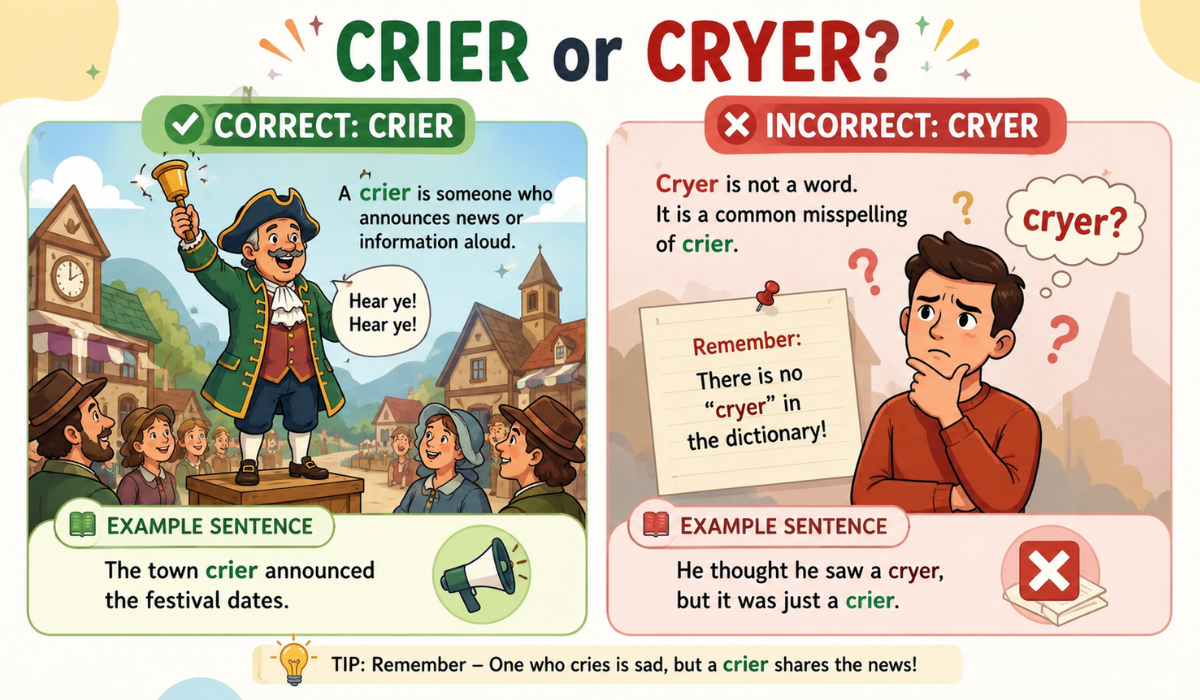
If you’ve ever typed “crier or cryer” into Google, you’re not alone. Many English learners, students, writers, and even native speakers wonder which spelling is correct. At first glance, both words appear valid because they are pronounced the same way. However, only one of them is the standard English spelling in most situations.
Understanding the difference between crier or cryer is important because using the wrong spelling can make your writing look less professional. While crier is a recognized English noun found in major dictionaries, cryer is rarely used as a common noun and is primarily seen as a surname. Knowing when to use each spelling will help you write more accurately and confidently.
In this comprehensive guide, we’ll explain the difference between crier or cryer, explore their meanings, provide grammar rules, compare their usage, and share plenty of examples so you’ll never confuse these words again.
Why Do People Confuse Crier or Cryer?
The confusion between crier or cryer mainly comes from pronunciation. Both words sound exactly the same, making it difficult for many people to know which spelling is correct when writing. Since English contains many words with irregular spelling patterns, it’s easy to assume that both versions are acceptable.
Another reason for the confusion is that people often see the surname Cryer, especially in the names of famous personalities. This leads some writers to believe that cryer is simply an alternative spelling of crier, which isn’t true in standard English grammar.
Crier or Cryer – Which One Is Correct?
The correct spelling depends on the context, but in almost every everyday situation, crier is the correct word. If you’re referring to someone who cries frequently or someone who publicly announces news (such as a town crier), the correct spelling is crier. The spelling cryer is generally not used as a common English noun. Instead, it is mostly found as a family name or surname.
The Short Answer
Here’s the simple rule:
- Crier = Correct English word.
- Cryer = Usually incorrect unless referring to someone’s surname.
For example:
- She has always been a crier during emotional movies.
- The town crier rang his bell before making announcements.
- She is a cryer during emotional movies.
Why People Get Confused
English often forms nouns by adding -er to verbs. Because the verb is cry, many people naturally assume the noun should become cryer. However, English follows a special spelling rule. When a verb ends in y, the y usually changes to i before adding certain suffixes.
That’s why:
- Cry → Crier
- Carry → Carrier
- Marry → Marrier (rare usage)
This spelling rule explains why crier is correct instead of cryer.
What Does “Crier” Mean?
The word crier has been part of the English language for centuries. It has two primary meanings depending on the context. The first refers to someone who cries easily or frequently. The second refers to an official person who publicly announces important news or messages. Both meanings are widely accepted and appear in standard English dictionaries.
Crier as Someone Who Cries Frequently
This is the meaning most people use today. A crier is someone who cries easily because of emotions like happiness, sadness, excitement, or sympathy.
Examples include:
- My sister is such a crier that she cries during every romantic movie.
- He’s never been much of a crier, even during difficult times.
- I’m a crier whenever I watch emotional documentaries.
Being called a crier doesn’t necessarily mean someone is weak. It simply describes a person who expresses emotions through tears more often than others.
Crier as a Town Crier
Historically, the word crier referred to a town crier. Before newspapers, television, radio, and the internet existed, towns employed a person whose job was to announce important public information.
The town crier would:
- Ring a bell.
- Gather people’s attention.
- Read official announcements.
- Share royal proclamations.
- Inform citizens about laws and local events.
Although town criers are mostly ceremonial today, the profession played a vital role in history.
Dictionary Definition
Most English dictionaries define crier as:
- A person who cries.
- Someone who cries frequently.
- A public announcer, especially a town crier.
Because it appears in major dictionaries, crier is considered the standard and grammatically correct spelling.
What Does “Cryer” Mean?
Unlike crier, the word cryer is not commonly recognized as a standard English noun. If you search modern dictionaries, you’ll notice that cryer usually does not appear as an accepted spelling for someone who cries. Instead, Cryer is primarily used as a surname. This is one of the biggest reasons people become confused when comparing crier or cryer.
Is “Cryer” a Real Word?
Technically, yes but not in the way most people think.
Cryer exists mainly as:
- A surname
- A family name
- Occasionally an old historical spelling in rare documents
It is not considered the correct modern spelling for someone who cries.
When Is “Cryer” Used?
You’ll mostly encounter Cryer when referring to people’s names.
For example:
- Jon Cryer (American actor)
- Families with the surname Cryer
Outside names, using cryer instead of crier is generally considered a spelling mistake in standard English.
Cryer as a Surname
Perhaps the most famous person with the surname Cryer is actor Jon Cryer, best known for his role in the television sitcom Two and a Half Men. Because his surname is widely recognized, many people mistakenly believe cryer is an accepted alternative spelling of crier. It’s important to remember that a surname follows its own spelling conventions and doesn’t change the standard spelling of the common noun.
Crier vs Cryer: Key Differences
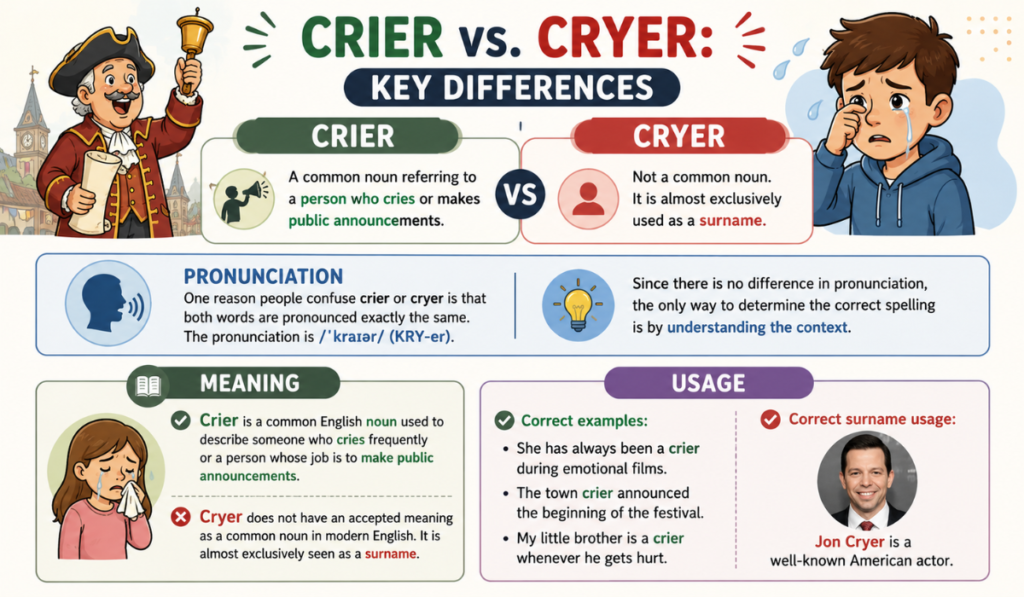
Although crier and cryer are pronounced the same way, they are not interchangeable in standard English. The word crier is the accepted spelling used in dictionaries, grammar books, and everyday writing. On the other hand, cryer is generally used only as a surname and is not considered the correct spelling when referring to someone who cries.
Knowing the distinction between crier or cryer helps improve your writing accuracy and prevents common spelling mistakes. Whether you’re writing an essay, an email, a social media post, or professional content, using the correct spelling ensures your writing appears polished and grammatically correct.
Comparison Table
| Feature | Crier | Cryer |
| Correct English spelling | Yes | No (as a common noun) |
| Found in dictionaries | Yes | Rarely (mainly as a surname) |
| Means someone who cries | Yes | No |
| Means a town announcer | Yes | No |
| Used as a surname | Rarely | Yes |
| Appropriate for formal writing | Yes | No |
Pronunciation
One reason people confuse crier or cryer is that both words are pronounced exactly the same. The pronunciation is /ˈkraɪər/ (KRY-er).
Since there is no difference in pronunciation, the only way to determine the correct spelling is by understanding the context. If you’re referring to a person who cries or a town crier, the correct spelling is crier. If you’re referring to someone’s last name, Cryer may be correct.
Meaning
The meanings of these two spellings are quite different.
Crier is a common English noun used to describe someone who cries frequently or a person whose job is to make public announcements. It has been used in English literature and dictionaries for centuries.
Cryer, however, does not have an accepted meaning as a common noun in modern English. It is almost exclusively seen as a surname and should not replace crier in general writing.
Usage
The correct usage depends entirely on the context.
Correct examples:
- She has always been a crier during emotional films.
- The town crier announced the beginning of the festival.
- My little brother is a crier whenever he gets hurt.
Correct surname usage:
- Jon Cryer is a well-known American actor.
Incorrect examples:
- She is a cryer whenever she watches sad movies.
- The town cryer made an announcement.
Why “Crier” Is the Preferred Spelling
The reason crier is preferred lies in English spelling rules. Although the verb is cry, the noun derived from it follows a standard grammatical pattern that changes the spelling slightly.
This rule applies to many English words ending in -y, ensuring consistency throughout the language. As a result, dictionaries, grammar guides, and style manuals recognize crier as the correct spelling.
Grammar Rule
When forming nouns from verbs ending in y, English often changes the y to i before adding certain endings.
Examples include:
| Verb | Correct Noun |
| Cry | Crier |
| Carry | Carrier |
| Marry | Marrier (rare) |
| Apply | Applier |
Because of this grammatical rule, crier follows the standard spelling pattern, while cryer does not.
Formation from the Verb “Cry”
The noun crier comes directly from the verb cry, meaning to shed tears or call out loudly. Over time, English adopted crier as the accepted noun form rather than cryer.
This spelling has remained consistent for centuries and is used in books, newspapers, academic writing, and dictionaries. Therefore, if you’re unsure whether to use crier or cryer, remember that crier is almost always the correct choice.
Examples of “Crier” in Sentences
Seeing a word used in real-life examples is one of the best ways to understand its meaning and usage. Here are different situations where crier is used correctly.
Everyday Examples
In everyday conversations, crier usually refers to someone who becomes emotional easily.
Examples:
- I’m such a crier whenever I watch family movies.
- My mother has always been a crier during weddings.
- Don’t worry if you’re a crier—it simply means you’re expressive.
- He’s not much of a crier, even during emotional moments.
- She admitted she was always the first crier in the room.
Emotional Context
The word is commonly used when discussing emotions.
Examples:
- My best friend is a happy crier and cries whenever something good happens.
- Even though he looks tough, he’s actually a crier.
- She became a crier after becoming a parent because emotional moments affected her more deeply.
- I’m definitely a crier when watching inspirational sports documentaries.
- He laughed and admitted he was always the family crier.
Historical Context
Historically, crier often referred to a town crier.
Examples:
- The town crier rang his bell before reading the king’s message.
- Every morning, the town crier announced important local news.
- Before newspapers existed, the town crier informed people about official events.
- The village crier gathered everyone in the marketplace.
- Many historical festivals still feature a traditional town crier.
Examples of “Cryer” in Sentences
Unlike crier, cryer is rarely used as a common noun. Its most common appearance is as a surname.
Correct examples include:
- Jon Cryer won several awards for his acting career.
- The Cryer family has lived in the town for generations.
- Professor Cryer delivered an excellent lecture.
- Ms. Cryer published a new research paper.
- The award was presented to Dr. Cryer.
Notice that each example refers to a person’s name rather than someone who cries.
Common Mistakes People Make
The confusion surrounding crier or cryer leads to several common mistakes. Fortunately, these errors are easy to avoid once you understand the correct grammar. Many writers accidentally replace crier with cryer simply because the spelling looks logical. However, English spelling doesn’t always follow simple phonetic rules.
Spell Check Issues
Some spell-check tools may not immediately flag cryer as incorrect because it is a legitimate surname. This can mislead writers into believing the spelling is acceptable in all contexts.
To avoid this mistake, always think about the meaning of the sentence. If you’re referring to someone who cries, use crier.
Typing Errors
Typing quickly is another common reason people write cryer instead of crier. Since both words sound identical, the mistake often goes unnoticed during proofreading.
A simple way to remember the correct spelling is this:
- If the person cries, they are a crier. If it’s someone’s last name, it may be Cryer.
That small reminder can help you avoid one of the most common spelling mistakes involving these words.
Is “Cryer” Ever Grammatically Correct?
Yes, cryer can be grammatically correct but only in very specific situations. It is primarily used as a proper noun, meaning it is someone’s surname or family name. In these cases, the spelling should never be changed because names retain their original spelling.
However, if you’re referring to a person who cries frequently or a public announcer, cryer is not the correct spelling. Standard English dictionaries and grammar references consistently recommend crier for these meanings. Therefore, unless you’re writing about a person whose last name is Cryer, you should always choose crier.
When “Cryer” Is Correct
Use Cryer only in situations such as:
- Referring to someone with the surname Cryer.
- Mentioning historical records where “Cryer” appears as a family name.
- Writing biographies or articles about people named Cryer.
Examples:
- Jon Cryer is an award-winning actor.
- Professor Cryer delivered the keynote speech.
- The Cryer family has lived in the village for generations.
Outside these contexts, crier remains the correct choice.
Tips to Remember the Correct Spelling
Remembering the correct spelling of crier is easier when you understand the grammar rule and use a few simple memory tricks. These tips can help students, writers, and English learners avoid common mistakes.
One of the easiest ways to remember the difference is to associate crier with the word cries. If a person cries, they are a crier. The spelling follows the standard English pattern and is accepted in dictionaries. On the other hand, Cryer should remind you of a person’s last name rather than a common noun.
Easy Memory Tricks
- Crier = Someone who cries.
- Crier = Town crier.
- Cryer = Usually a surname.
- If you’re writing an essay or professional document, choose crier.
- If you’re writing about Jon Cryer or another person with that surname, use Cryer.
By practicing these simple rules, you’ll quickly remember the correct spelling whenever you encounter the phrase “crier or cryer.”
Frequently Asked Questions (FAQs)
Q1. Which is correct: crier or cryer?
The correct spelling in standard English is crier when referring to someone who cries frequently or a town crier who makes public announcements. Cryer is generally used as a surname and is not considered the correct spelling for the common noun.
Q2. Is “cryer” a real word?
Yes, Cryer is a real word, but it is primarily used as a surname or family name. It is not the accepted spelling for someone who cries. In everyday English writing, crier is the correct choice.
Q3. What does “crier” mean?
A crier has two common meanings in English. It can refer to a person who cries easily or frequently due to emotions, or it can refer to a town crier, an official who historically announced important news and public notices before the advent of newspapers and modern communication.
Q4. Why do people confuse crier and cryer?
People often confuse crier or cryer because both words have the same pronunciation. Additionally, the surname Cryer, made famous by individuals like actor Jon Cryer, leads many people to believe that cryer is an alternative spelling of crier. However, dictionaries recognize crier as the standard noun.
Q5. Can I use “cryer” in formal writing?
You should only use Cryer in formal writing when referring to someone’s surname. If you’re describing a person who cries or a town announcer, crier is the grammatically correct spelling and should always be used.
Conclusion
The difference between crier and cryer is quite simple once you understand their usage.
- Crier is the correct English spelling when referring to someone who cries or a town crier.
- Cryer is generally incorrect in everyday English and is mainly used as a surname.
A simple way to remember the difference is:
- Cry → Crier (the correct noun form)
- Cryer is typically used only as a person’s last name, such as Jon Cryer.
By remembering this easy rule and paying attention to the context, you can confidently choose the correct spelling every time. Whether you’re writing an essay, email, blog post, or social media caption, using crier correctly will make your English more accurate, professional, and grammatically correct.
