
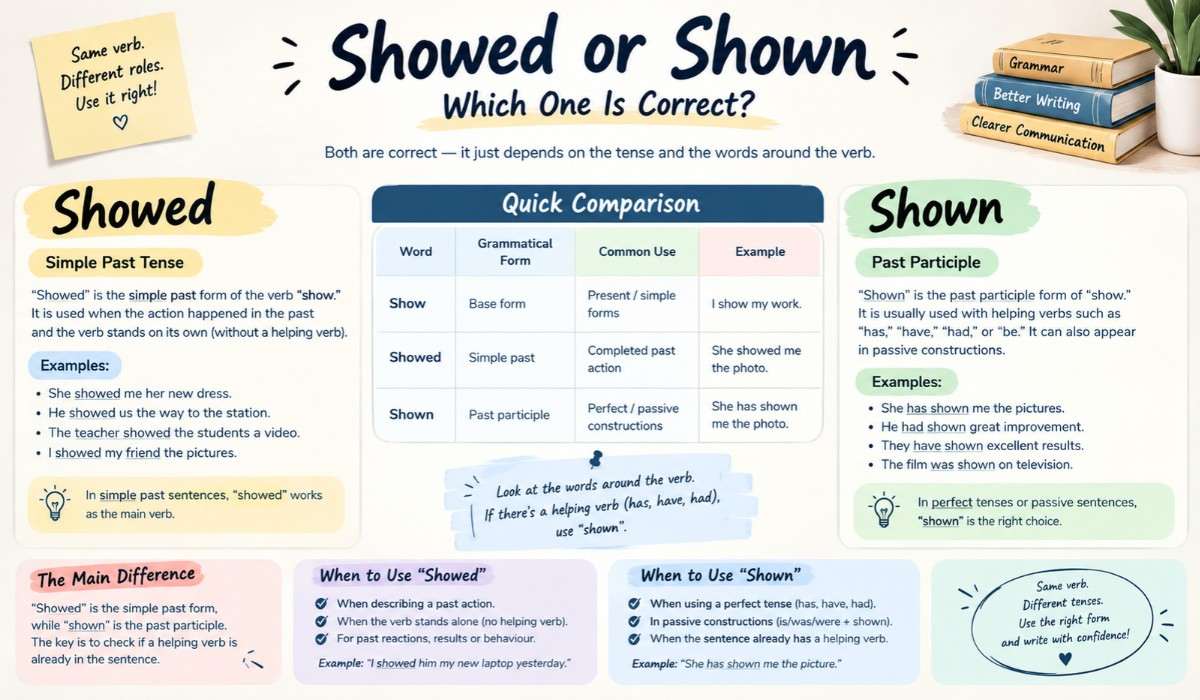
Choosing between “showed or shown” can be confusing because both words come from the verb “show,” but they are not used in exactly the same way. The main difference is connected to verb tense and sentence structure. “Showed” is the simple past form of “show,” while “shown” is generally used as the past participle and usually appears with helping verbs such as “have,” “has,” “had,” or “be.”
For example, you can say, “She showed me her new phone yesterday,” because the action happened in the past. However, you would say, “She has shown me her new phone,” because “shown” is being used with the helping verb “has.” Understanding this basic difference makes it much easier to decide whether showed or shown is correct in a sentence.
Showed or Shown: Quick Answer
Both “showed” and “shown” are correct words, but they have different grammatical functions. “Showed” is the simple past tense of “show,” while “shown” is the past participle form. The easiest way to remember the difference is to look at the words around the verb. If you are describing a completed action in the simple past, “showed” is normally the right choice. If you are using a perfect tense, “shown” usually follows “has,” “have,” or “had.”
| Word | Grammatical Form | Common Use | Example |
| Show | Base form | Present/simple forms | I show my work. |
| Showed | Simple past | Completed past action | She showed me the photo. |
| Shown | Past participle | Perfect/passive constructions | She has shown me the photo. |
Knowing this distinction will help you use both forms naturally in everyday writing and conversation.
What Does “Showed” Mean?
“Showed” is the simple past tense of the verb “show.” It is used when someone performed the action of showing something at a particular point in the past or when describing a completed past action.
For example, “He showed me his new car” tells us that he showed the car to the speaker at some time in the past. The sentence does not need another auxiliary verb before “showed.” Another example is, “The teacher showed us how to solve the problem.” Here, “showed” describes an action that took place in the past. The verb works independently as the main past-tense verb in the sentence.
Examples of “Showed” in Sentences
Here are some common examples of “showed”:
- She showed me her new dress.
- He showed us the way to the station.
- The teacher showed the students a video.
- They showed great interest in the project.
- I showed my friend the pictures.
- The doctor showed me the test results.
- She showed everyone her artwork.
In each example, “showed” describes a completed action in the past.
Read Also: Chosing or Choosing || Seal vs Seel || Flakey or Flaky
What Does “Shown” Mean?
“Shown” is the past participle form of “show.” Unlike “showed,” it usually does not function as the simple past tense on its own. It commonly appears with auxiliary verbs such as “has,” “have,” and “had.” For example, “He has shown me the report” is correct because “has” is followed by the past participle “shown.” Similarly, “They had shown us the results before the meeting” uses “shown” correctly because it follows “had.” “Shown” can also be used in passive constructions. For example, “The movie was shown at the theater.” In this sentence, “shown” is part of a passive verb construction.
Examples of “Shown” in Sentences
Consider these examples:
- She has shown me the pictures.
- He has shown great improvement.
- They have shown excellent results.
- I had shown him the document earlier.
- The film was shown on television.
- The results have shown a significant difference.
- The students were shown how to complete the task.
These examples demonstrate how “shown” normally works with a helping verb.
Showed vs. Shown: The Main Difference
The main difference between “showed” and “shown” is their grammatical role. “Showed” is the simple past form, while “shown” is the past participle.
Consider these two sentences:
- “She showed me the picture.”
- “She has shown me the picture.”
The first sentence uses “showed” because the sentence is in the simple past tense. The second uses “shown” because “has” requires the past participle form. A useful rule is to check whether the sentence already contains a helping verb. When “has,” “have,” or “had” is being used to create a perfect tense, “shown” is normally required.
When to Use “Showed”
Use “showed” when you are talking about an action that happened in the past and the verb is being used in the simple past tense. For example, “I showed him my new laptop yesterday.” The word “showed” tells us that the action happened in the past. The sentence does not use “have,” “has,” or “had” before the verb. You can also use “showed” when describing a past reaction, result, or behavior. For example, “The survey showed that most people preferred the first option.” Here, “showed” refers to what the survey revealed.
“Showed” With Specific Past Time
“Showed” often appears with expressions that clearly identify a past time.
Examples include:
- She showed me the message yesterday.
- He showed us the house last week.
- The report showed a decline in sales last year.
- They showed their support during the event.
- I showed him the information earlier.
Words such as “yesterday,” “last week,” “last year,” and “earlier” often fit naturally with the simple past form “showed.”
When to Use “Shown”
Use “shown” when it is functioning as a past participle, especially after “has,” “have,” or “had.”
For example:
- She has shown me the document.
- They have shown strong interest.
- He had shown excellent leadership.
- We have shown that the method works.
In each sentence, “shown” works with a helping verb to create a perfect construction. “Shown” is also common in passive sentences. For example, “The documentary was shown last night.” Here, “was” works with “shown” to form the passive voice.
“Shown” in Perfect Tenses
The perfect tenses are one of the easiest places to recognize when “shown” is required.
Present perfect:
- “She has shown me the answer.”
- “They have shown impressive progress.”
Past perfect:
- “He had shown me the documents before the meeting.”
- “We had shown them the correct procedure.”
The basic pattern is:
- has/have/had + shown
This pattern is a useful shortcut when deciding between “showed or shown.”
Can You Say “I Have Showed”?
No. In standard English, “I have showed” is generally incorrect when “show” is being used in its normal sense. After “have,” you need the past participle “shown.”
Correct:
- “I have shown him the picture.”
Incorrect:
- “I have showed him the picture.”
The same rule applies to “has” and “had.”
Correct:
- “She has shown us the results.”
- “He had shown me the document.”
Incorrect:
- “She has showed us the results.”
- “He had showed me the document.”
Remembering this rule can prevent one of the most common mistakes involving “showed or shown.”
Can You Say “I Shown”?
No. “Shown” generally cannot be used by itself as the simple past tense.
Incorrect:
- “I shown him the photo yesterday.”
Correct:
- “I showed him the photo yesterday.”
However, “shown” becomes correct when it has the appropriate helping verb:
- “I have shown him the photo.”
The difference is simple: use “showed” for the simple past and “shown” as a past participle in constructions that require it.
Showed or Shown in Questions
The same distinction applies when forming questions. For simple past questions, use “show” after “did,” not “showed.”
Correct:
- “Did she show you the picture?”
Incorrect:
- “Did she showed you the picture?”
This happens because “did” already marks the sentence as past tense, so the main verb returns to its base form.
For perfect constructions, use “shown”:
- “Has she shown you the picture?”
- “Have they shown you the results?”
- “Had he shown you the document?”
This creates an important three-way distinction:
- She showed me the picture.
- Did she show me the picture?
- She has shown me the picture.
Understanding this pattern makes the use of “show,” “showed,” and “shown” much easier.
Showed or Shown in Passive Voice
“Shown” is frequently used in passive constructions. Passive voice focuses on the thing receiving the action rather than the person performing it.
For example:
- “The movie was shown at the theater.”
- “The results were shown to the audience.”
- “The presentation was shown on a large screen.”
In these sentences, “shown” is used with forms of the verb “be.” This is different from simple past active sentences such as “The theater showed the movie.”
The active and passive structures can be compared like this:
| Active Voice | Passive Voice |
| The theater showed the movie. | The movie was shown at the theater. |
| The teacher showed the students a video. | A video was shown to the students. |
| The company showed the results. | The results were shown by the company. |
This is another reason why understanding the role of “shown” is important.
Common Mistakes With Showed and Shown
Many mistakes involving “showed or shown” happen because learners treat both words as interchangeable. Although they come from the same verb, their grammatical roles are different. One common mistake is using “showed” after “have,” “has,” or “had.” Another is using “shown” alone when the sentence requires the simple past form. These errors are easy to avoid once you recognize the verb pattern.
Mistake 1: Using “Showed” After Have
Incorrect: “I have showed him the picture.”
Correct: “I have shown him the picture.”
After “have,” use the past participle “shown.”
Mistake 2: Using “Shown” as Simple Past
Incorrect: “She shown me the report yesterday.”
Correct: “She showed me the report yesterday.”
Because the sentence describes a simple past action, “showed” is needed.
Mistake 3: Using “Showed” After Did
Incorrect: “Did he showed you the house?”
Correct: “Did he show you the house?”
When “did” is used, the main verb should be in its base form.
Show, Showed, and Shown Examples
Looking at all three forms together can make the difference clearer.
| Form | Example |
| Show | I show my work to the teacher. |
| Show | Did you show her the message? |
| Showed | I showed her the message yesterday. |
| Shown | I have shown her the message. |
| Shown | The message was shown to her. |
The base form “show” is used in the present tense and after auxiliary verbs such as “did.” “Showed” is the simple past form, while “shown” is the past participle.
Showed or Shown: Easy Grammar Rule
If you are unsure whether to use “showed or shown,” ask yourself one simple question: Is the word being used as the simple past form, or is it being used as a past participle?
Use “showed” for a straightforward past action:
- “She showed me her new phone.”
- Use “shown” after “has,” “have,” or “had”:
- “She has shown me her new phone.”
- Use “shown” in many passive constructions:
- “The phone was shown to me.”
- If “did” is present, use the base form “show”:
- “Did she show you her phone?”
This quick test can help you choose the correct form without memorizing complicated grammar terminology.
Showed or Shown in Formal Writing
The distinction is equally important in professional, academic, and formal writing. Reports often use “showed” when describing a specific finding from a completed study, while “has shown” or “have shown” can be used when discussing findings that remain relevant.
For example:
- “The study showed a significant increase in participation.”
Several studies have shown similar results.
Both sentences are grammatically correct, but the tense creates a slightly different perspective on the information. Using the correct form can make professional writing clearer and more polished.
How to Remember the Difference Between Showed and Shown
A simple memory trick is to associate “showed” with a completed past action and “shown” with a helping verb.
Think of these patterns:
- Past action → showed
- Have/has/had → shown
- Passive construction → shown
- Did → show
For example:
- “I showed.”
- “I have shown.”
- “It was shown.”
- “Did you show?”
This pattern covers many of the situations where people become confused about the correct form.
Showed or Shown: More Examples
Here are additional examples to help reinforce the difference:
- She showed me her new painting.
- He showed us where the office was.
- The results showed an improvement.
- I showed my parents the invitation.
- They have shown great patience.
- She has shown considerable improvement.
- We had shown them the correct route.
- The documentary was shown on television.
- Did he show you the email?
- Have they shown you the final design?
Notice how “showed” is used for simple past statements, while “shown” appears with helping verbs or in passive constructions.
Frequently Asked Questions
Q1. Is “showed or shown” correct?
Both “showed” and “shown” are correct, but they are used differently. “Showed” is the simple past form, while “shown” is the past participle. For example, “She showed me the photo” is correct, while “She has shown me the photo” uses the past participle correctly.
Q2. Is “shown” the past tense of show?
“Shown” is the past participle of “show,” not normally the simple past form. The simple past is “showed.” For example, “He showed me the way” is simple past, while “He has shown me the way” uses “shown” as a past participle.
Q3. Should I say “I showed” or “I shown”?
You should say “I showed” when using the simple past tense. For example, “I showed him the document yesterday.” “I shown” is not correct in standard English when “shown” is being used without a suitable helping verb.
Q4. Is “I have showed” correct?
In standard English, the usual form is “I have shown,” not “I have showed.” The word “shown” is the past participle used after “have.” For example, “I have shown her the results” is grammatically correct.
Q5. Is it “Did you showed” or “Did you show”?
The correct form is “Did you show.” When “did” is used to form a past-tense question, the main verb returns to its base form. Therefore, “Did you show him the picture?” is correct, while “Did you showed him the picture?” is incorrect.
Q6. What is the easiest way to remember showed vs shown?
Remember that “showed” is normally used for simple past sentences, while “shown” is used with helping verbs such as “has,” “have,” and “had,” and in many passive constructions. For example, “She showed me” and “She has shown me” are both correct.
Conclusion About Showed or Shown
The difference between “showed or shown” becomes much easier once you understand their grammatical roles. “Showed” is the simple past form of “show,” so it is used for completed actions in the past. “Shown” is the past participle and normally appears with helping verbs such as “has,” “have,” or “had,” as well as in many passive constructions.
The easiest examples to remember are “She showed me the picture” and “She has shown me the picture.” If you see “did,” use “show,” as in “Did she show you the picture?” With these three patterns in mind, you can confidently choose the correct form in everyday conversation, professional writing, academic work, and online content.
Read Also: Finaly or Finally || Persue vs Pursue
