
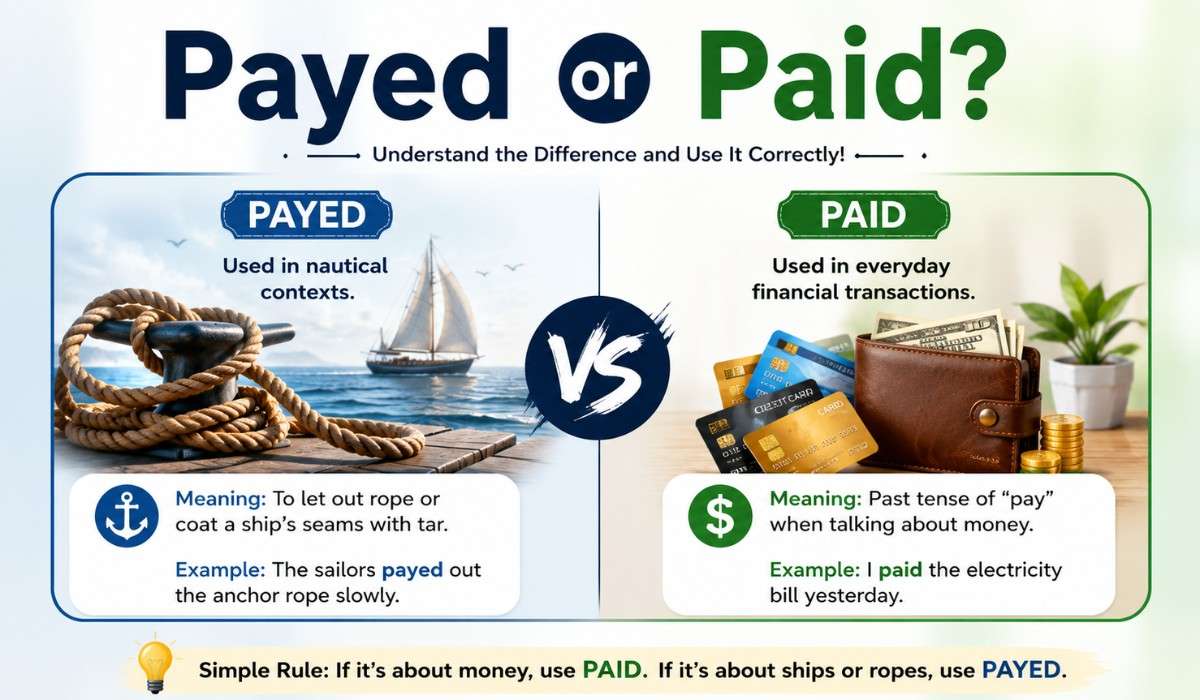
Have you ever paused while writing and wondered whether to use “payed” or “paid”? You’re not alone. These two words often confuse English learners, students, professionals, and even native speakers because they look similar. However, only one of them is correct in most everyday situations. The simple answer is that “paid” is the correct past tense and past participle of the verb “pay” when referring to money, salaries, bills, fees, or debts.
On the other hand, “payed” is a rare word used mainly in nautical contexts, where it means letting out rope or coating a ship’s seams with tar. In this complete guide, you’ll learn the difference between payed or paid, understand when to use each word, explore grammar rules, compare examples, avoid common mistakes, and discover an easy trick to remember the correct spelling forever.
Payed or Paid: Quick Answer
If you’re in a hurry, here’s the answer:
- Paid = Correct for money, wages, bills, debts, purchases, salaries, and payments.
- Payed = Correct only in specific nautical or maritime situations.
- Payed is not the correct spelling when talking about giving money.
In everyday English, you will almost always use paid.
Payed or Paid at a Glance
| Word | Correct? | Meaning | Common Usage |
| Paid | Yes | Past tense of “pay” (money or payment) | Everyday English |
| Payed | Yes (Rare) | To let out rope or seal a ship with tar | Maritime and sailing terminology |
What Does “Paid” Mean?
Paid is the standard past tense and past participle of the verb pay. It is used whenever you’re referring to giving money, receiving wages, settling bills, paying taxes, buying products, or making any financial transaction.
It is one of the most commonly used irregular verbs in English and appears in both spoken and written communication. Whether you’re discussing rent, salaries, school fees, subscriptions, or online purchases, paid is always the correct word.
Examples of “Paid”
- She paid the electricity bill yesterday.
- I paid for dinner using my credit card.
- They paid the employees before the holiday.
- We have already paid the registration fee.
- He paid full price for the new laptop.
In all of these examples, replacing paid with payed would be grammatically incorrect.
What Does “Payed” Mean?
Unlike paid, the word payed has a very specific meaning. It is used almost exclusively in the world of ships, boats, sailing, and maritime operations.
The verb pay in nautical English has meanings that are completely different from paying money. It can refer to:
- Letting out a rope, chain, or cable.
- Covering the seams of a wooden ship with tar or pitch to make it waterproof.
Because these situations are uncommon in daily life, most people rarely encounter the word payed.
Examples of “Payed”
- The sailors payed out the anchor chain slowly.
- The crew carefully payed the rope into the water.
- Workers payed the wooden hull with hot tar before launching the ship.
Although these sentences are correct, they belong to specialized maritime vocabulary rather than everyday English.
Read Also: Crier or Cryer
Why Do People Confuse “Payed” and “Paid”?
The confusion between payed and paid comes from the fact that most regular English verbs form their past tense by adding -ed.
For example:
- Walk → Walked
- Clean → Cleaned
- Open → Opened
- Watch → Watched
Naturally, many learners assume that pay should become payed. However, pay is an irregular verb, which means it doesn’t follow the standard rule. Instead of becoming payed, it changes to paid.
This is similar to other irregular verbs such as:
| Base Verb | Past Tense |
| Say | Said |
| Make | Made |
| Sell | Sold |
| Tell | Told |
| Pay | Paid |
Learning irregular verbs takes practice, but once you know that paid is the correct form for financial transactions, the mistake becomes much easier to avoid.
Why “Paid” Is Used Almost Everywhere
If you read newspapers, books, emails, websites, or social media posts, you’ll notice that paid appears thousands of times more frequently than payed.
That’s because nearly every conversation involving money uses paid:
- Paid salary
- Paid subscription
- Paid promotion
- Paid internship
- Paid leave
- Paid invoice
- Paid advertisement
- Paid membership
- Paid parking
- Paid vacation
In contrast, payed appears mainly in historical documents, sailing manuals, naval books, and maritime dictionaries. For the average English speaker or writer, paid is the only version you’ll ever need.
Common Uses of “Paid”
Here are some situations where paid is always correct.
Paying Bills
Whether it’s electricity, water, internet, or phone bills, paid is the correct choice.
Example: I paid the electricity bill before the due date.
Paying Employees
Businesses regularly pay salaries and wages.
Example: The company paid all employees on Friday.
Buying Products
Every purchase involves payment.
Example: She paid for her groceries using a debit card.
School and College Fees
Students often pay tuition or examination fees.
Example: My parents paid my college fees last week.
Online Payments
Digital payments are now part of everyday life.
Example: I paid through UPI in just a few seconds.
Taxes and Insurance
Governments and insurance companies also use paid.
Example: He paid his annual income tax before the deadline.
Everyday Expressions That Use “Paid”
You’ll find the word paid in many common English phrases, such as:
- Paid attention
- Paid tribute
- Paid respect
- Paid leave
- Paid holiday
- Paid service
- Paid promotion
- Paid partnership
- Paid internship
- Paid subscription
Notice that every one of these uses paid, never payed.
Payed vs Paid: Key Differences
Although payed and paid come from the same verb, they have entirely different meanings and are used in different contexts. Understanding these differences will help you avoid one of the most common grammar mistakes in English.
| Feature | Paid | Payed |
| Meaning | Past tense of pay (money or payment) | To let out rope or coat a ship with tar |
| Usage | Everyday English | Maritime or nautical English |
| Common? | Yes | Very rare |
| Used for money? | Yes | No |
| Used in business? | Yes | No |
| Used in sailing? | No | Yes |
The easiest way to remember this is that if your sentence involves money, salaries, bills, shopping, or payments, the correct word is always paid.
When to Use “Paid”
Use paid whenever you’re talking about giving or receiving money or anything related to financial transactions. This includes salaries, rent, fees, taxes, subscriptions, loans, and purchases. It is the standard past tense and past participle of the verb pay in modern English.
Examples
- I paid my rent on the first day of the month.
- She paid the restaurant bill before leaving.
- They paid the workers on time.
- We paid for the movie tickets online.
- The customer paid using a credit card.
- He paid all his taxes before the deadline.
- My parents paid my university fees.
- We paid extra for express delivery.
In each of these examples, replacing paid with payed would make the sentence grammatically incorrect.
When to Use “Payed”
The word payed should only be used in specialized maritime or sailing contexts. It has nothing to do with money or financial transactions. Instead, it refers to letting out a rope, cable, or chain gradually, or sealing the seams of a wooden boat with tar to make it waterproof.
Unless you’re writing about ships, sailing, or naval operations, you’ll rarely need to use this word.
Examples
- The sailors payed out the anchor rope carefully.
- The crew payed the cable as the ship moved away from the dock.
- Workers payed the seams of the wooden vessel with tar.
- The captain instructed the crew to pay out the rope slowly.
- The old fishing boat was payed before it was launched.
These examples demonstrate the correct but uncommon use of payed.
Common Mistakes to Avoid
Many English learners accidentally write payed because they assume every verb follows the regular “-ed” rule. Here are some of the most common mistakes and their correct versions.
| Incorrect | Correct |
| I payed the bill yesterday. | I paid the bill yesterday. |
| She payed her school fees. | She paid her school fees. |
| We payed for dinner. | We paid for dinner. |
| They payed the rent. | They paid the rent. |
| He payed attention in class. | He paid attention in class. |
Remember, paid attention is the correct expression not payed attention.
Grammar Rule Explained
The verb pay is classified as an irregular verb. Unlike regular verbs that form their past tense by adding -ed, irregular verbs change their spelling.
For example:
| Base Form | Past Tense | Past Participle |
| Pay | Paid | Paid |
| Say | Said | Said |
| Make | Made | Made |
| Sell | Sold | Sold |
| Buy | Bought | Bought |
Since pay is irregular, its correct past tense is paid, not payed.
Quick Tip to Remember
Ask yourself one simple question before writing:
“Is this sentence about money or payment?”
- If the answer is Yes, use paid.
- If the answer is No, and you’re talking about ropes, ships, or sailing, then payed may be correct.
This simple trick can help you avoid the mistake every time.
Real-Life Examples of “Paid”
The following examples show how paid is correctly used in everyday English.
Money and Shopping
- I paid for my groceries using a debit card.
- She paid cash for the new smartphone.
- They paid the hotel bill before checking out.
- We paid extra for faster delivery.
- He paid for everyone’s lunch.
Office and Business
- The company paid employee salaries on time.
- Our client paid the invoice within seven days.
- She paid the annual membership fee.
- We paid the vendor through bank transfer.
- The business paid all outstanding taxes.
School and Education
- My parents paid my tuition fees.
- He paid the examination fee online.
- They paid for the training course.
- I paid the library fine yesterday.
- She paid the hostel charges before moving in.
Daily Conversations
- Thanks, I already paid.
- Have you paid the electricity bill?
- We paid for our tickets in advance.
- She paid attention during the meeting.
- He paid respect to the national flag.
Real-Life Examples of “Payed”
Although rarely used, these examples demonstrate the proper nautical use of payed.
- The sailors payed out the anchor rope slowly.
- The crew payed the cable into the sea.
- Workers payed the seams of the wooden boat with tar.
- The captain instructed the team to pay out more rope.
- The old ship was carefully payed before its voyage.
Unless you’re writing about ships or sailing, you are unlikely to use these sentences in everyday communication.
Practice Exercise
Test your understanding by choosing the correct word.
1. I ______ my electricity bill yesterday.
Answer: Paid
2. She ______ for the concert tickets online.
Answer: Paid
3. The sailors ______ out the rope before docking.
Answer: Payed
4. We have already ______ the registration fee.
Answer: Paid
5. The crew carefully ______ the seams of the wooden ship.
Answer: Payed
6. They ______ their employees every Friday.
Answer: Paid
Frequently Asked Questions (FAQs)
Q1. Is “paid” or “payed” the correct past tense of “pay”?
In almost every situation, paid is the correct past tense and past participle of the verb pay. It is used when talking about money, bills, salaries, fees, purchases, or any type of financial transaction. Payed is only correct in specialized nautical contexts.
Q2. Why is “payed” considered incorrect in most sentences?
Many people assume payed is the past tense because most English verbs form the past tense by adding -ed. However, pay is an irregular verb, so its correct past tense is paid. Unless you’re referring to ships, ropes, or sailing, payed is generally incorrect.
Q3. Can I write “I payed the bill”?
No. The correct sentence is “I paid the bill.” Since the sentence involves money, paid is the only grammatically correct choice.
Q4. When should I use “payed”?
You should use payed only when writing about maritime or nautical activities. It refers to letting out a rope or cable or sealing the seams of a wooden ship with tar. This usage is rare and is unlikely to appear in everyday writing.
Q5. How can I easily remember the difference between “paid” and “payed”?
A simple trick is to ask yourself whether the sentence is about money. If it is, always use paid. If the sentence is about ships, ropes, or sailing, then payed may be the correct word.
Q6. Is “paid” used in business and professional writing?
Yes. Paid is the standard spelling used in business emails, contracts, invoices, advertisements, banking, education, accounting, and everyday communication. It is the form recognized in formal and informal English.
Read Also: Best Pickup Lines
Conclusion
Understanding the difference between payed or paid is essential for writing clear and grammatically correct English. Although the two words look similar, their meanings and uses are completely different. Paid is the correct spelling whenever you’re referring to money, bills, salaries, fees, purchases, or any financial transaction. It is the form used in everyday English and is accepted in professional, academic, and casual writing.
On the other hand, payed is a specialized nautical term that appears mainly in maritime contexts. By remembering that money always means “paid”, you can confidently avoid one of the most common spelling mistakes in English. Whether you’re writing an email, completing an assignment, publishing a blog post, or communicating at work, using the correct form will make your writing more accurate and professional.
