
Have you ever typed “loosing” and “losing” and wondered which spelling is correct? You are not alone. These two words look almost identical, but they come from different verbs and have completely different meanings. This small spelling difference can easily cause confusion in emails, school assignments, social media posts, and professional writing.
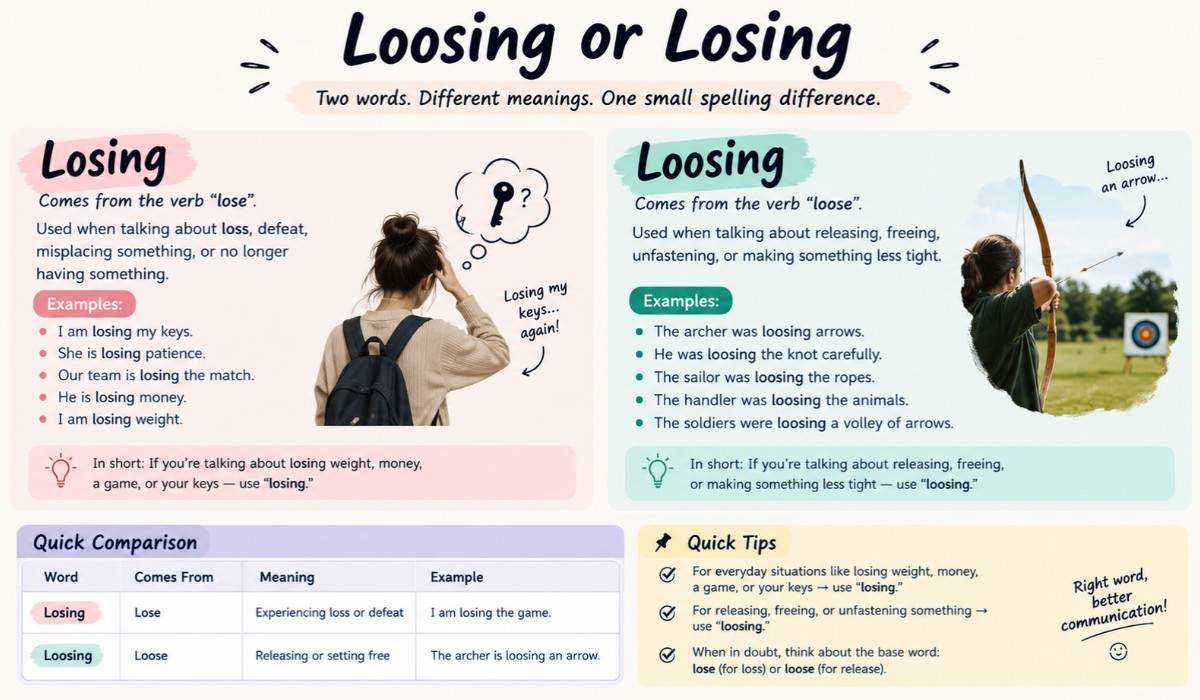
The good news is that understanding the difference between loosing or losing is quite simple once you look at their base words. “Losing” comes from “lose” and is used when talking about loss, defeat, misplacing something, or no longer having something. “Loosing,” on the other hand, comes from “loose” and means releasing, freeing, or making something less tight.
Loosing or Losing: Quick Answer
If you are wondering whether to write “loosing” or “losing,” the answer depends on what you mean. In most everyday situations, “losing” is the word you need. It is used for situations involving loss, defeat, misplacement, or a reduction in something. “Loosing” is also a real English word, but it is much less common. It is the present participle of “loose” and can mean releasing, freeing, unfastening, or letting something fly.
| Word | Comes From | Meaning | Example |
| Losing | Lose | Experiencing loss or defeat | I am losing the game. |
| Loosing | Loose | Releasing or setting free | The archer is loosing an arrow. |
So, if you are talking about losing weight, losing money, losing a game, or losing your keys, use “losing.”
Read Also: Showed or Shown || Truth or Dares || Chosing or Choosing
What Does Losing Mean?
“Losing” is the present participle of the verb “lose.” The word can describe several situations, including failing to win, misplacing something, no longer having something, or experiencing a reduction.
For example, when someone says, “I am losing my phone,” they mean they cannot find or keep track of their phone. Similarly, “Our team is losing the match” means the team is currently behind or being defeated. The meaning changes slightly depending on the context, but the central idea involves loss or failure to retain something.
Examples of Losing
Here are some common examples of “losing”:
- I am losing my keys.
- She is losing patience.
- Our team is losing the match.
- He is losing money.
- They are losing valuable time.
- She is losing interest in the project.
- I am losing weight.
- The company is losing customers.
These are all everyday uses of “losing.” In each example, something is being lost, reduced, or no longer maintained.
What Does Loosing Mean?
“Loosing” comes from the verb “loose.” Unlike “losing,” it is associated with releasing, freeing, unfastening, or making something less tight. Cambridge Dictionary identifies “loosing” as the present participle of “loose.” The word is much less common in everyday conversation, which is one reason people often assume that “loosing” is simply a misspelling of “losing.” However, it is a legitimate word when used in the right context.
For example, an archer can be described as “loosing an arrow,” meaning the archer is releasing the arrow from a bow. Someone can also “loose a knot,” meaning they make the knot less tight or undo it.
Examples of Loosing
Here are some examples where “loosing” can be correct:
- The archer was loosing arrows at the target.
- He was loosing the knot carefully.
- The sailor was loosing the ropes.
- The handler was loosing the animals from the enclosure.
- The soldiers were loosing a volley of arrows.
These examples have nothing to do with defeat or misplacing something. Instead, they involve releasing or making something less tight.
Difference Between Loosing and Losing
The easiest way to understand the difference between loosing or losing is to look at their base verbs.
“Losing” comes from “lose.” The verb “lose” is used when something is no longer possessed, when someone fails to win, or when something decreases.
“Loosing” comes from “loose.” The verb “loose” can mean to release something, free something, make something less tight, or let something fly.
| Situation | Correct Word | Example |
| Not winning a game | Losing | We are losing the game. |
| Misplacing an item | Losing | She is losing her phone. |
| Weight going down | Losing | He is losing weight. |
| Money decreasing | Losing | The business is losing money. |
| Releasing an arrow | Loosing | The archer is loosing an arrow. |
| Making a knot less tight | Loosing | She is loosing the knot. |
| Setting something free | Loosing | They are loosing the animals. |
The key is to focus on the meaning rather than the spelling alone.
Why Do People Confuse Loosing and Losing?
The main reason for the confusion is that “lose” and “loose” look extremely similar. Both begin with “lo” and contain the same basic letters, while their -ing forms differ by only one extra “o.” Another reason is that the pronunciation can make the distinction difficult, especially when people hear the words quickly. Because of this, someone may assume that “loosing” is the natural -ing form of “lose.” However, the correct form is “losing.”
The basic word forms make the difference easier to remember:
- Lose → Losing
- Loose → Loosing
Once you remember these two patterns, many spelling mistakes become easier to avoid.
Is Loosing a Correct Word?
Yes, “loosing” is a correct English word. It is not simply an incorrect spelling of “losing.” Its use, however, is relatively uncommon in everyday English. Cambridge Dictionary lists “loosing” as the present participle of “loose” and provides uses involving releasing, making something less tight, expressing emotions, and letting something fly.
This means that saying “loosing is always wrong” would not be accurate. Instead, the important point is that “loosing” should only be used when the meaning comes from the verb “loose.”
For example:
- “The archer is loosing arrows.”
This sentence is grammatically possible because the archer is releasing arrows.
However:
- “I am loosing my keys.”
is incorrect if the intended meaning is that the person cannot find the keys. The correct sentence is:
- “I am losing my keys.”
Is It Losing Weight or Loosing Weight?
The correct phrase is “losing weight.”
When someone says they are “losing weight,” they mean their body weight is decreasing. The verb being used is “lose,” so the correct present participle is “losing.”
Correct:
- “I am losing weight.”
Incorrect:
- “I am loosing weight.”
The extra “o” changes the word into a form of “loose,” which does not express the intended meaning. This is one of the most common mistakes involving these two words.
Is It Losing Money or Loosing Money?
The correct phrase is “losing money.”
For example:
- “The company is losing money.”
This means the company is experiencing a financial loss. Since the meaning relates to loss, the verb “lose” is required.
“Loosing money” would not communicate this meaning correctly. The word “loosing” relates to releasing or making something less tight, not experiencing financial loss.
Is It Losing the Game or Loosing the Game?
The correct phrase is “losing the game.”
For example:
- “Our team is losing the game.”
This means the team is currently being defeated or is behind its opponent.
Using “loosing” would be incorrect in this context because the sentence is about defeat rather than releasing something. The same rule applies to sports, competitions, contests, and other situations where someone is not winning.
More Examples
Correct:
- India is losing the match.
- The team is losing by ten runs.
- We are losing the competition.
- She is losing the race.
Incorrect:
- India is loosing the match.
- The team is loosing by ten runs.
- We are loosing the competition.
- She is loosing the race.
Losing vs Loose vs Loosing
Another reason people struggle with this topic is the similarity between “lose,” “loose,” “losing,” and “loosing.” Although they look alike, they have different grammatical functions and meanings.
“Lose” is a verb. It can mean to misplace something, fail to win, or no longer have something.
“Loose” can be an adjective meaning not firmly fixed or tight. It can also be used as a verb meaning to release or make something less tight.
- “Losing” is the -ing form of “lose.”
- “Loosing” is the -ing form of “loose.”
| Word | Meaning | Example |
| Lose | Misplace, fail to keep, or fail to win | Don’t lose your phone. |
| Loose | Not tight | The shirt is loose. |
| Losing | Experiencing loss or defeat | We are losing the match. |
| Loosing | Releasing or making less tight | He is loosing the rope. |
Understanding the base word makes the correct spelling much easier.
Common Mistakes With Loosing or Losing
One of the most common mistakes is writing “loosing” when discussing weight.
- Wrong: “She is loosing weight.”
- Correct: “She is losing weight.”
Another common mistake appears in sports.
- Wrong: “Our team is loosing the match.”
- Correct: “Our team is losing the match.”
People also frequently use “loosing” when talking about money.
- Wrong: “The company is loosing money.”
- Correct: “The company is losing money.”
The opposite mistake can also happen. When someone is actually describing the release of something, “loosing” may be appropriate.
For example:
- “The archer is loosing an arrow.”
Here, “loosing” comes from “loose” and describes the release of an arrow.
How to Remember Losing and Loosing
A simple trick is to remember the base verbs.
- Lose → Losing
- Loose → Loosing
Think about “losing” whenever the sentence involves loss. If someone is losing a game, losing money, losing weight, losing keys, or losing patience, use “losing.”
Think about “loosing” only when something is being released, freed, or made less tight. This situation is much less common in everyday writing.
You can also remember it this way:
- Loss = Losing
- Release = Loosing
This simple association can help you choose the correct word quickly.
Loosing or Losing in Everyday Writing
In normal conversations, emails, articles, school assignments, and social media posts, “losing” is far more likely to be the word you need.
Consider these everyday sentences:
- “I am losing my patience.”
- “She is losing her phone again.”
- “We are losing valuable time.”
- “The company is losing customers.”
- “He is losing confidence.”
None of these sentences should use “loosing.”
On the other hand, “loosing” tends to appear in more specific contexts involving release or unfastening. It can be appropriate in historical writing, descriptions of archery, literary writing, or situations involving the release of something.
Examples of Losing in Sentences
Here are several examples to make the difference clearer:
- I keep losing my keys.
- She is losing interest in the subject.
- We are losing the match.
- The company is losing customers.
- He is losing confidence.
- They are losing valuable time.
- I am losing track of the conversation.
- The team is losing momentum.
- She is losing weight.
- He is worried about losing his job.
In every example, the meaning is connected with something being lost, reduced, or no longer retained.
Examples of Loosing in Sentences
Although “loosing” is less common, it can be used correctly in specific contexts:
- The archer was loosing arrows at the target.
- She was loosing the tight knot.
- The sailor was loosing the ropes.
- The trainer was loosing the horses into the field.
- The soldiers were loosing arrows toward the enemy.
The important point is that these examples involve releasing, freeing, or making something less tight.
A Simple Rule to Avoid the Mistake
The easiest rule is:
- Use “losing” for loss.
- Use “loosing” for release.
If you can replace the word with “suffering a loss,” “misplacing,” “failing to win,” or “no longer having,” use “losing.”
If you can replace it with “releasing,” “freeing,” “unfastening,” or “making less tight,” “loosing” may be the right choice.
This rule works for most situations and is easier to remember than trying to memorize every possible example.
Frequently Asked Questions
Q1. Is “loosing” or “losing” correct?
Both words are correct, but they have different meanings. “Losing” comes from “lose” and refers to experiencing loss, defeat, misplacement, or reduction. “Loosing” comes from “loose” and refers to releasing, freeing, or making something less tight.
Q2. Is it losing weight or loosing weight?
The correct phrase is “losing weight.” Since the meaning is that someone’s weight is decreasing, the word comes from “lose.” “Loosing weight” is incorrect for this meaning.
Q3. Is “loosing” a real word?
Yes. “Loosing” is a real English word and is the present participle of “loose.” It can describe releasing something, making something less tight, or letting something fly.
Q4. Is it losing a game or loosing a game?
The correct phrase is “losing a game.” It describes a person or team being defeated or failing to win. “Loosing a game” does not have the intended meaning.
Q5. What is the easiest way to remember losing vs. loosing?
Remember the base verbs: “lose → losing” and “loose → loosing.” Use “losing” when something involves loss and “loosing” when something is being released or made less tight.
Q6. Is “loosing” a common word?
“Loosing” is valid English but is considerably less common in everyday writing than “losing.” Most everyday situations involving loss, defeat, misplacement, or reduction require “losing.”
Conclusion About Loosing or Losing
The difference between loosing or losing becomes much easier once you understand their base verbs. “Losing” comes from “lose” and is used when talking about loss, defeat, misplacement, reduction, or no longer having something. “Loosing” comes from “loose” and refers to releasing, freeing, unfastening, or making something less tight.
For everyday writing, “losing” is the word you will use most often. Remember the simple pattern: lose becomes losing, while loose becomes loosing. So write “losing weight,” “losing money,” “losing the game,” and “losing my keys.” Use “loosing” only when the sentence genuinely describes the act of releasing or loosening something.
Read Also: Seal vs Seel || Flakey or Flaky || Finaly or Finally
