
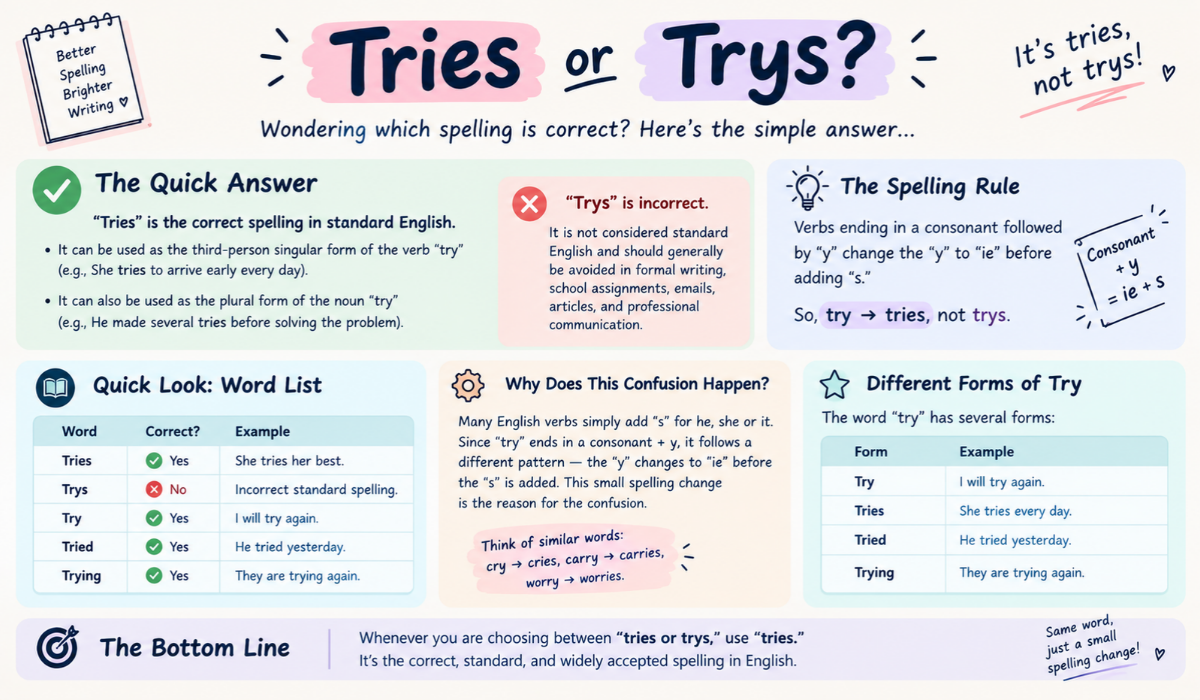
When you are unsure whether to write “tries” or “trys,” the correct spelling is “tries.” “Tries” is the third-person singular form of the verb “try” and is also the plural form of the noun “try.” The spelling “trys” is not considered standard English and should generally be avoided in formal writing, school assignments, emails, articles, and professional communication. Understanding the spelling rule behind “tries” makes it much easier to remember and use correctly.
The confusion usually happens because many English verbs simply add “s” when they refer to he, she, or it. However, “try” follows a different spelling pattern because it ends in a consonant followed by “y.” In this case, the “y” changes to “ie” before the “s” is added, giving us “tries.” Once you understand this simple rule, choosing between “tries or trys” becomes much easier.
The Quick Answer
“Tries” is the correct spelling in standard English. It can be used when talking about someone making an attempt, such as “She tries to arrive early every day.” It can also be used as a noun, as in “He made several tries before solving the problem.”
“Trys” is not the standard plural or third-person singular form of “try.” Although people sometimes type it because they apply the common rule of simply adding “s,” it is considered a spelling mistake in standard English. Therefore, whenever you are choosing between “tries or trys,” use “tries.”
| Word | Correct? | Example |
| Tries | Yes | She tries her best. |
| Trys | No | Incorrect standard spelling |
| Try | Yes | I will try again. |
| Tried | Yes | He tried yesterday. |
| Trying | Yes | They are trying again. |
Read Also: Hussle vs Hustle || Showed or Shown || Seal vs Seel
Why Does This Confusion Happen?
One reason people write “trys” is that English often forms the third-person singular of a verb by adding “s.” For example, “walk” becomes “walks,” “play” becomes “plays,” and “read” becomes “reads.” Because of this familiar pattern, it can seem logical to change “try” into “trys.”
However, verbs ending in a consonant plus “y” follow a different spelling rule. The final “y” changes to “ie” before the “s” is added. Therefore, “try” becomes “tries,” not “trys.” This small spelling change is responsible for much of the confusion surrounding the phrase “tries or trys.”
The Role of the Letter Y
The letter “y” behaves differently depending on the letters that come before it. When a verb ends in a consonant followed by “y,” the “y” usually changes to “ie” when forming the third-person singular present tense.
For example, “cry” becomes “cries,” “carry” becomes “carries,” and “worry” becomes “worries.” Since “try” follows the same pattern, its correct form is “tries.” Remembering these similar examples can make the rule easier to apply.
Where Does “Try” Come From?
The verb “try” means to make an effort to do something, test something, or attempt to achieve a particular result. It is a very common English word and can be used in everyday conversations as well as formal writing.
For example, someone might say, “I will try to finish the work today.” Another person could say, “She wants to try a different method.” The word can describe both a physical effort and an attempt to solve a problem or achieve a goal.
Different Forms of Try
The word “try” has several grammatical forms. The present form is “try,” the past tense is “tried,” the present participle is “trying,” and the third-person singular present form is “tries.”
Understanding these forms can help prevent spelling mistakes. For example, “I try,” “she tries,” “they tried,” and “we are trying” are all correct constructions. The form changes according to the grammatical role of the word.
| Form | Example |
| Try | I will try again. |
| Tries | She tries every day. |
| Tried | He tried yesterday. |
| Trying | They are trying again. |
How “Tries” Is Actually Used
“Tries” is mainly used as the third-person singular form of the verb “try,” meaning that someone makes an effort or attempts to do something. For example, “She tries to finish her work on time” and “He tries to stay positive” are both correct. It is also used as the plural form of the noun “try,” referring to more than one attempt.
The spelling “tries” follows the rule for verbs ending in a consonant followed by “y.” The final “y” changes to “ie” before the letter “s” is added. This is why we write “tries,” not “trys,” just as we write “cries” instead of “crys” and “carries” instead of “carrys.”
Tries as a Verb
“Tries” is commonly used as a verb when the subject is singular and refers to he, she, or it. For example, “He tries to exercise every morning” uses “tries” correctly because the subject is “he.”
Another example is, “The company tries to provide better service.” Here, “company” is singular, so “tries” is the appropriate verb form. In both cases, the spelling follows the consonant-plus-y rule.
Tries as a Noun
“Tries” can also be the plural form of the noun “try.” In this context, it refers to multiple attempts or efforts. For example, “She made three tries before opening the jar” uses “tries” as a noun.
You may also see the noun form in sentences such as “After several tries, he finally solved the puzzle.” The meaning is related to attempts, but the grammatical role is different from the verb form.
Is “Trys” Ever Correct?
In standard English, “trys” is not the accepted spelling of the third-person singular form of “try.” Writing “He trys to help” is considered incorrect because the final “y” should change to “ie” before the “s.”
The same rule applies in both formal and informal standard English. Whether you are writing a school assignment, website article, business email, or social media post, “tries” is the spelling you should normally use.
Are There Exceptions?
You may occasionally see “trys” in usernames, brand names, informal online writing, typos, or other contexts where someone intentionally changes a word’s spelling. Such uses do not make “trys” the standard English form.
If you are writing according to normal English spelling rules, there is no need to use “trys.” When in doubt, remember that “try” changes to “tries” when the third-person singular form is required.
Common Mistakes People Make
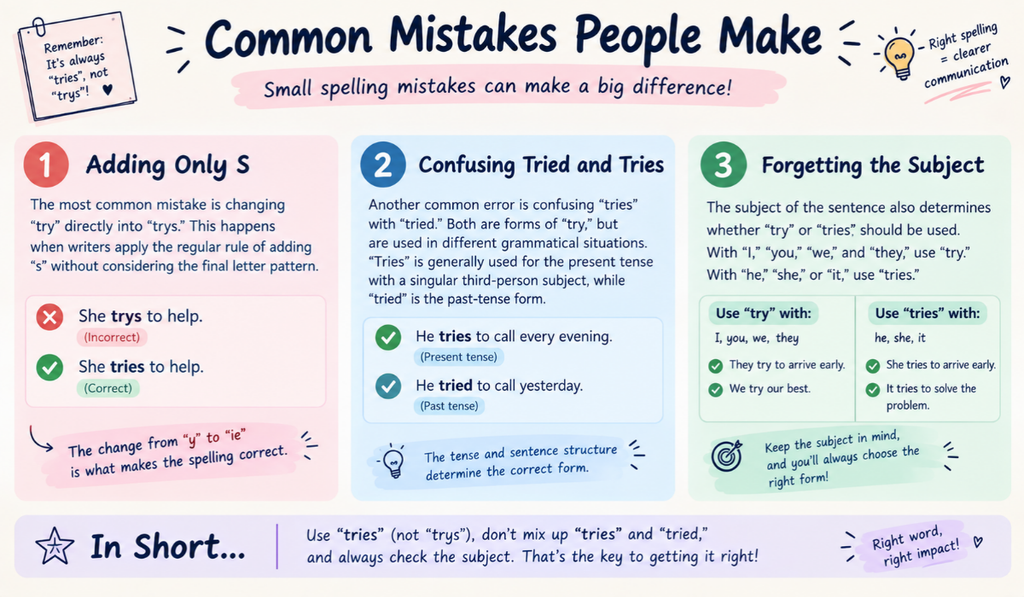
One of the most common mistakes is writing “trys” instead of “tries.” This usually happens because people assume they can simply add “s” to the word “try,” as they do with words like “read” and “reads.” However, because “try” ends in a consonant followed by “y,” the “y” changes to “ie” before adding “s,” making “tries” the correct spelling.
Another mistake is confusing “tries” with other forms of “try,” such as “tried” and “trying.” “Tries” is used for present-tense sentences with a singular third-person subject, while “tried” refers to the past and “trying” describes an ongoing action. Understanding these forms can help you avoid common errors when deciding between “tries or trys.”
Mistake 1: Adding Only S
The most common mistake is changing “try” directly into “trys.” This happens when writers apply the regular rule of adding “s” without considering the final letter pattern.
For example, “She trys to help” is incorrect. The correct sentence is “She tries to help.” The change from “y” to “ie” is what makes the spelling correct.
Mistake 2: Confusing Tried and Tries
Another common error is confusing “tries” with “tried.” Both are forms of “try,” but they are used in different grammatical situations. “Tries” is generally used for the present tense with a singular third-person subject, while “tried” is the past-tense form.
For example, “He tries to call every evening” describes a present or habitual action. “He tried to call yesterday” describes an action that happened in the past. Choosing the correct form depends on the tense and sentence structure.
Mistake 3: Forgetting the Subject
The subject of the sentence also determines whether “try” or “tries” should be used. With “I,” “you,” “we,” and “they,” use “try.” With “he,” “she,” or “it,” use “tries.”
For example, “They try to arrive early” is correct, while “She tries to arrive early” is also correct. Paying attention to the subject can help you select the right form automatically.
A Way To Easily Remember This Rule
A simple way to remember the correct spelling is to focus on the final “y” in “try.” When a verb ends with a consonant followed by “y,” the “y” usually changes to “ie” before adding “s.” That gives us “try → tries,” just like “cry → cries” and “carry → carries.”
You can also remember the phrase “consonant + y changes to ies.” Whenever you are confused about “tries or trys,” apply this rule before adding the ending. Once you learn a few examples, the correct spelling “tries” becomes much easier to remember and use in everyday writing.
Remember the Consonant + Y Rule
A simple way to remember “tries or trys” is to look at the letter immediately before the final “y.” In “try,” the letter before “y” is “r,” which is a consonant. When a verb ends in a consonant plus “y,” the “y” usually changes to “ie” before adding “s.”
You can remember the pattern with a few familiar examples: try becomes tries, cry becomes cries, carry becomes carries, and study becomes studies. Seeing these words together makes the spelling pattern easier to recognize.
Use the “Tries” Test
Whenever you are unsure, place “he” or “she” before the word. If the sentence describes a current or habitual action, the correct form is “tries.” For example, “She tries to understand” sounds natural, while “She trys to understand” does not follow standard spelling.
This quick test can be useful when writing quickly. Instead of wondering whether “trys” looks right, think about similar words such as “cries” and “carries.” The same spelling pattern applies to “tries.”
Why Getting This Right Matters
Using the correct spelling “tries” helps make your writing clear, professional, and easy to understand. Although “trys” may look like a simple spelling variation, it is not the standard English form. Using “tries” correctly is especially important in school assignments, professional emails, website content, and other formal writing.
Correct spelling also helps readers understand your message without unnecessary distractions. When you know the rule behind “try → tries,” you can avoid a common mistake and write more confidently. Learning small grammar and spelling rules like this can gradually improve the overall quality of your English writing.
Clear and Professional Writing
Correct spelling makes your writing easier to understand and gives readers confidence in the quality of the content. A small mistake such as “trys” can stand out because the correct form “tries” is very common in everyday English.
This matters particularly in professional emails, educational writing, websites, resumes, and other published content. Using “tries” correctly helps your writing follow standard English conventions.
Better Communication
Spelling rules are not only about avoiding mistakes. They also help readers understand your message without distractions. When common words are spelled correctly, readers can focus on the meaning rather than stopping to question the spelling.
If you regularly create online content, knowing the difference between “tries or trys” can also improve the overall quality of your writing. Correct grammar and spelling contribute to clearer and more polished communication.
FAQs About Tries or Trys
Q1. Is “trys” ever correct?
“Trys” is not the standard English spelling of the third-person singular form of “try.” The correct form is “tries.” You may see “trys” in usernames, informal content, or as a typing mistake, but it should generally be avoided in standard writing.
Q2. Can “tries” be a noun?
Yes. “Tries” can be the plural form of the noun “try,” meaning multiple attempts. For example, “He made several tries before completing the task” uses “tries” as a noun.
Q3. Is “trys” an informal spelling?
It can appear as an informal or intentional spelling in certain online contexts, but it is not the standard form. If you want to follow conventional English spelling, use “tries” instead.
Q4. How do I recall the spelling?
Remember the consonant-plus-y rule. Words such as “try,” “cry,” and “carry” change their final “y” to “ie” before “s” is added. Therefore, try becomes tries.
Q5. What is the difference between “try” and “tries”?
“Try” is used with subjects such as “I,” “you,” “we,” and “they,” while “tries” is generally used with “he,” “she,” or “it.” For example, “They try to help” and “She tries to help” are both correct.
Q6. Is “tries” both a verb and a noun?
Yes. “Tries” can be a verb, as in “She tries to help,” or a plural noun, as in “He made several tries.” Its meaning and grammatical role depend on how it is used in the sentence.
Conclusion
When choosing between “tries or trys,” the correct standard English spelling is “tries.” The word “tries” is used as the third-person singular form of the verb “try” and can also serve as the plural form of the noun “try.” The spelling “trys” is generally considered incorrect in standard English.
The easiest way to remember the rule is to focus on the final “y.” Because “try” ends with a consonant followed by “y,” the “y” changes to “ie” before “s” is added. Once you remember examples such as “try → tries,” “cry → cries,” and “carry → carries,” this spelling becomes much easier to recall.
Read Also: Flakey or Flaky || Finaly or Finally || Persue vs Pursue
