
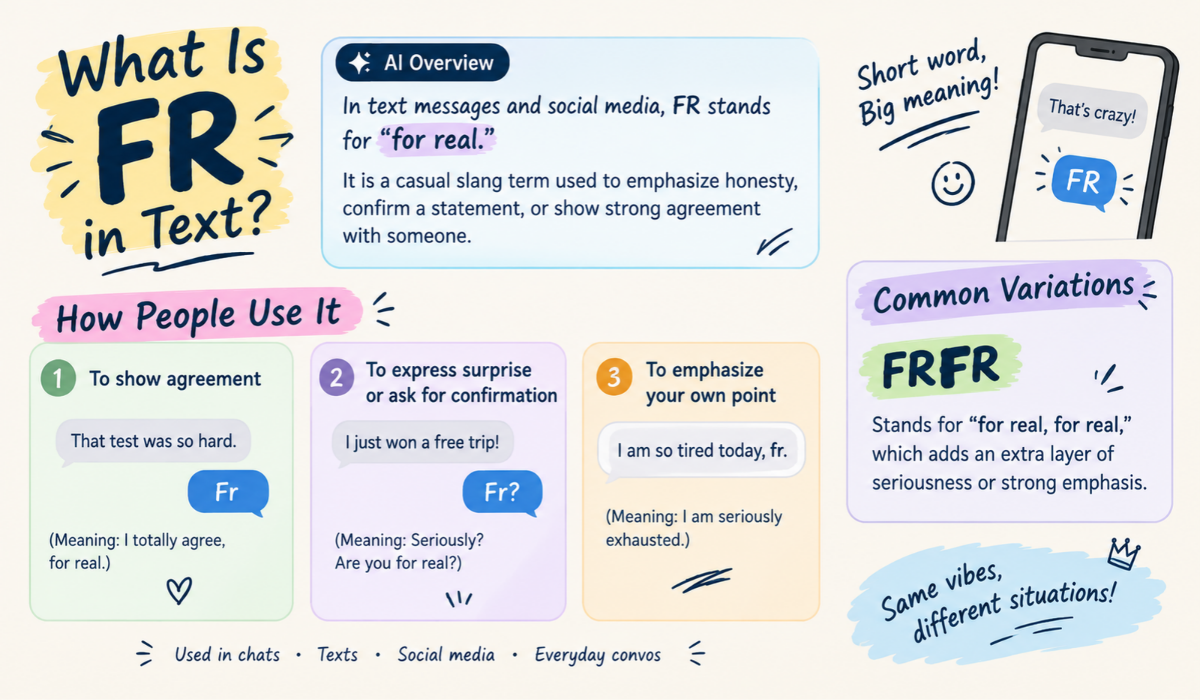
What is FR in text? In texting, social media, and online conversations, FR usually stands for “for real.” It is a casual slang abbreviation people use to show agreement, emphasize honesty, confirm something, or express that they genuinely mean what they are saying. For example, if someone says, “That test was so hard,” replying “FR” means “for real” or “I totally agree.” Depending on the context, “FR?” can also mean “Seriously?” or “Are you for real?” while adding “fr” at the end of a sentence can strengthen the statement. Another common variation is FRFR, meaning “for real, for real,” which adds extra emphasis.
The abbreviation FR is especially common in text messages, TikTok comments, social media posts, chats, and other informal online conversations. Its meaning is generally easy to understand from the surrounding message, but punctuation can slightly change its tone. “FR” often shows agreement, while “FR?” can express surprise or ask someone to confirm what they said. Understanding these small differences can help you interpret online conversations more naturally.
What Does FR Mean in Text?
FR in text means “for real.” It is an informal abbreviation used when someone wants to agree with another person, emphasize a statement, or show that something is genuine or serious. Because it is short and easy to type, FR has become a common part of casual digital communication.
The exact feeling behind FR depends on the conversation. Someone replying only with “FR” is usually agreeing with what another person said, while “FR?” can sound like a question asking whether something is actually true. When someone places “fr” at the end of their own sentence, it usually adds emphasis to their statement.
| FR Usage | Meaning |
| FR | For real / I agree |
| FR? | For real? / Seriously? |
| fr | Seriously / genuinely |
| FRFR | For real, for real |
| fr fr | Strong agreement or emphasis |
FR Meaning in Simple Words
In simple words, FR is a quick way of saying “for real.” It can replace phrases such as “seriously,” “I agree,” “honestly,” or “that is true,” depending on how it is used. The abbreviation is most common in relaxed conversations rather than formal writing.
For example, if your friend says, “This movie was amazing,” and you respond with “FR,” you are agreeing with them. If your friend tells you something surprising and you ask “FR?”, you are asking whether they are serious or whether the information is actually true.
Read Also: Aging Like Fine Wine Quotes || NTM Meaning in Text || Hard Launch Meaning
How Is FR Used in Text Messages?
FR is commonly used in text messages to make conversations shorter and more casual. People can use it as a complete response or include it within a longer sentence. Its meaning normally depends on the statement that comes before or after it. The abbreviation is especially useful when someone wants to show immediate agreement without writing a full sentence. Instead of typing “I completely agree with you,” a person may simply reply “FR.” This makes the conversation feel quick, natural, and informal.
FR to Show Agreement
One of the most common uses of FR is to show agreement. When someone makes a statement that you strongly agree with, replying “FR” communicates that you feel the same way.
For example, consider this conversation:
- Person A: “That test was so hard.”
- Person B: “FR.”
Here, “FR” means “for real” and expresses strong agreement. Person B is essentially saying that they also thought the test was very difficult.
FR to Emphasize a Statement
People can also add FR to the end of their own messages when they want to emphasize what they are saying. In this usage, it works similarly to “seriously” or “genuinely.”
For example:
- “I am so tired today, fr.”
- “That was the funniest video, fr.”
- “I really need a vacation, fr.”
In each example, FR reinforces the statement. It tells the reader that the speaker genuinely feels that way and is not simply making a casual comment.
What Does FR Mean With a Question Mark?
When written as “FR?”, the abbreviation can have a slightly different meaning. Instead of simply showing agreement, it can be used to express surprise, disbelief, or a request for confirmation. In this context, FR can mean “For real?” or “Are you serious?” For example, if someone says, “I just won a free trip!” the other person might respond, “FR?” This response indicates that they are surprised and want confirmation that the statement is actually true.
Examples of FR?
Here are some common examples of how FR? can appear in conversations:
| Message | Possible Meaning |
| “I got tickets for the concert.” | “FR?” = Really? |
| “She is moving to another city.” | “FR?” = Is that actually true? |
| “I met my favorite actor today.” | “FR?” = Seriously? |
| “We finished the project already.” | “FR?” = Really? |
The question mark is important because it changes the tone from simple agreement to a question. Without the question mark, “FR” is more commonly understood as agreement or emphasis.
What Does FR Mean on Social Media?
On social media, FR is often used in comments, captions, direct messages, and replies. People use it to agree with posts, emphasize their opinions, or react to something that feels relatable or true. It can appear on platforms such as TikTok and other social networking sites. Social media conversations often rely on short expressions, and FR fits naturally into this style. A person may comment “FR” under a relatable post to say they completely agree with it. They may also use “fr” in a caption or comment to emphasize their feelings.
FR on TikTok
On TikTok, FR can appear in comments and casual conversations when users strongly agree with a video or another person’s comment. A simple “FR” can communicate that the person relates to or agrees with the content.
For example, if a TikTok says, “Mondays should be illegal,” someone might comment “FR.” The comment does not literally mean “for real” in a formal sense; it works as a quick way to say, “I completely agree.”
FR in Instagram and Other Social Apps
FR can also be used on Instagram, Snapchat, messaging apps, and other social platforms. Its basic meaning remains “for real,” but the tone can change depending on the conversation.
A person might use “FR” in a comment to agree with someone’s opinion or send “FR?” in a direct message when they are surprised by something. Since it is informal slang, it is generally more appropriate for casual conversations than professional communication.
What Does FR Mean in Different Contexts?
Although FR most commonly means “for real,” its conversational meaning can vary slightly depending on how it appears. The surrounding words, punctuation, and tone help determine whether the person is agreeing, emphasizing something, or asking for confirmation. Understanding the context is particularly important when FR appears by itself. A standalone “FR” usually indicates agreement, while “FR?” generally asks whether something is true. When used at the end of a sentence, it usually strengthens the speaker’s statement.
FR as Agreement
When someone replies “FR” to another person’s message, it commonly means “for real” and shows agreement.
Example:
“Delhi traffic is exhausting.”
“FR.”
The second person is agreeing with the first statement and essentially saying, “That is so true.”
FR as Confirmation
When someone writes “FR?” they may be asking whether the information they received is genuine.
Example:
“I won a new phone.”
“FR?”
Here, the response means “Really?” or “Are you serious?”
FR as Emphasis
When FR is placed at the end of a statement, it can emphasize that the speaker genuinely means what they said.
Example:
“I need a break from work fr.”
The speaker is emphasizing that they genuinely need a break.
What Does FRFR Mean?
FRFR stands for “for real, for real.” It is an extended form of FR used to provide stronger emphasis. Repeating “for real” makes the expression more intense and can show that someone strongly agrees, genuinely means something, or wants the other person to take the statement seriously. FRFR is usually found in informal digital conversations. Like FR, it can be written in uppercase or lowercase depending on a person’s texting style. The lowercase version “frfr” is also very common in casual messages and social media comments.
FR vs FRFR
The main difference between FR and FRFR is the level of emphasis. FR can simply mean agreement or “for real,” while FRFR generally communicates stronger agreement or seriousness.
| Slang | Meaning | Typical Use |
| FR | For real | Agreement or emphasis |
| FR? | For real? | Surprise or confirmation |
| FRFR | For real, for real | Strong emphasis |
| fr fr | For real, for real | Casual strong agreement |
For example, “That was a great match, FR” expresses agreement or emphasis. Saying “That was the best match, FRFR” adds stronger emphasis to the statement.
Examples of FR in Texting
FR can be used in many everyday conversations because it is flexible and easy to understand from context. It can appear as a one-word response, at the end of a sentence, or as a question. The examples below show some of the most common ways people use it. Using examples is one of the easiest ways to understand the difference between FR, FR?, and FRFR. Although the abbreviation remains the same, punctuation and placement can change the conversational meaning.
Examples of FR
- “That food was amazing.”
- “FR.”
- “I am exhausted today, fr.”
- “This weather is crazy, fr.”
- “FR, I cannot believe that happened.”
- “You were right about that movie, fr.”
In these examples, FR either shows agreement or adds emphasis to the speaker’s statement.
Examples of FR?
- “I just met a celebrity.”
- “FR?”
- “We are going on vacation tomorrow.”
- “FR?”
- “He actually won the competition.”
- “FR?”
Here, the question mark indicates surprise or a request for confirmation.
Why Do People Use FR in Texting?
People use FR because online conversations are often quick and informal. Short abbreviations allow users to communicate reactions without typing complete sentences. FR is particularly convenient when someone wants to agree with another person’s statement immediately. Another reason is that slang can make conversations feel more natural and conversational. Saying “FR” may sound more relaxed than writing “I completely agree with you.” This makes it useful among friends and in social-media communities where informal language is common.
FR Saves Time
One obvious advantage of using FR is that it is much shorter than typing “for real.” In a fast-moving conversation, a three-letter abbreviation can communicate the same basic idea quickly.
For example, instead of replying, “Yes, I completely agree with what you just said,” someone can simply write “FR.” This keeps the conversation short while still communicating a clear reaction.
FR Adds a Casual Tone
FR can also make a message sound more relaxed and conversational. Texting slang is often used to create a friendly tone between people who are comfortable communicating informally.
However, FR is not normally suitable for formal emails, academic assignments, official documents, or professional communication. In those situations, writing the complete phrase or expressing the idea more formally is usually clearer.
Is FR Formal or Informal?
FR is informal internet and texting slang. It is designed for casual digital conversations rather than formal writing. Friends, social-media users, and online communities may use it frequently, but it is generally not appropriate in professional documents. If you are writing an email to a teacher, employer, customer, or business, using “for real” may still be too casual depending on the context. In formal communication, phrases such as “I agree,” “indeed,” “seriously,” or “I can confirm” may be more suitable.
Where Should You Avoid Using FR?
FR should generally be avoided in situations where clear and professional language is expected.
Examples include:
- Formal business emails
- Job applications
- Academic assignments
- Official letters
- Professional reports
- Legal documents
- Formal presentations
The abbreviation works best when the conversation is casual and the people involved understand common internet slang.
FR Meaning in Other Situations
Although “for real” is the meaning covered in this article and is common in texting and social media, abbreviations can have different meanings in different communities. The meaning of FR should therefore be interpreted according to the conversation and subject. For casual texting, however, “for real” is the meaning most directly associated with the examples provided here. Looking at the complete sentence can help determine whether FR is being used to agree, emphasize, or ask for confirmation.
Why Context Matters
Online abbreviations are often flexible, and a short expression can communicate different tones depending on punctuation. “FR,” “FR?” and “FRFR” are related but are not always interchangeable.
When you see FR in a message, first look at what was said immediately before it. If it appears as a reply to an opinion, it likely expresses agreement. If it is written with a question mark, it may be asking whether something is true.
Common FR Variations
The most common variation discussed with FR is FRFR, meaning “for real, for real.” Other differences are often created by capitalization, punctuation, and placement within a sentence rather than by changing the basic abbreviation.
These variations help people communicate subtle differences in tone. A simple FR can show agreement, while FRFR can make the agreement more enthusiastic or serious.
| Variation | Meaning | Tone |
| FR | For real | Casual agreement |
| fr | For real | Casual and relaxed |
| FR? | For real? | Surprise or confirmation |
| FRFR | For real, for real | Strong emphasis |
| fr fr | For real, for real | Strong casual agreement |
FAQs About What Is FR in Text
Q1. What does FR mean in text?
FR in text usually means “for real.” It is an informal slang abbreviation used to show agreement, emphasize a statement, or indicate that someone genuinely means what they are saying.
Q2. What does FR mean on TikTok?
On TikTok, FR generally means “for real.” It is commonly used in comments or replies to show agreement with a video, statement, or opinion. A simple “FR” can mean “I completely agree” or “That is so true.”
Q3. What does FR? mean in texting?
FR? usually means “For real?” or “Are you serious?” It is commonly used to express surprise or ask someone to confirm whether something they said is actually true.
Q4. What does FRFR mean?
FRFR means “for real, for real.” It is a stronger version of FR and is used to add extra emphasis, seriousness, or strong agreement to a statement.
Q5. Is FR a formal abbreviation?
No. FR is informal texting and social-media slang. It is best suited to casual conversations with friends, online communities, and social platforms rather than formal emails, academic writing, or professional documents.
Q6. Can FR mean different things?
Yes, abbreviations can have different meanings depending on the context or community. However, in the texting and social-media context covered here, FR commonly means “for real.” Looking at the surrounding message can help determine the intended tone.
Conclusion
If you are wondering what is FR in text, the most common meaning is “for real.” It is a casual abbreviation used to agree with someone, emphasize a statement, show that something is genuine, or ask for confirmation when written as “FR?” The meaning becomes even stronger with FRFR, which stands for “for real, for real.”
FR is popular because it is short, easy to type, and fits naturally into informal digital conversations. Whether you see it in a text message, TikTok comment, Instagram conversation, or online chat, the surrounding context usually makes its intended meaning clear. For formal communication, however, writing the complete phrase or using more conventional language is generally a better choice.
Read Also: EMP Meaning in Text from a Girl || BWC Meaning || What Does CFS Mean in Text
