
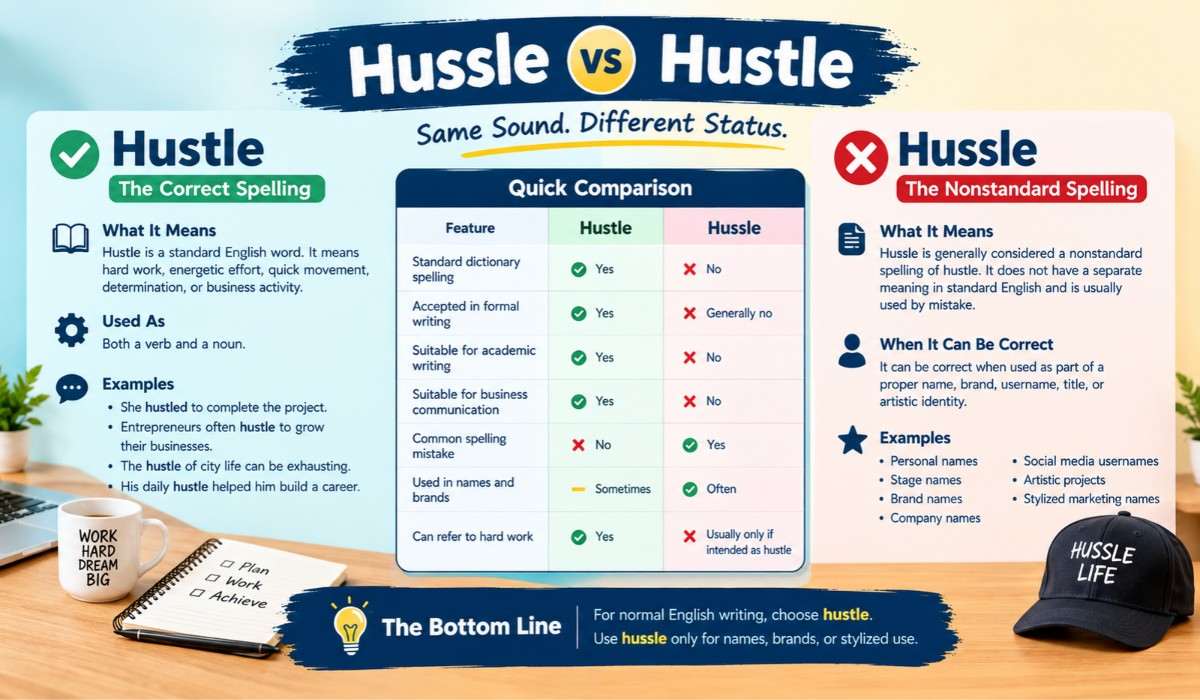
The comparison between hussle vs hustle is a common spelling confusion because both words look and sound almost identical. However, they do not have the same status in standard English. Hustle is the correct and widely accepted spelling used when talking about hard work, energetic effort, quick movement, determination, or business activity. Hussle, on the other hand, is generally considered a nonstandard spelling or misspelling of hustle, although it can be correct when used as part of a specific person’s name, brand, username, or artistic identity. Knowing the difference between these two spellings can help you avoid mistakes in professional, academic, and everyday writing.
Hussle vs Hustle: Comparison Overview
The terms hustle and hussle are frequently confused because changing one letter makes the two spellings look very similar. In standard English, however, hustle is the preferred spelling when you are describing effort, movement, work, or energetic activity.
Hussle does not normally have a separate dictionary meaning from hustle. In most cases, people who write hussle actually intend to write hustle. The spelling can still be correct when it forms part of a proper name or intentional brand identity.
| Term | Status | Meaning | Standard English Usage |
| Hustle | Standard spelling | Hard work, energetic effort, quick movement, or business activity | Yes |
| Hussle | Nonstandard spelling | Usually intended to mean hustle | No, except for names, brands, or stylized uses |
For normal English writing, hustle is the spelling you should choose.
Definition of Hustle
Hustle is a standard English word that can function as both a verb and a noun. As a verb, it can mean to work energetically, move quickly, make an effort, or push someone toward action. The exact meaning depends on the context in which it is used.
As a noun, hustle can refer to energetic activity, determined effort, busy movement, or the work someone puts into achieving a goal. In modern conversations, the word is also strongly associated with entrepreneurship, productivity, and earning money through additional work.
Examples:
- She hustled to complete the project before the deadline.
- Entrepreneurs often hustle to grow their businesses.
- The hustle of city life can be exhausting.
- His daily hustle helped him build a successful career.
Read Also: Loosing or Losing || Showed or Shown || Chosing or Choosing
Definition of Hussle
Hussle is generally considered a nonstandard spelling of hustle when it is used as an ordinary English word. It is not the spelling you should normally use when writing about hard work, effort, movement, or determination.
However, Hussle can appear correctly in certain situations when it is part of a proper name, brand, username, title, or artistic identity. A well-known example is the late American rapper Nipsey Hussle, who intentionally used Hussle as part of his stage name.
The spelling Hussle may therefore appear in:
- Personal names
- Stage names
- Brand names
- Company names
- Social media usernames
- Artistic projects
- Stylized marketing names
Outside these specific situations, hustle is the safer and correct spelling.
Main Differences Between Hustle and Hussle
Although the two spellings look nearly identical, their usage is different. Hustle is a recognized standard English word, while hussle is generally used as a nonstandard spelling or as part of a specific name.
| Feature | Hustle | Hussle |
| Standard dictionary spelling | Yes | No |
| Accepted in formal writing | Yes | Generally no |
| Suitable for academic writing | Yes | No |
| Suitable for business communication | Yes | No |
| Common spelling mistake | No | Yes |
| Used in names and brands | Sometimes | Often |
| Can refer to hard work | Yes | Usually only if intended as hustle |
The most important point is simple: if you are referring to hard work, effort, movement, or determination, use hustle.
Meaning Difference
There is normally no separate meaning difference between hussle and hustle when someone uses hussle as an ordinary English word. The person usually means hustle but has used an incorrect spelling.
For example, if someone writes, “I need to hussle to finish this work,” the intended meaning is the same as “I need to hustle to finish this work.” The second sentence uses the standard spelling.
Usage Difference
Hustle can be used in almost any normal writing situation, including:
- School assignments
- Business emails
- Articles and blogs
- Professional documents
- Everyday conversations
- Social media posts
- Books and other publications
Hussle should generally only be used when the spelling is intentionally part of a name, brand, username, or other proper identity.
Hustle as a Verb and Noun
One reason hustle is sometimes confusing is that it can work as both a verb and a noun. Its meaning changes slightly depending on how it functions in a sentence.
| Part of Speech | Example |
| Verb | You need to hustle to meet the deadline. |
| Verb | She hustled across the street. |
| Noun | His hustle helped him achieve his goals. |
| Noun | The hustle of downtown never stops. |
As a verb, hustle often emphasizes action or movement. As a noun, it can describe the effort, activity, or determination involved in achieving something.
Common Contexts Where Hustle Is Used
Hustle appears in many different areas of everyday English. Its meaning can range from simply moving quickly to working hard toward a personal or professional goal.
Work and Business
In professional and business conversations, hustle is often used to describe determination and consistent effort. Someone who works hard to build a company, attract customers, or achieve professional goals may be described as having hustle.
For example, a business owner might say, “Success requires patience, planning, and hustle.” In this context, the word suggests energy, persistence, and a willingness to keep working toward a goal.
Sports
Hustle is also common in sports. Coaches often use the word when praising athletes who show strong effort, energy, and determination during a game.
For example, a basketball player who runs back quickly to defend, fights for a loose ball, or keeps working even when tired may be praised for their hustle. Here, hustle describes effort rather than a specific technical skill.
Daily Life
In everyday conversations, hustle can simply mean moving quickly or working hard to complete something. Someone might say they need to hustle because they are running late for work or trying to finish several tasks.
The word is especially common in informal conversations because it gives the idea of urgency and energetic action.
Entrepreneurship
Hustle is strongly associated with entrepreneurship and the idea of building something through consistent effort. The expression side hustle is particularly common in modern English.
A side hustle can be a small business, freelance service, online activity, or other income-producing activity that someone manages alongside their main job.
Grammar Guide
Understanding how to use hustle correctly can make the difference between natural English and an obvious spelling mistake. The word can be used in several sentence patterns depending on whether it functions as a verb or noun.
How Hustle Is Used in Sentences
As a verb, hustle can be followed by an object, an infinitive phrase, or an adverbial expression.
Common patterns include:
- Hustle + object
- Hustle + to + verb
- Hustle + around
Examples:
- We need to hustle to finish the report.
- She hustled her team toward the finish line.
- They hustled around preparing for the event.
- He hustled to catch the train.
As a noun, hustle can appear in expressions such as:
- The hustle of life
- Daily hustle
- Side hustle
- Business hustle
Examples:
- He started a side hustle to earn additional income.
- The daily hustle can become stressful.
- Her hustle impressed everyone on the team.
How Hussle Is Used
Hussle should generally not be used as an ordinary English word. If you are talking about effort, work, movement, or determination, use hustle instead.
Incorrect:
- I need to hussle harder to finish the project.
Correct:
- I need to hustle harder to finish the project.
The main exception is when Hussle is part of an official name or intentionally stylized identity.
Common Mistakes Learners Make
People often confuse hussle and hustle because their pronunciation is similar. The extra “s” in hussle can seem logical, especially when someone hears the word rather than sees it written.
Common mistakes include:
- Adding an extra “s” and writing hussle.
- Assuming both spellings are equally correct.
- Using hussle in academic assignments.
- Writing hussle in professional emails.
- Confusing a proper name with standard English spelling.
- Copying an incorrect spelling from social media.
- Assuming a familiar brand or username represents standard dictionary spelling.
Simple Rules to Remember
Remembering the difference between hussle vs hustle does not need to be difficult.
- Hustle is the standard English spelling.
- Hussle is usually considered a misspelling.
- Use hustle when referring to hard work or effort.
- Use hustle in formal and professional writing.
- Use Hussle when it is intentionally part of a proper name or brand.
- Do not copy stylized spellings into normal English writing.
Quick Tips for Writing and Speaking
If you regularly confuse these two spellings, a few simple habits can help.
- Remember that the standard word is hustle.
- Check the spelling before submitting professional documents.
- Use dictionary spelling in formal communication.
- Be careful when copying words from social media.
- Remember that names can intentionally use unusual spellings.
- Think of “side hustle” as a familiar example of the correct spelling.
When to Use Each One
The easiest way to understand hussle vs hustle is to look at the situations where each spelling belongs.
Use Hustle When
Use hustle whenever you are referring to hard work, effort, energetic activity, quick movement, or determination.
It is appropriate when:
- Writing essays
- Sending professional emails
- Creating business content
- Writing articles
- Preparing reports
- Discussing entrepreneurship
- Describing athletic effort
- Talking about productivity
Examples:
- You need to hustle if you want to finish on time.
- Her hustle helped the company grow.
- His side hustle became a full-time business.
- The player showed incredible hustle during the match.
Use Hussle When
Hussle can be used when it is intentionally part of a person’s name, brand, username, title, or artistic identity.
Examples:
- The documentary discussed Nipsey Hussle’s career.
- Fans remembered Nipsey Hussle for his music and community work.
- The company intentionally used Hussle in its brand name.
- The social media account included Hussle in its username.
The important point is that you should preserve the official spelling when referring to a specific name or brand.
When NOT to Use Each One
Knowing when not to use a word can be just as useful as knowing when to use it.
Do Not Use Hustle
You should not change an official name or brand that intentionally uses another spelling.
For example, if a person’s official name contains Hussle, you should not replace it with hustle simply because hustle is the standard English spelling.
Similarly, when quoting a brand or title that intentionally uses Hussle, preserve the original spelling.
Do Not Use Hussle
Avoid hussle when you are writing about ordinary hard work, movement, effort, or determination.
Do not normally use hussle in:
- School assignments
- Academic papers
- Business reports
- Professional emails
- Formal articles
- Resumes
- Standard English writing
In these situations, hustle is the appropriate choice.
Which One to Use: Decision Guide
If you are unsure which spelling to choose, ask yourself what you are trying to describe.
Are you talking about hard work, effort, movement, determination, or productivity?
→ Use hustle.
Are you writing an essay, email, article, report, or professional document?
→ Use hustle.
Are you referring to a person’s official name, brand, username, or artistic identity that is spelled Hussle?
→ Use Hussle.
For almost every ordinary English sentence, hustle is the correct spelling.
Real-World Practical Examples
Looking at examples can make the difference between these two spellings easier to remember.
Hustle Examples
- Education: Students must hustle to complete assignments before deadlines.
- Business: The entrepreneur’s hustle helped grow the company.
- Daily Life: She hustled to catch the bus.
- Technology: Developers hustle to release new updates.
- Freelancing: Freelancers hustle to meet client deadlines.
- Sports: The coach praised the player’s hustle.
- Conversation: You need to hustle if you want to achieve your goals.
- Entrepreneurship: His side hustle eventually became his main source of income.
Hussle Examples
- Fans listened to music by Nipsey Hussle.
- The article discussed Nipsey Hussle’s career.
- A social media account used “Hussle” as part of its username.
- A brand intentionally used Hussle in its name.
- The documentary mentioned Nipsey Hussle’s influence.
- A company trademark included the word Hussle.
- The poster displayed the official name “Hussle.”
- A creative project used Hussle as a stylized title.
Self-Assessment: Fill in the Blanks
Test your understanding of hussle vs hustle by completing the following sentences.
- I need to ______ to finish this project on time.
- The correct word is ______ because it means working hard.
- She decided to ______ toward her career goals.
- The city’s daily ______ can feel overwhelming.
- The correct spelling in formal English is ______.
- Students often ______ before final exams.
- His side ______ generates extra income.
- The correct word is ______ because “hussle” is usually considered a misspelling.
- Entrepreneurs often ______ to build successful companies.
- The office was full of activity and ______.
- The correct spelling for hard work is ______.
- Athletes are praised for their ______ on the field.
- We must ______ if we want to meet the deadline.
- The correct word is ______ because “hussle” is generally nonstandard.
- She showed remarkable ______ throughout the competition.
- The startup’s ______ impressed investors.
- Workers ______ every day to achieve their targets.
- The correct dictionary form is ______.
- A successful side ______ requires dedication.
- The correct word is ______ when referring to effort and determination.
Answers
- hustle
- hustle
- hustle
- hustle
- hustle
- hustle
- hustle
- hustle
- hustle
- hustle
- hustle
- hustle
- hustle
- hustle
- hustle
- hustle
- hustle
- hustle
- hustle
- hustle
FAQs About Hussle vs Hustle
Q1. Is hustle the correct spelling?
Yes. Hustle is the standard and widely accepted spelling in English. It can refer to hard work, energetic effort, quick movement, determination, or business activity.
Q2. Is hussle a real word?
Hussle is generally not considered the standard spelling of the ordinary English word. It is usually treated as a misspelling of hustle, although it can be correct when used in a proper name, brand, username, or artistic identity.
Q3. What does hustle mean?
Hustle can mean working hard, moving quickly, making an energetic effort, or pursuing a goal with determination. It can function as both a noun and a verb.
Q4. Can hustle be used as both a noun and a verb?
Yes. As a verb, hustle can describe working hard or moving quickly. As a noun, it can describe effort, activity, determination, or a person’s work toward achieving a goal.
Q5. Why do people write hussle instead of hustle?
The two spellings sound very similar, so some people naturally add an extra “s” when spelling the word. The confusion can also come from names, social media usernames, and brands that intentionally use Hussle.
Q6. Is hussle acceptable in formal writing?
Generally, no. Hussle should not be used as a normal spelling in academic papers, business reports, professional emails, or other formal writing. Use hustle unless you are referring to a specific proper name or brand.
Conclusion About Hussle vs Hustle
Understanding the difference between hussle and hustle can help you avoid one of the more common spelling mistakes in informal and professional English. Although the two words look and sound very similar, hustle is the standard spelling used when discussing hard work, determination, energetic effort, movement, or business activity. It is the form you should normally use in articles, emails, assignments, reports, and everyday writing.
Hussle, meanwhile, is generally considered a nonstandard spelling when used as an ordinary English word. However, it can be correct when it is part of a person’s official name, brand, username, or artistic identity. Therefore, the best rule is simple: use hustle when you mean effort or hard work, and preserve Hussle only when it is the intentional spelling of a specific name or brand.
Read Also: Seal vs Seel || Flakey or Flaky || Finaly or Finally
