
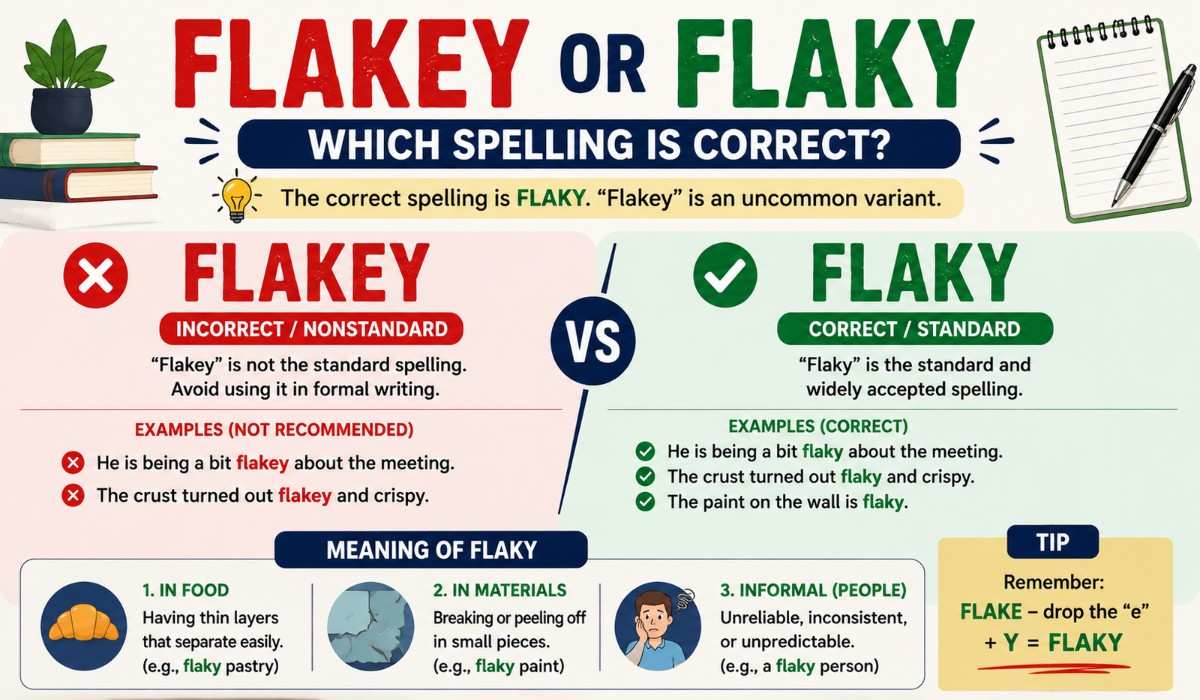
When deciding between “flakey or flaky,” the correct spelling in standard modern English is usually “flaky.” The word flaky is widely accepted in American and British English and can describe something that breaks into thin pieces, such as a flaky pastry, as well as a person who is unreliable or unpredictable.
“Flakey” is sometimes used as an informal or variant spelling, but it is far less common and is generally not the preferred choice in standard writing. Understanding the difference is useful because the two spellings are pronounced the same, which makes this a common spelling question for students, writers, bloggers, and English learners.
Flakey or Flaky: Quick Answer
If you are wondering whether to write “flakey or flaky,” choose flaky in most situations.
| Word | Correct in Standard English? | Common Usage | Example |
| Flaky | Yes | Very common | The pie has a flaky crust. |
| Flakey | Sometimes seen | Uncommon/variant | The spelling “flakey” appears occasionally in informal writing. |
| Flake | Yes | Common noun/verb | The paint began to flake. |
| Flakiness | Yes | Common noun | His flakiness made planning difficult. |
The safest choice is simple: use “flaky” rather than “flakey.” It is the standard spelling you are most likely to find in dictionaries, edited publications, educational writing, and professional communication.
That said, “flakey” is not completely mysterious. English has many words in which the letter combination changes when a suffix is added, and spelling patterns can sometimes make people expect “flakey.” The confusion is especially understandable because the pronunciation remains the same.
What Does Flaky Mean?
The word flaky has several meanings depending on the context. Its original and literal sense is connected to something that comes off or breaks into thin, small pieces called flakes. For example, a pastry can have a flaky crust, while dry paint can become flaky as it begins to peel. Over time, flaky also developed an informal meaning when describing a person. In this sense, a flaky person may be unreliable, inconsistent, forgetful, eccentric, or difficult to depend on. The meaning depends heavily on the sentence and the situation in which the word is used.
Flaky Meaning in Food
One of the most common uses of flaky is related to food. Bakers and food writers frequently use the word to describe pastries that have thin, delicate layers that separate easily.
For example:
- The croissant has a light and flaky texture.
- She made a pie with a perfectly flaky crust.
- The pastry was golden, crisp, and flaky.
In these examples, flaky describes a desirable texture. A flaky pastry is generally associated with layers that separate and create a crisp or delicate bite.
Flaky Meaning for Materials
Flaky can also describe materials that are peeling, breaking apart, or coming off in small pieces.
For example:
- The old paint had become flaky.
- His skin was dry and flaky.
- The wall had a flaky surface.
Here, flaky does not describe something positive in the same way it can describe pastry. Instead, it suggests that the surface is breaking apart or coming away in flakes.
Flaky Meaning When Describing a Person
In informal English, calling someone flaky usually means that the person is unreliable or unpredictable.
For example:
- He is a little flaky when it comes to making plans.
- She has a reputation for being flaky.
- My friend is sometimes flaky about appointments.
In this context, flaky does not mean that the person physically breaks into flakes. It is an informal description of someone’s behavior.
Read Also: Finaly or Finally || Persue vs Pursue || Adress or Address
Why Is Flaky the Correct Spelling?
The spelling flaky comes from the noun flake combined with the suffix -y. When the suffix is added, the final silent e in flake is removed before forming flaky.
The pattern can be understood like this: flake + y = flaky
This spelling follows a common English spelling rule in which a word ending in a silent e drops the e when a suffix beginning with a vowel is added.
The same pattern can be seen in other words:
- noise → noisy
- ice → icy
- spice → spicy
- shine → shiny
- haze → hazy
- taste → tasty
Because of this spelling pattern, flaky is the standard form rather than flakey.
Flakey or Flaky: Why Do People Get Confused?
The confusion between flakey or flaky is understandable because English spelling does not always follow perfectly predictable rules. People may look at the word flake and assume that adding “y” should produce flakey.
At first glance, “flakey” appears logical: flake + y = flakey
However, English spelling conventions generally remove the silent e in this situation, producing flaky. Another reason for the confusion is that “flakey” does appear occasionally in informal writing, online content, names, and other contexts. Seeing the alternative spelling can make people wonder whether both versions are equally correct. In standard writing, however, flaky is the preferred spelling.
Flaky or Flakey: What Is the Difference?
The main difference between flaky and flakey is not pronunciation but standard usage.
Flaky is the established and widely accepted spelling. It should be your first choice in essays, articles, professional writing, educational content, websites, and other situations where standard English is expected.
Flakey is an uncommon variant spelling. You may encounter it in informal contexts, creative writing, usernames, brand names, or other situations where spelling has been intentionally modified.
Is Flakey a Misspelling?
In most standard writing situations, “flakey” would be considered a nonstandard or incorrect spelling of flaky. If you are answering a grammar question, writing an academic assignment, or preparing SEO content, flaky is the safer and more appropriate form.
However, it is worth noting that language can contain variants. A word appearing as “flakey” does not necessarily mean the writer does not understand English. It may simply reflect an informal spelling preference or a particular usage.
For formal communication, though, there is little reason to choose flakey when flaky is the established form.
Examples of Flaky in Sentences
Understanding the word through examples is one of the easiest ways to remember its spelling and meaning.
Flaky Used for Food
- The bakery is known for its flaky croissants.
- I love the flaky crust on this apple pie.
- The chef prepared a flaky pastry filled with vegetables.
- The biscuits were light, buttery, and flaky.
- She wanted a recipe for a perfectly flaky pie crust.
In these examples, flaky refers to a delicate texture made up of layers or small pieces.
Flaky Used for a Surface
- The old paint on the door was flaky.
- The dry weather left his skin flaky.
- The wall had a flaky layer of paint.
- The coating became flaky after several years.
- Her hands felt dry and flaky during winter.
Here, flaky means that something is peeling, breaking apart, or coming off in small pieces.
Flaky Used for a Person
- He can be flaky when making plans.
- She is sometimes flaky about responding to messages.
- I would not rely on him because he can be quite flaky.
- His flaky behavior made the project difficult to organize.
- She apologized for being flaky and missing the meeting.
In these sentences, flaky has an informal meaning related to unreliability or inconsistency.
Flaky as an Informal Description of Personality
The informal use of flaky is particularly common in everyday English. When someone is called flaky, it generally means they do not behave consistently or cannot always be relied upon. For example, a person might agree to meet a friend and then forget about the appointment. Someone who repeatedly changes plans at the last minute might also be described as flaky. However, the word can sometimes be playful rather than strongly insulting. Its tone depends on the relationship between the speakers and the context.
Is Calling Someone Flaky Rude?
Calling someone flaky can be mildly negative because it suggests that the person is unreliable. However, it is generally not considered a severe insult. For example, saying “He is a bit flaky about plans” is softer than saying “He is completely unreliable.” In casual conversations, friends may even use flaky humorously. In professional situations, it is usually better to use a more precise and neutral expression such as “unreliable,” “inconsistent,” or “frequently misses appointments.”
Flaky or Flakey in British and American English
The spelling flaky is widely recognized in both American and British English. There is no major British-versus-American spelling distinction that requires you to change flaky to flakey.
This is important because English learners sometimes assume that differences between British and American English explain every spelling variation. In this case, they do not.
Whether you are writing for an American audience, a British audience, or an international English-speaking audience, flaky is the standard choice.
Common Words Related to Flaky
Learning related words can make it easier to understand how flaky functions in English.
Flake
Flake is the base word. It can be used as both a noun and a verb.
As a noun:
- A flake of snow landed on my jacket.
- A few flakes of pastry fell onto the plate.
As a verb:
- The paint began to flake.
- The dry skin started to flake.
Flakiness
Flakiness is the noun form of flaky when describing a quality or characteristic.
For example:
- The flakiness of the pastry made it delicious.
- His flakiness made it difficult to organize the event.
The word can therefore refer either to physical texture or, informally, to unreliable behavior.
Flaked
Flaked is the past-tense form of flake.
For example:
- The paint flaked off the wall.
- The pastry flaked apart when I cut it.
Flaky vs. Similar Words
Several words can be confused with flaky because they describe texture or behavior.
| Word | Meaning | Example |
| Flaky | Breaking into flakes or unreliable | The pastry is flaky. |
| Crisp | Firm, dry and easily broken | The crust is crisp. |
| Crumbly | Easily breaking into crumbs | The cookie is crumbly. |
| Brittle | Hard but easily broken | The material is brittle. |
| Unreliable | Not dependable | He is unreliable. |
| Inconsistent | Not staying the same | Her performance is inconsistent. |
Choosing the right word depends on what you are trying to communicate. If you are specifically describing a layered pastry that breaks into thin pieces, flaky is usually the natural choice. If you are describing someone’s behavior, unreliable or inconsistent may be more appropriate in formal writing.
How to Remember the Correct Spelling
A simple memory trick can help you remember whether to write flakey or flaky.
Think of the base word: FLAKE
Now remove the silent “e” and add “y”: FLAK + Y = FLAKY
This same pattern appears in several other English words. For example, “spice” becomes “spicy,” not “spicey,” and “ice” becomes “icy,” not “icey.” Once you recognize this spelling pattern, it becomes much easier to remember that flaky is the standard form.
Flakey or Flaky: Which One Should You Use?
If you need one clear answer, use flaky.
Use flaky when writing:
- Blog articles
- School assignments
- Business content
- Emails
- News articles
- Product descriptions
- Recipes
- SEO content
- Social media captions
- Formal documents
You may encounter “flakey” in informal contexts, but there is generally no advantage to choosing it over flaky in standard writing.
Why Correct Spelling Matters
Correct spelling is more than a matter of appearance. It makes writing easier to understand and helps readers trust the information being presented.
For websites and professional content, spelling mistakes can also affect the perceived quality of a page. A reader who sees repeated nonstandard spellings may question the accuracy of the rest of the content.
That is why choosing flaky instead of “flakey” is the better option when you want your writing to follow standard English conventions.
FAQs About Flakey or Flaky
Q1. Is it flakey or flaky?
The standard spelling is flaky. “Flakey” is an uncommon variant that may appear in informal contexts, but flaky is the preferred spelling in standard English.
Q2. Is flakey a correct word?
“Flakey” can be found as a variant spelling, but it is much less common than flaky. For formal and standard writing, it is best to use flaky.
Q3. What does flaky mean?
Flaky can mean something that breaks or peels into thin pieces, such as flaky pastry or flaky paint. Informally, it can also describe someone who is unreliable or unpredictable.
Q4. Why is flaky spelled without an e?
The word is formed from “flake” and the suffix “-y.” The silent e is dropped before the suffix is added, giving flaky rather than “flakey.”
Q5. Is flaky an American or British word?
Flaky is used in both American and British English. The standard spelling is generally the same in both varieties of English.
Q6. Can I use flakey in an article?
You may encounter “flakey” as an informal or variant spelling, but flaky is the better choice for an article, academic work, professional content, or SEO-focused writing.
Conclusion
So, when it comes to flakey or flaky, which spelling should you use? The answer is flaky. Flaky is the standard and widely accepted spelling. It can describe something that breaks into flakes, such as a pastry or peeling paint, and it can also informally describe a person who is unreliable or unpredictable. The spelling follows the common pattern of dropping the silent “e” from flake before adding the suffix “-y.”
Although “flakey” can occasionally be found in informal writing and as a variant spelling, it is not the preferred choice for standard English. If you are writing an article, assignment, professional document, or website content, choosing flaky will keep your writing clear, conventional, and grammatically polished.
Read Also: Recognization vs Recognition || Absence or Absense || Reciept vs Receipt
